


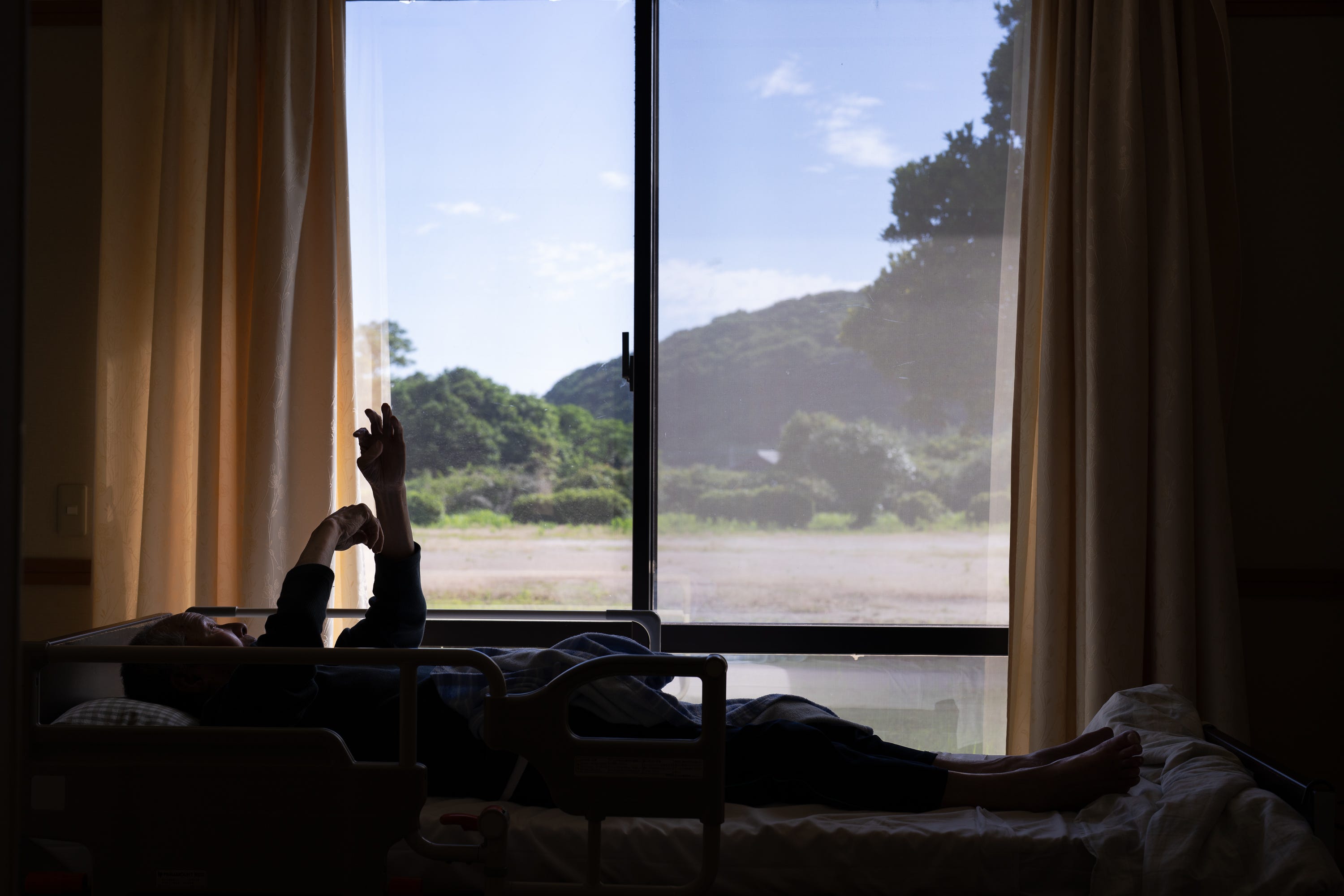
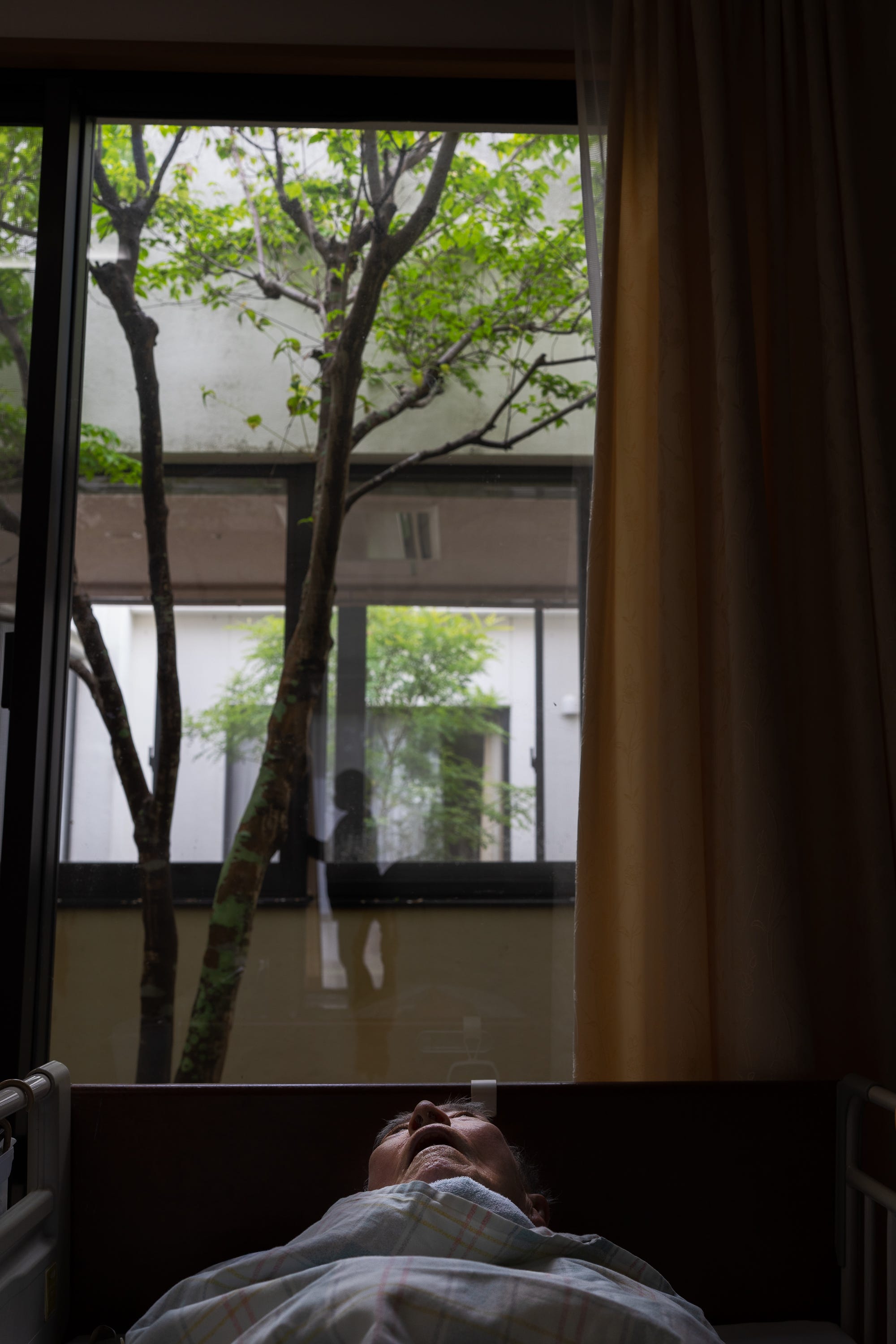
Hatsuo Matsusaka picked thousands of fields over his years, millions of flat-faced tobacco leaves passing through his hands as he stooped over their raucous crowns of green, hands floating from bundled bush to bush, the small sticky hairs of their wide cheeks dragging across his fingertips as they ran the dark edges, this movement that became so entwined with his days, his dreams, his life, that it rooted itself into his body, its rhythm furrowed into his mind, never to leave, not then, when he was just a teenager in this country emerging from the ruins of the war, the world-ending destruction of The Bomb that had engulfed Nagasaki City just over the horizon, not after he had his three children or as they grew, not even as his mind began to slip, these 89 years after his mother brought him into the world on this small island at the western edge of Japan, this perch of rock and forest born from fire and pressure in the East China Sea. And as he lies in bed now, the big windows peering out onto the world outside, he picks the leaves all over again, back in that field of his mind, walking the soil he poured his life into. And his arms stretch out overhead, fluttering in the air like the thrushes dancing midflight outside as they flit from branch to sky to branch to earth, their compact bodies defying the grip of gravity. And he’s old now. And where did it all go for it went by so quickly and how are we here, in this bed, children grown, with lives and spouses and children of their own, and how are we in this body, this newly old body that seems so familiar yet unrecognizable, this perfectly tailored suit made from some unknown cloth. But what are questions with no answers if not some koan to lose ourselves in, so let us sit back into this field again, let us pick these leaves, this sun on our face, breeze licking the sweat off our brow.
And as he picks and picks the seconds speed past into minutes into hours into days, time bleeding through his mind without beginning or end, punctuation of the present or anticipation of the future, only this reliving of what has been.
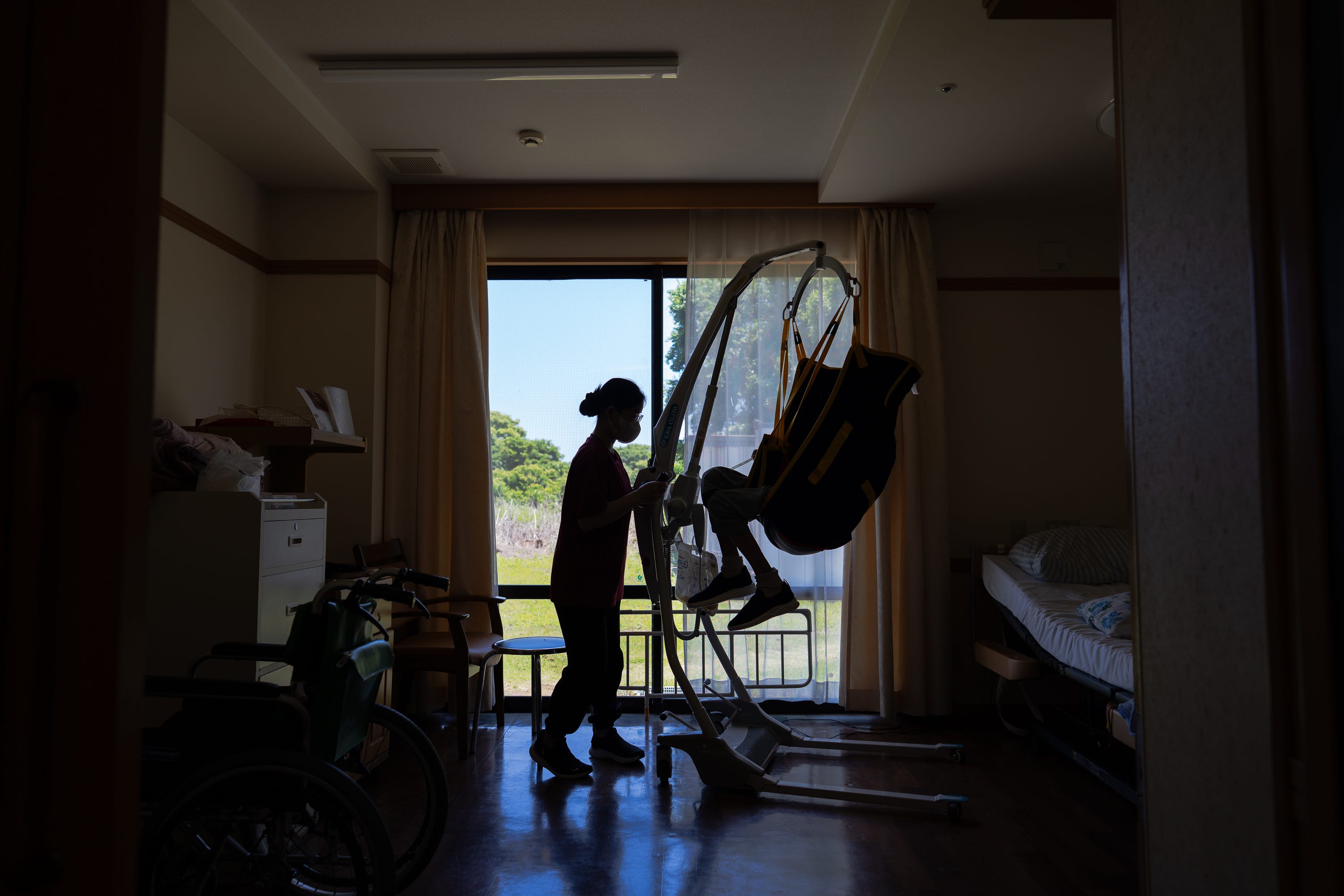
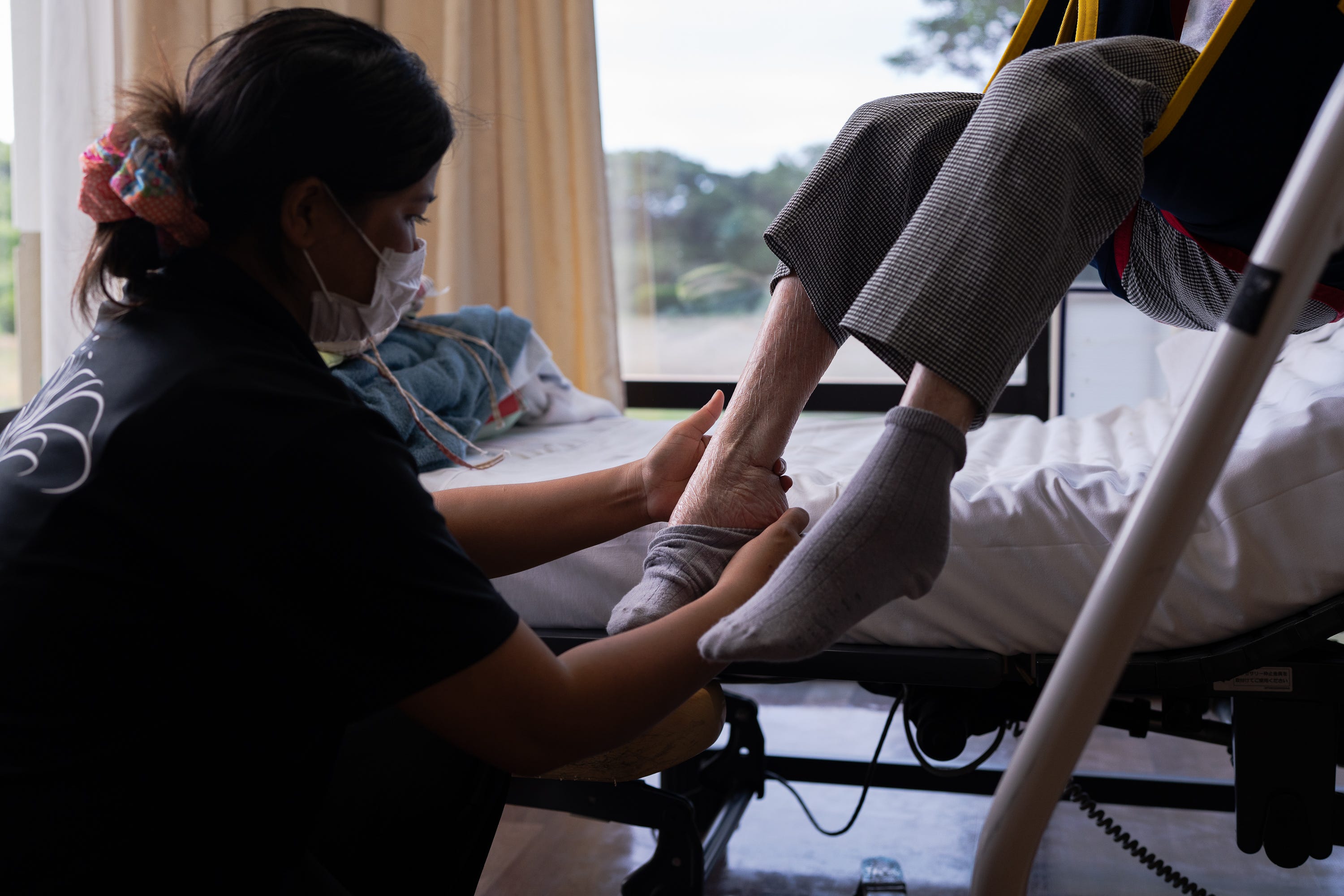
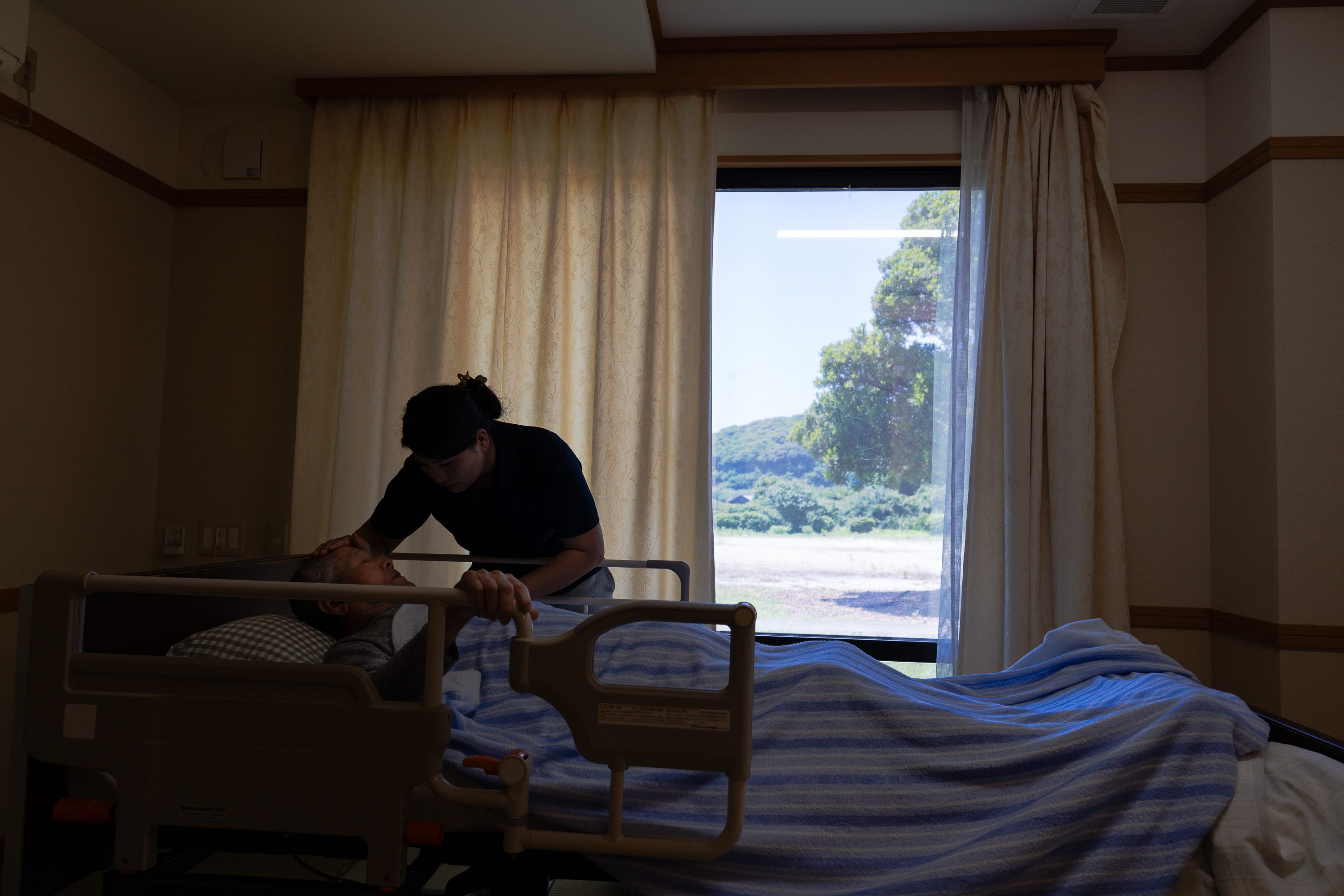
And yet now it’s time to eat, and as Anjana Thapa walks into his room she greets him softly in Japanese, the even syllables pouring easily out of her after all these years of study, “Hello, Hatsuo-san, it’s time to get up, time for lunch.” But he’s still in the fields, still carrying out his day-to-day work because someone has to put rice on the table and the sun feels so nice, and so Anjana sits on the bed beside him and squeezes his shoulder the way you squeeze a cantaloupe for ripeness, and his hands stop and he stares up at the ceiling, eyes lost, uncertain, as this third hand grips and pulls him into this middle world. “Time for lunch, Hatsuo-san, let’s get up now, shall we?” and she pulls the white sheet on his bed back gently, taking his left foot in her hands, the sinewy tendons rippling his papery-thin skin, and rubs the top of his naked foot with her thumb and then pulls on his gray sock before doing the same with his right, and she stands and turns and grabs his right hand, her left arm sweeping around his shoulders in one fluid motion as she swings him upright, turning him to sit on the edge of the bed, as she sits down next to him. And the two sit there side by side, faces forward, their feet together on the ground, and Anjana rubs his right hand, both of hers clasped over his now, this pairing of 28-year-old Nepali woman and 89-year-old Japanese man. And her left arm moves back around his shoulders again, looping up under his armpit, right hand still in his and she stands, pulling him up as she does. And his body is strong and lithe, his frame athletic, for he was a good runner, even five years ago chasing his grandchildren around the yard.
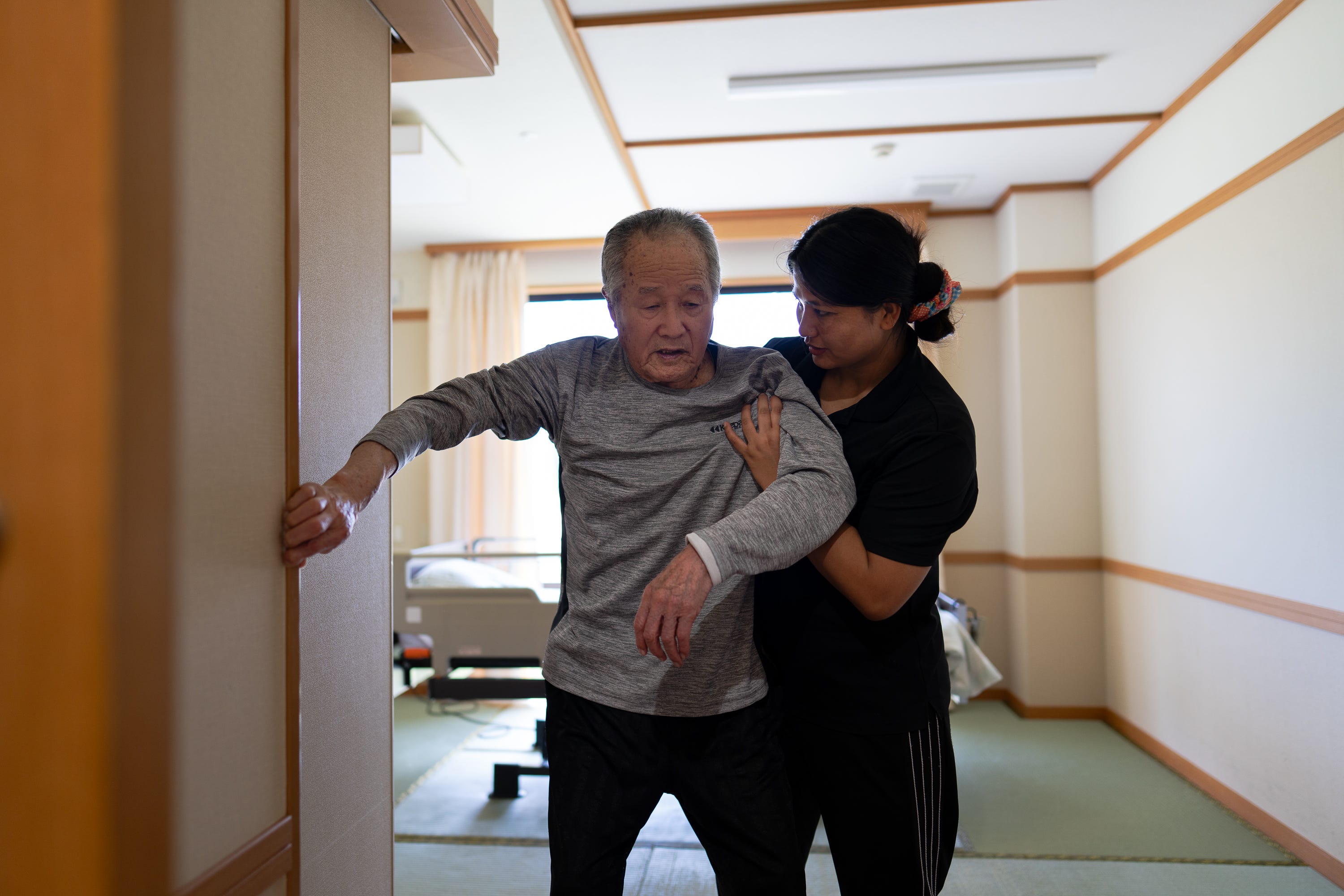
As if on cue Ha enters the room as the two stand, and takes Hatsuo’s left arm, her right hand circling around his back to hold the right side of his chest, Anjana and Ha, these two women from distant lands holding him upright, his body unsettled and tense, and as the three inch closer to the doorway Hatsuo leans farther and farther back into their arms, his feet digging into the tatami mat of his room with each step, unsure of this transition into the hallway, this threshold to somewhere else with its fake wooden floors and bleached walls, with the smells of old bodies that have betrayed minds, of minds that have stopped directing bodies, and Ha and Anjana gently, forcefully pull him step by step closer to this crossing and he leans back further still until he is at 30 degrees, his strong frame taut and worried as his feet shuffle reluctantly forward, giving ground only in so much as he’s pulled, until he’s at the edge, and he leans back once more, silent and economical and determined in his movement, and Ha and Anjana pull and guide until one final step over the line, from the soft woven grass of his mat and onto the slick printed grain of Tadakari-so, this elderly care facility, and his body unspools and straightens, the resistance gone, back onto the balls of his feet.
The three shuffle toward the communal room, toward his small table where they sit him down and Anjana picks up the colorful cooking book he likes, sets it down in front of him as he sits there and begins to quietly trace his hands over the pictures of okonomiyaki and tonkatsu, ramen and donburi, remembering and relearning and speaking with meals from his past.
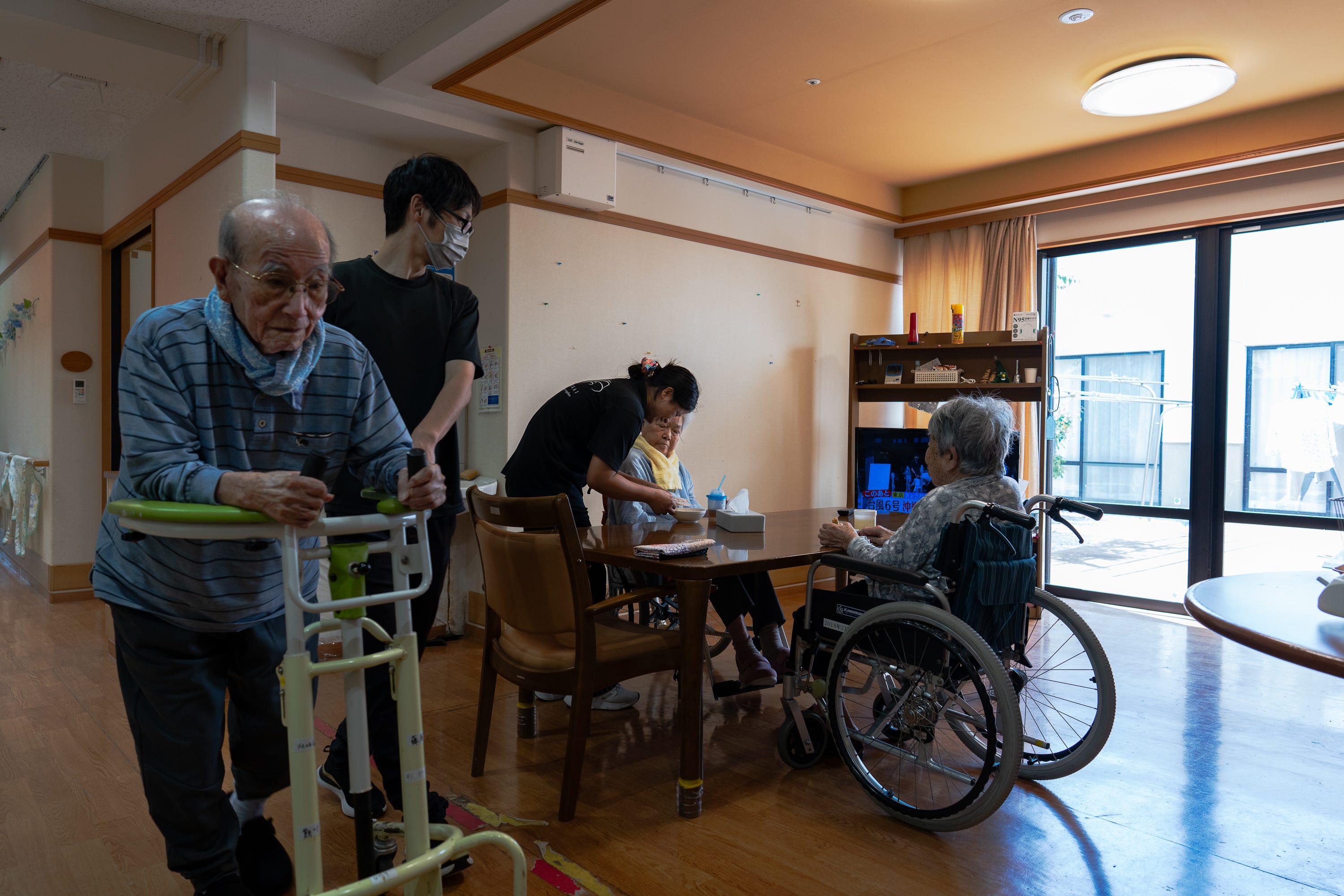
And Anjana and Ha head back to the other rooms, splitting off now to help dress and hold and wheel and guide the nine other residents to the table, their locked backs and stiff knees slumping and staggering, hunched, hollowed and cockeyed by the years.
Like Hatsuo, nearly half of all people here in The Goto Islands are older than 65. Across Japan it’s nearly one in three, the oldest population of any major nation on earth. Japan is now a country in decline, of a shrinking population that is marrying less, making fewer babies and getting older by the day with no reversal in sight. For every birth there are now two deaths and its population has fallen by more than three million people over just the past five years, the steepest decline since the country began counting itself more than a century ago. By 2040 its workforce will be short 11 million people.
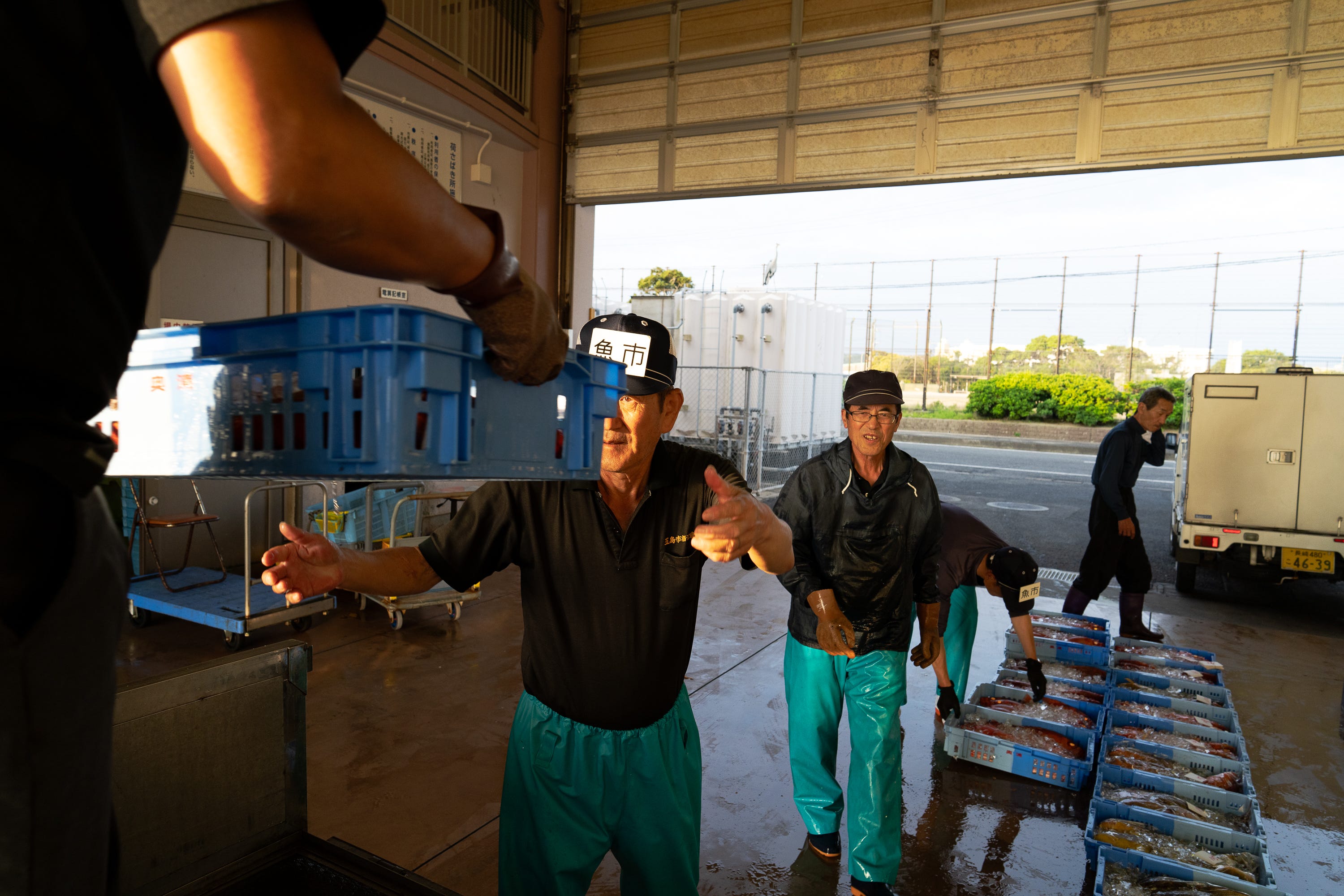


This dynamic is especially pronounced in a place like Goto, where children leave as soon as they can, off to more cosmopolitan lives in cities like Fukuoka and Osaka or farther north to Tokyo.
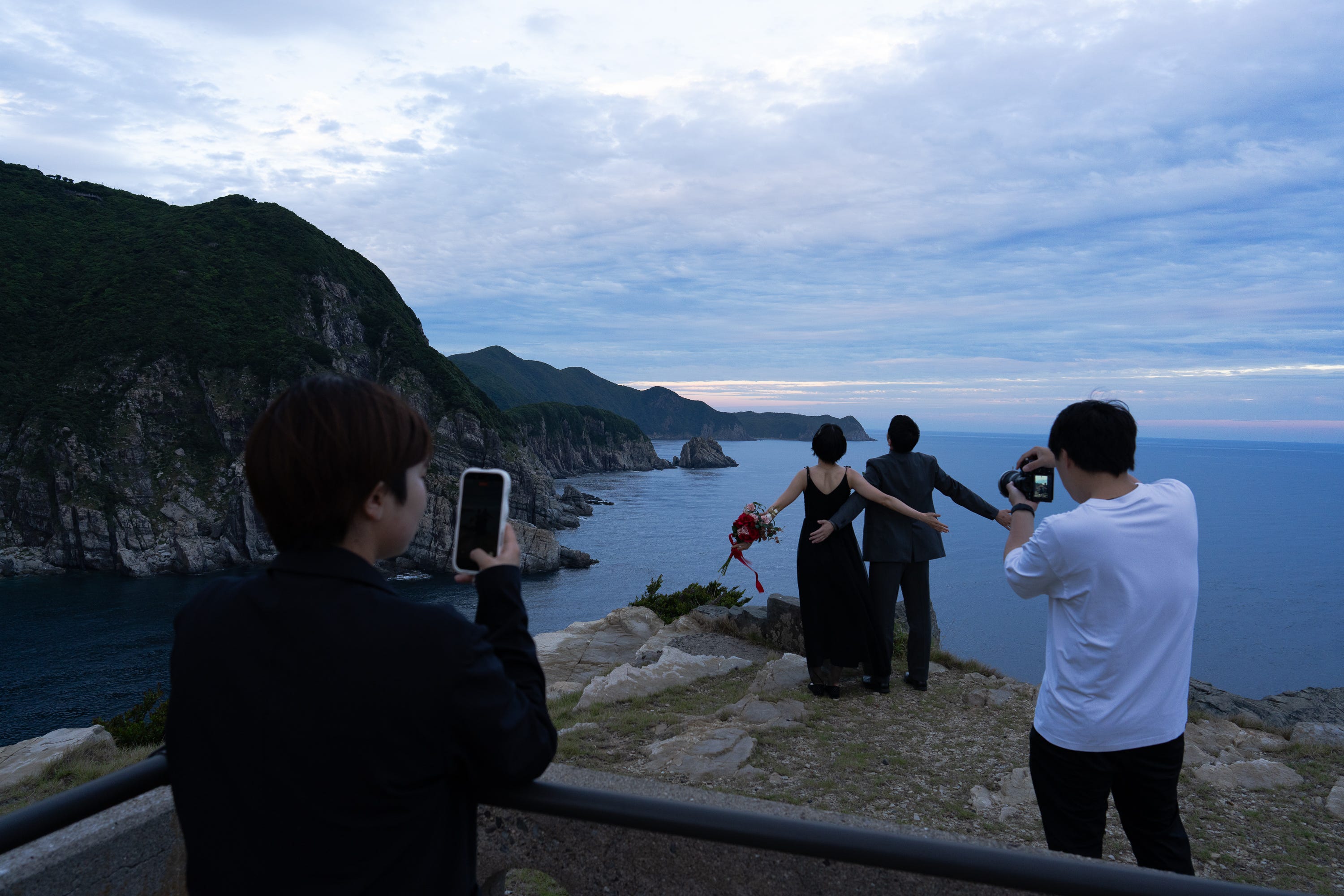
It’s the elderly that stay, a bigger share every year, and someone has to lift them and wash them, feed them and carry them. And the pressure is mounting because already there aren’t enough, the yawning gap large and widening every day. On the archipelago’s northernmost island of Uku, the last nursing home has already closed for lack of staff, its 27 residents carried off the land they had known their whole lives, to end their days among strangers on the mainland. “The workforce will keep reducing,” Murai Yasutaka, the chief of Goto’s Long-Term Care Division, told me from a conference room in Goto’s City Hall. “We’re not sure what will happen in 10 years. Especially our buses, our small shops - we don’t know if we’ll have enough people to keep them open and running.” And so a place like Goto has come to lean disproportionately on a small but growing number of foreigners like Anjana and Ha, outsiders ever more central to day-to-day life.
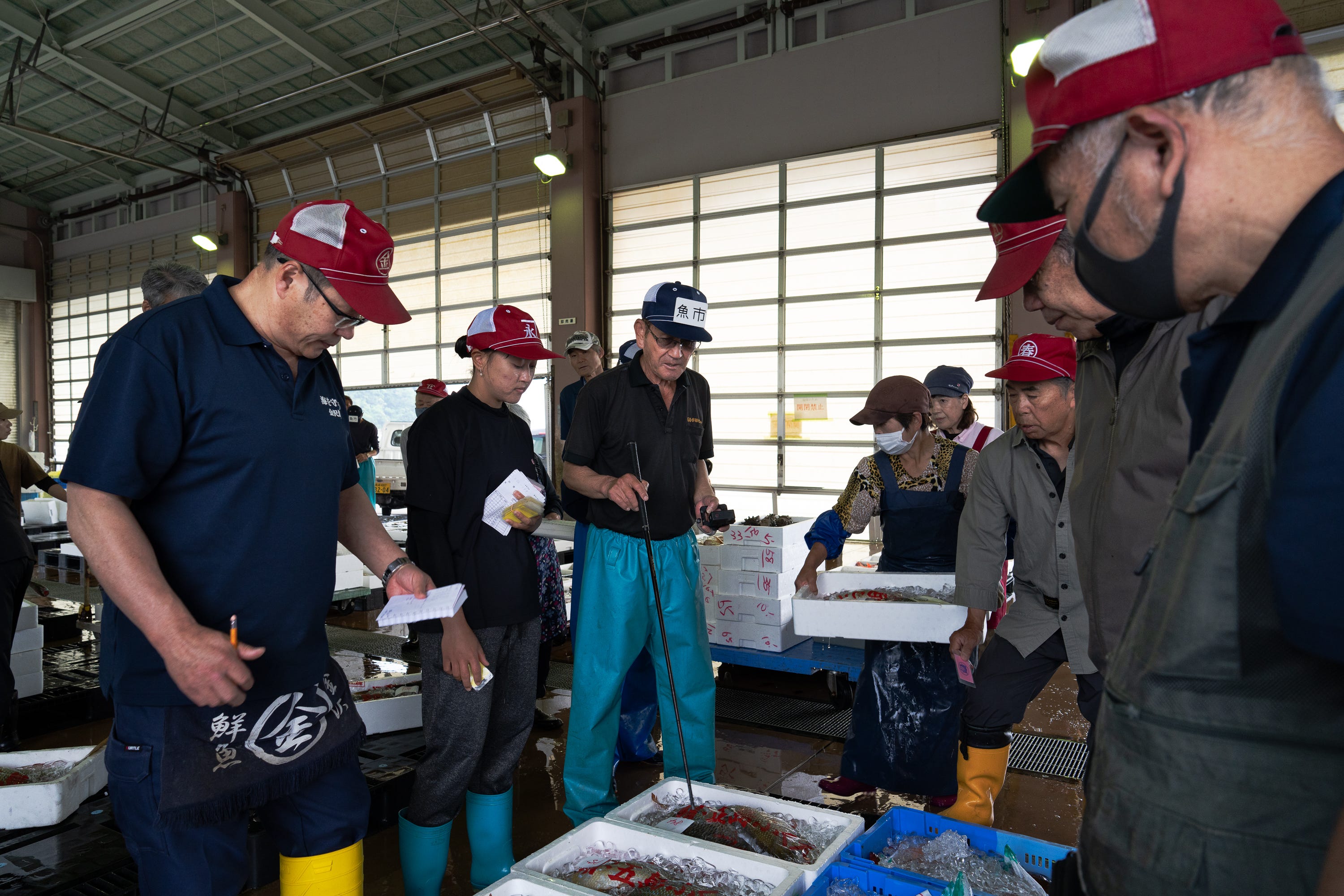
The entire care system across Japan is up against this crushing reality, for this sector is set to come up short by more than half a million by 2040. Already, four jobs stand vacant for every person willing to take just one, and the only number still climbing, the one line trending upward amidst it all, is foreign labor. More than a hundred thousand of them now hold up the care system here, more than triple what they were five years ago. Here immigration is a lifeline, maybe the only lifeline.
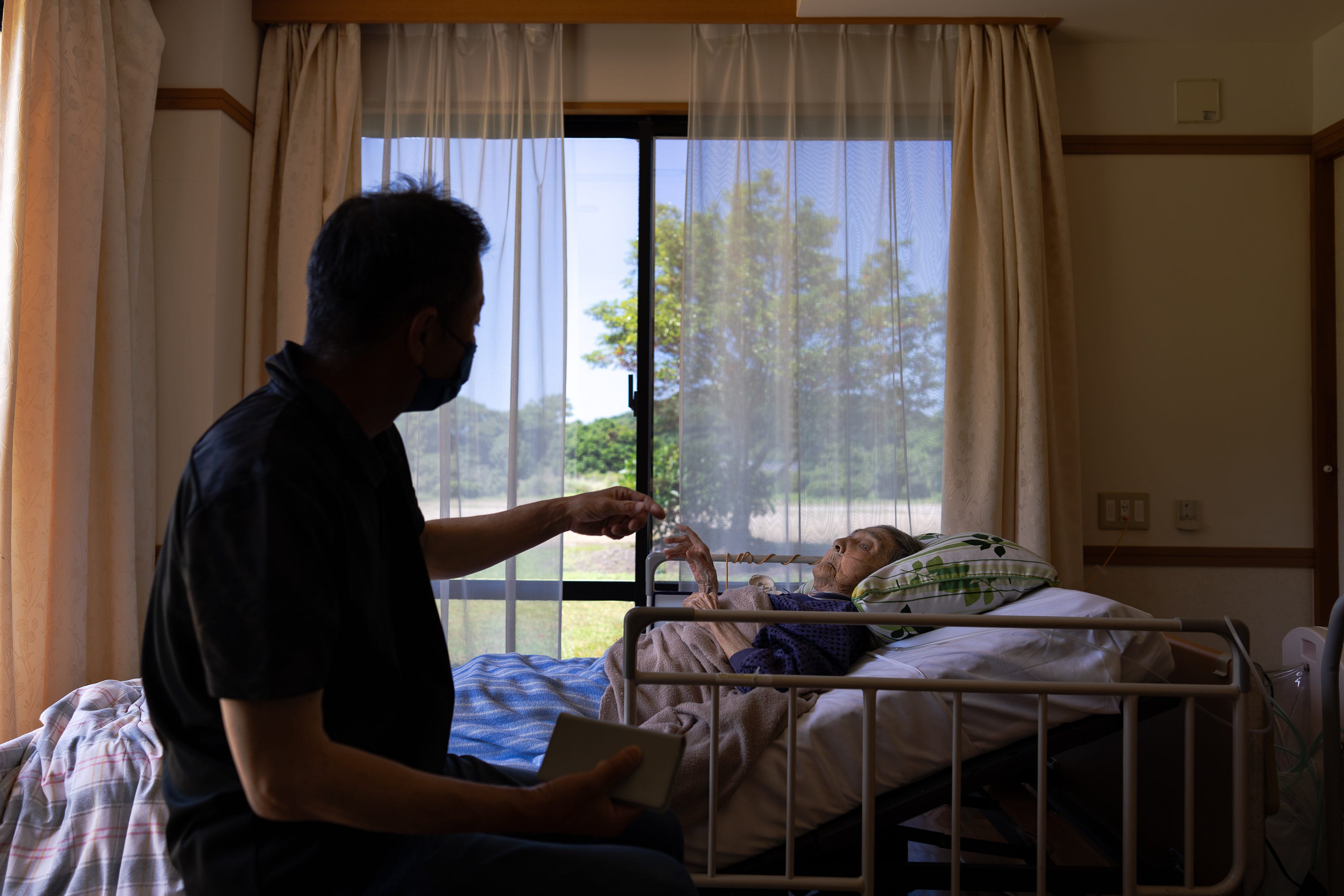
When Anjana was 15 she didn’t even know there was a country called Japan. She grew up on the plains of western Nepal in a small town called Kohalpur where the older kids went abroad, and they sent back photos and videos, and every year more showed this island nation, and it looked beautiful and clean and full of a future that she gradually came to understand Nepal couldn’t give her. So at 19 she set her mind to it and, with her family’s backing, spent six months at a Japanese language school in Nepal, passing the requisite exams to then board a flight east and two years more of language school in Japan paid for with a part-time job and the money her mother wired when she came up short. Then care-worker college in Nagasaki, certification and finally here to Goto. And from a distance her path can look like something meticulously designed, some route devised whole in a ministry and laid down brick by flawless brick.
But the truth is the country saw this coming for fifty years and put its head in the sand. Births fell below replacement levels in the 1970s, the working-age population crested in the 90s, demographers sounding the alarm again and again, and yet Japan still couldn’t bring itself to do the obvious thing, because as nearly everyone here will tell you, Japan is not a country of immigrants, it’s an island of one people and one blood and one tongue, and this mythology runs deep. So rather than tailor its policies and ramp its immigration, it settled for half measures and sidesteps and hedges, forever trying to take the thing without admitting it wanted the thing.
And the result was a shambles. The first care workers it brought in, Indonesian and Filipino nurses starting in 2008, arrived trained and ready, many with years on hospital wards back home, and Japan sat them in front of a national exam written in the kanji that Japanese teenagers spend nearly a decade learning, and so most of them failed and went home, the country’s relief flown in to crash against an impossible task. And yet it couldn’t walk away, and so the country adjusted and tested and adjusted again, tuning a broken process until, years later, it has finally begun to run.
It can be tempting to call this kaizen, the Japanese genius for refining a thing until it runs smooth, but that slowness wasn’t the honing of a craft. It was fear. For each step had to be small enough that no one would feel the country changing under their feet.
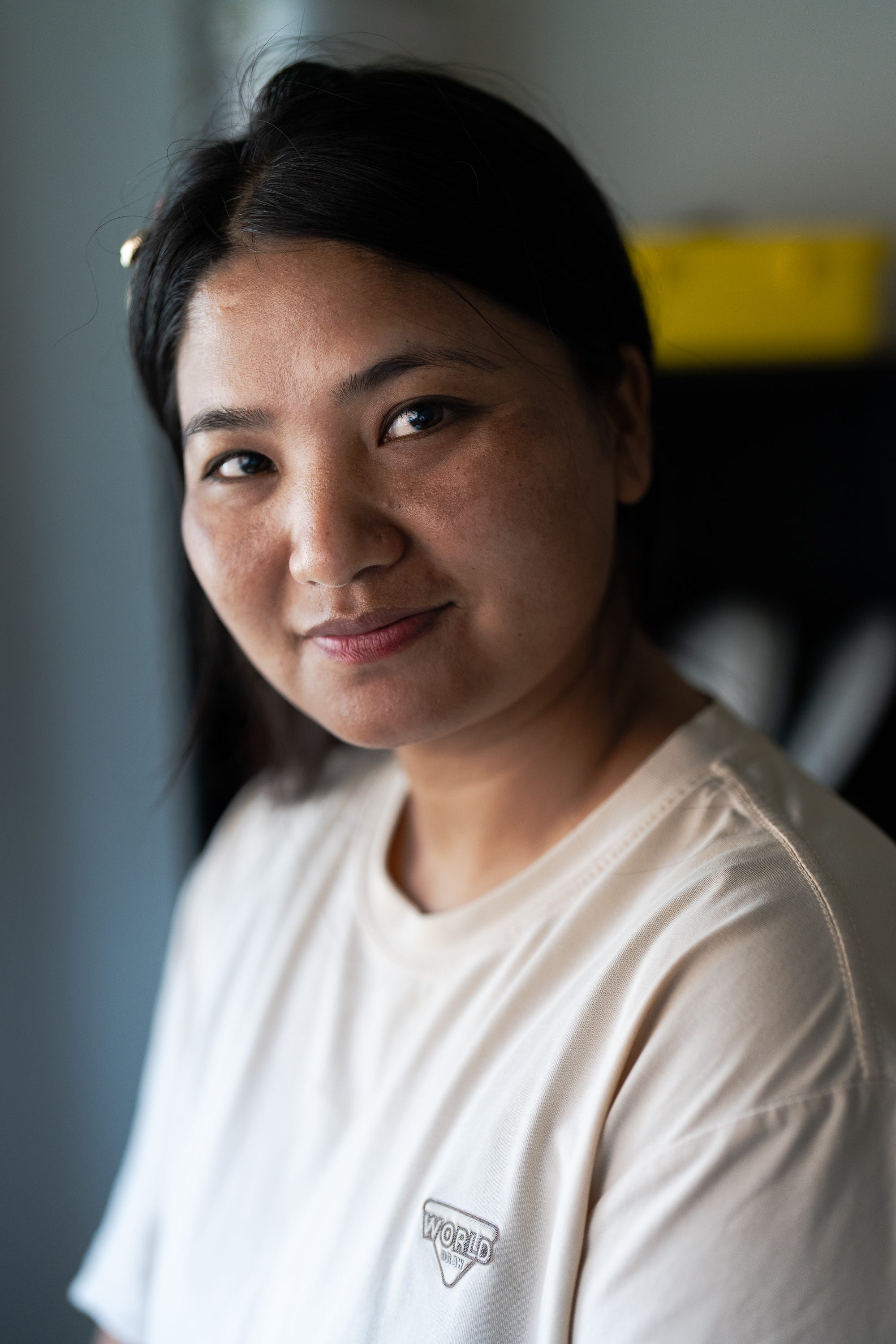
Anjana’s eyes are black and glinting, a blue surgical mask over her apple cheeks so that her whole face draws back up to them, the mask bunching at the creases in their corners as she smiles and laughs. She wears a black collared shirt from the company, Sayurikai, that owns the elderly care center, its name outlined in white across the back, her dark hair pinned up in a bun.
She initially comes off as shy, reserved, almost cold, someone who doesn’t want to give away too much, to seem too eager, the self-consciousness of cool, but very quickly as comfort comes, the fear of judgement eases, the rest of her shows, funny and blunt and motherly.
Like most twenty-somethings her idle hours pour into her phone, into the lives of others, into the life she sends out to her friends and family and IG followers back in Nepal. At home she films get-ready-with-me quick-cut videos applying makeup, others of her cooking, her hands pleating the tiny folds of momos or highlight reels of bbqs with friends and colleagues as upbeat music bounces through the background, social media’s matryoshka of lives within lives within lives, packaging and wrapping the delicate layers of ourselves with what we put in The Scroll.
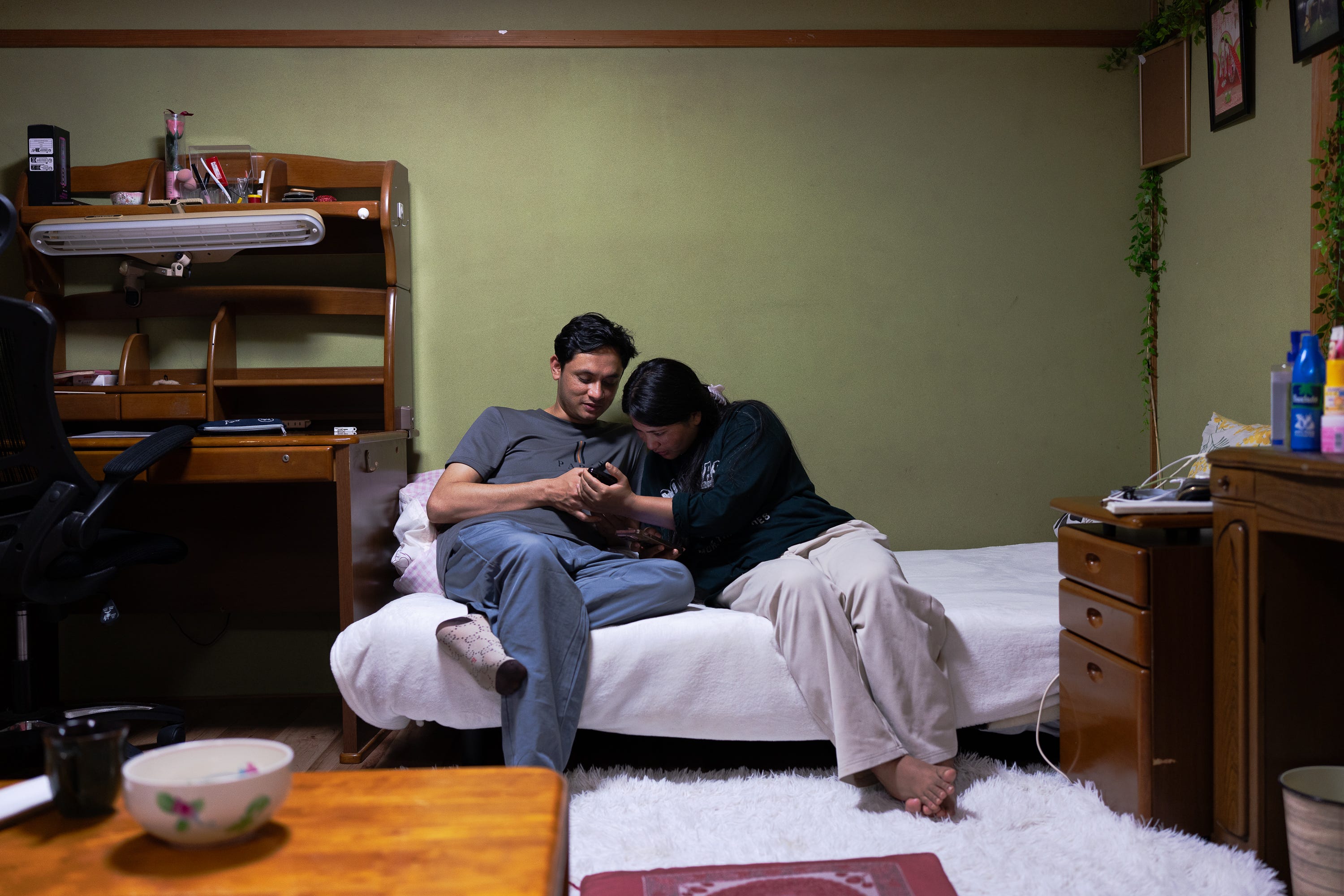
Anjana’s home was always overflowing as she grew up, a place where everyone knows everyone, where families are large and forever coming through your doorway with a meal you must eat, or a hope of sharing yours, a place with little pretense, where life is loud and direct and friction is a function of love as family and friends and friends of friends come and go and give and take.
And those years deciphering relationships and cues, of hosting and tending and navigating others, have given her a strong radar, honed her ability to read and understand and intuit and empathize.
“Foreign workers are very good at getting close naturally,” says Shin, her colleague, “Japanese people have a lot of rules and we have trouble communicating, but they can speak straightforwardly. Anjana and Ha are very warm naturally. Nobody has to teach them that. They’ve taught me a lot.”
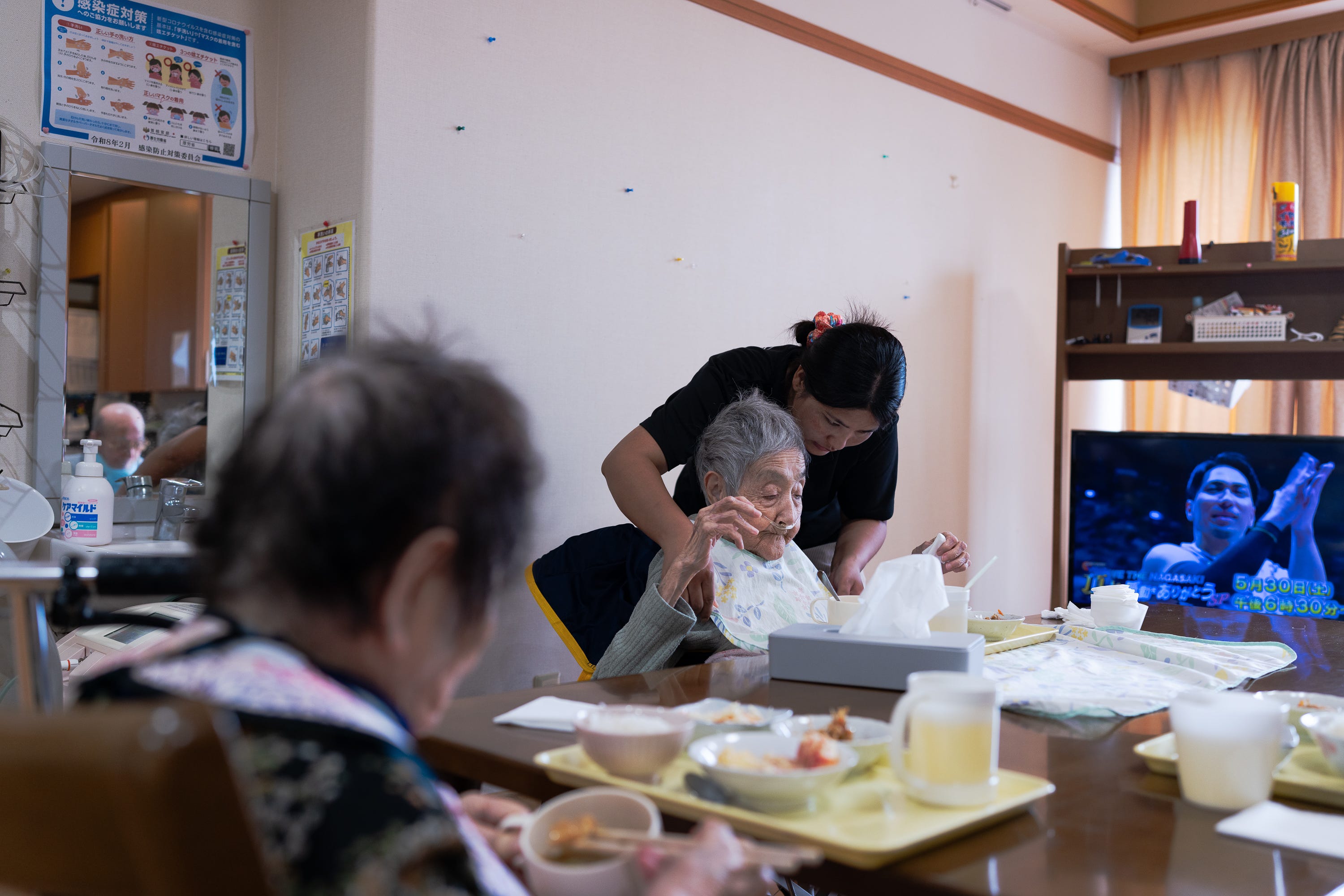
Lunch today is rice and salmon, grated daikon, and miso soup, and Anjana and Shin spin through the kitchen as they set it out, scissors in hand, cutting the food down for certain residents, blending and pureeing and mashing it for others. After setting out the plates, Anjana sits beside Hatsuo and helps him find the food with his chopsticks, guiding his hand to his mouth when it gets lost, two fingers around the delicate skin of his wrist. Once he’s taken a few bites his body clicks into gear and he’s largely self-sufficient. He’s what’s called a “whole-food resident” by kitchen staff, his body still able to chew and swallow and spit and cough, and so his food isn’t cut, his hands plucking the chunks of salmon efficiently and he chews slowly, quietly, eyes closed.
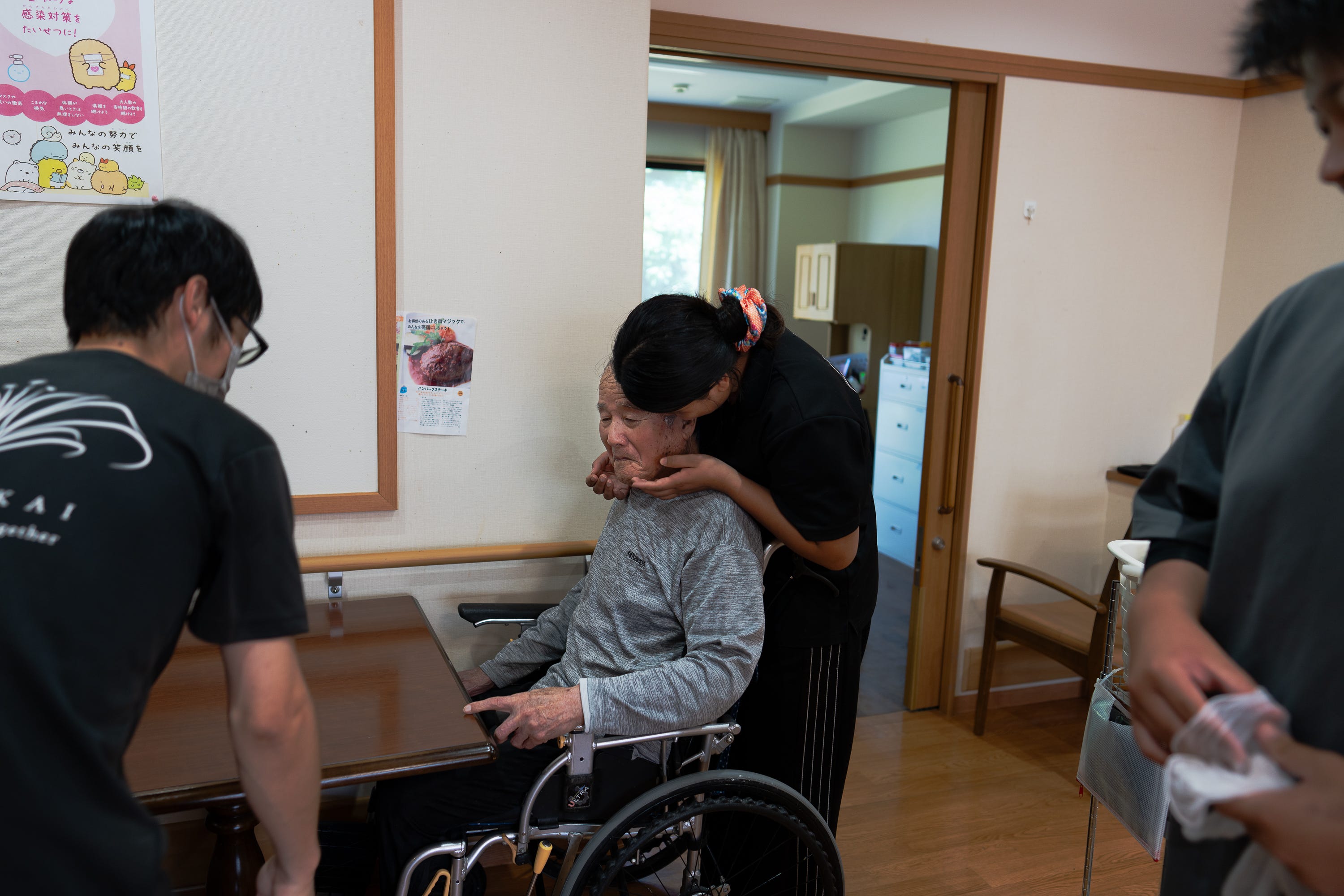
At one point he stops and the food sits bunched in his cheek, unable to move further down as his hand holds the chopsticks aloft like a conductor frozen in front of his orchestra. Anjana reaches up and touches his cheeks, one hand on each side, and gives a little tap before gently massaging the bulge of food, fingers occasionally working along his jawline, down the side of his throat, to remind his body of this moment. And very quickly it comes back to the task at hand and begins chewing again, his movement picking up exactly where he left off as he swallows and brings the chopsticks down for more.
Like nearly everyone who comes to care for Japan’s elderly, every stage of the life Anjana has built began with an exam, and with each exam comes a new visa, each one a touch more durable than the last, this path winding toward security, statuses lengthening as it edges toward something like permanence, toward the right to finally bring a family, to raise one. Very few ever get that far.
Because the life is a treadmill, every status renewing in stingy increments, a year, six months, three months, each renewal starting the countdown to another exam, and behind it all hums this implicit understanding that you can stay only so long as you keep moving, so long as you keep becoming Japanese, this thing you will never be. Learn the language, pass the test. Learn it better, pass the test. Keep investing, pass the test. No coasting. And this life that should feel more settled as time goes on needs to provide the same proof it had to on day one.
And that treadmill is a feature. Across most of the rich world, settlement is a function of time, a handful of years in Berlin or Toronto gradually granting a passport. Here, for all except those few at the top, a decade of constant earning and proving grants the right to stay until the next proving ground, nothing more. How much do you want this? How much can you fit in? How about now?
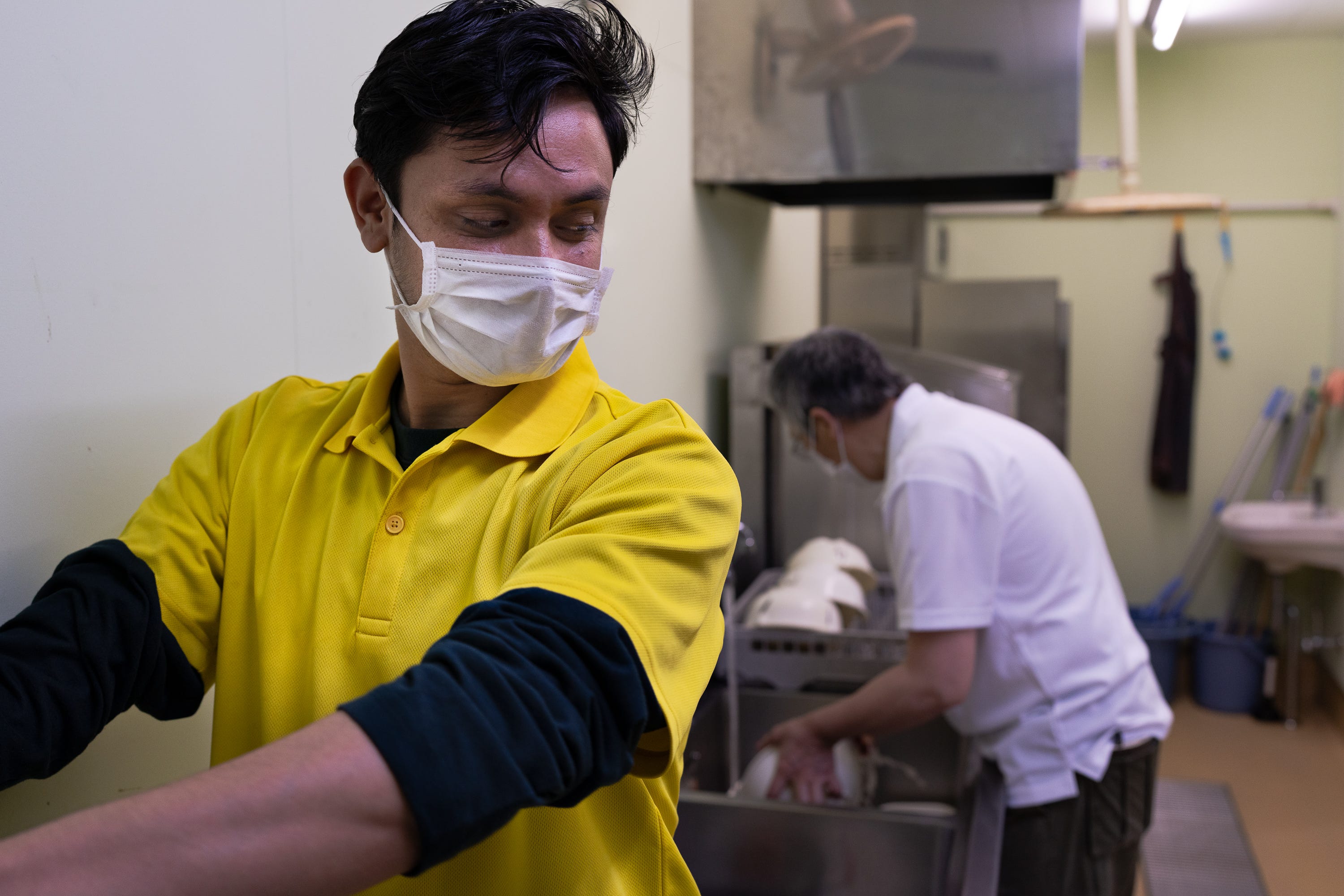
Anjana’s husband, Milan, is just beginning. She is one of the rare caregivers who’s reached far enough along to bring her spouse over and so Milan is here, working no more than 28 hours per week in the kitchen at Tadakari-so, and studying late into most nights, cross-legged on the floor as he hunches over a language book that Google Translate makes too easy to avoid practicing during the day. Milan didn’t come for the work. He came for Anjana, for the life and the family they hope to grow, but to have a career here, to do anything more than wash dishes part-time, he has to commit to the country, the culture, and jump on the treadmill.
And while that treadmill may look cruel at first glance, the state is spending real money and going to great lengths to get people here. Anjana’s family shelled out $17,000 to get her here and through language school, but she never paid for the care-worker college that made her a caregiver. Tadakari-so covered the tuition and the rent for her apartment, on the understanding that when she finished she would come to Goto and stay. Across the prefecture care centers receive rent subsidies when renting apartments to a foreign worker for the first time, seminars are held to coax nervous facilities into trying, and there’s even an entire support center in Nagasaki City whose whole job is to help care centers through the daily puzzle of onboarding foreign staff. The recruiters go even further, boarding planes for Hanoi and the hill towns of northeast India, pitching the rurals of Japan in slideshows and pamphlets pushed across the table to young people with dreams of a bigger life and the guts to chase it.
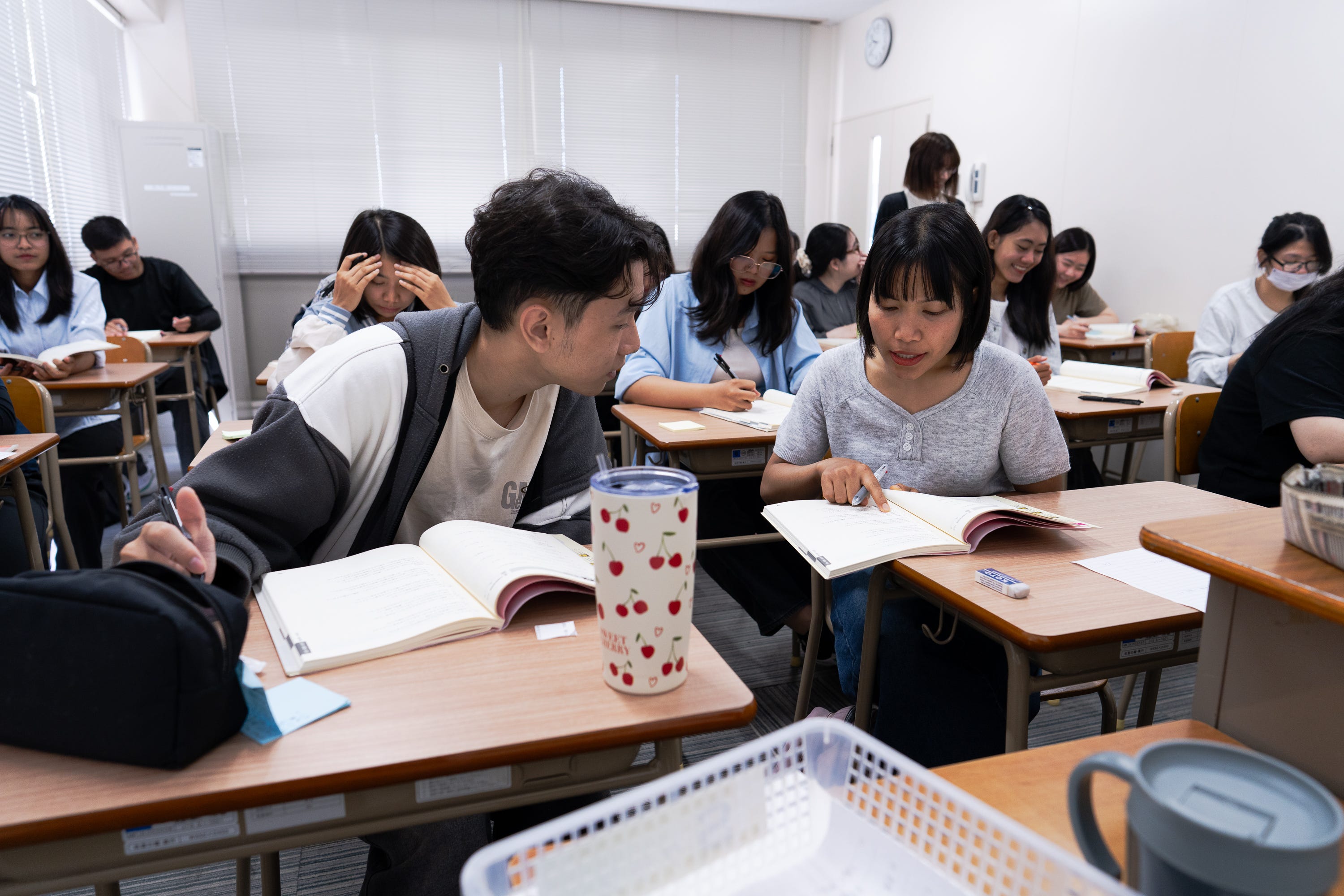
At Goto City’s local language school, a hundred students from Myanmar and Vietnam, Nepal and India breathe life back into an old high school the city had previously shuttered for lack of kids. Averaging 23 years old, each one of them works a part-time job in the ramen shops and hotels and fishing companies the island isn’t able to staff itself. “We all get a lot out of this,” says Yamagami Fukunori, the school’s head principal, “The city, the students, the country. It’s a win-win for everyone, but everyone needs to invest. If you invest you all win.”
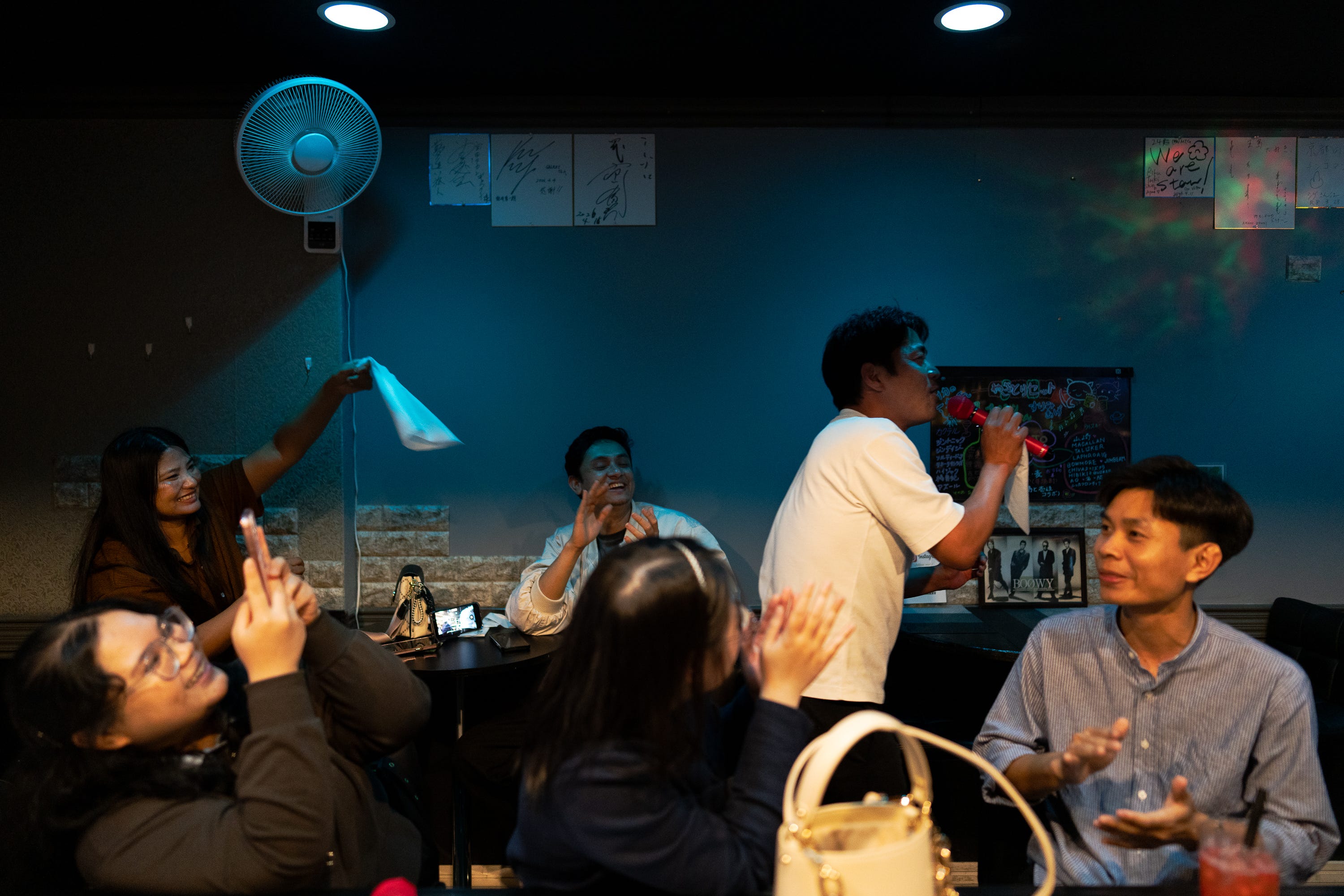
This is courtship. Expensive, deliberate, and slightly desperate courtship. And yet the country will not call it what it is. “For a lot of experts in the field there’s no doubt Japan has become an immigrant country,” Gracia Liu-Farrer, a sociologist at Waseda University who has spent two decades studying migration into Japan, told me. “But the political discourse is still non-immigration. There is this gap between what’s pragmatically going on on the ground and the public discourse.”
Fearful of its consequences, the people closest to that reality have already started trying to change the discourse. In July of 2025 all 47 of the country’s governors, those actually running these shrinking prefectures, issued a joint statement saying that the foreigners among them are essential members of the community, not some problem to solve, and that the national government needs to put in place the laws and budgets to honor that reliance. Even the government’s demographers agree, their own official projections showing a country that is 10% foreign by 2070, up from around 3% now. This growth is the very thing the government is banking on, because anything else would be suicide, and yet it’s can’t say it aloud, because the entire enterprise hangs in the balance, and calling attention to it might just topple it.
And it’s not hard to see that logic. Just look at the rest of the world, at what happens the moment a country throws the question open of who gets to come into the tent, who gets to stay. That conversation tends to burn the tent down and Japan has watched those fires rage from afar and drawn the conclusion that it’s better to keep its mouth shut. But without a public case being made, without a unified voice standing up to say “hey, hold on, these people are here and this is what they give us,” the field is left to those without any hesitation, and rhetoric unchallenged has a way of seeping into consciousness, into public life, into policy.
Because words carry weight, animating the inanimate like a magician on stage. And what is politics if not a magic trick, and politicians the conjurers and deceivers of our day. Maliciously done it is the saying of the popular while doing the selfish, when done graciously it’s the giving of what people need without making them name it.
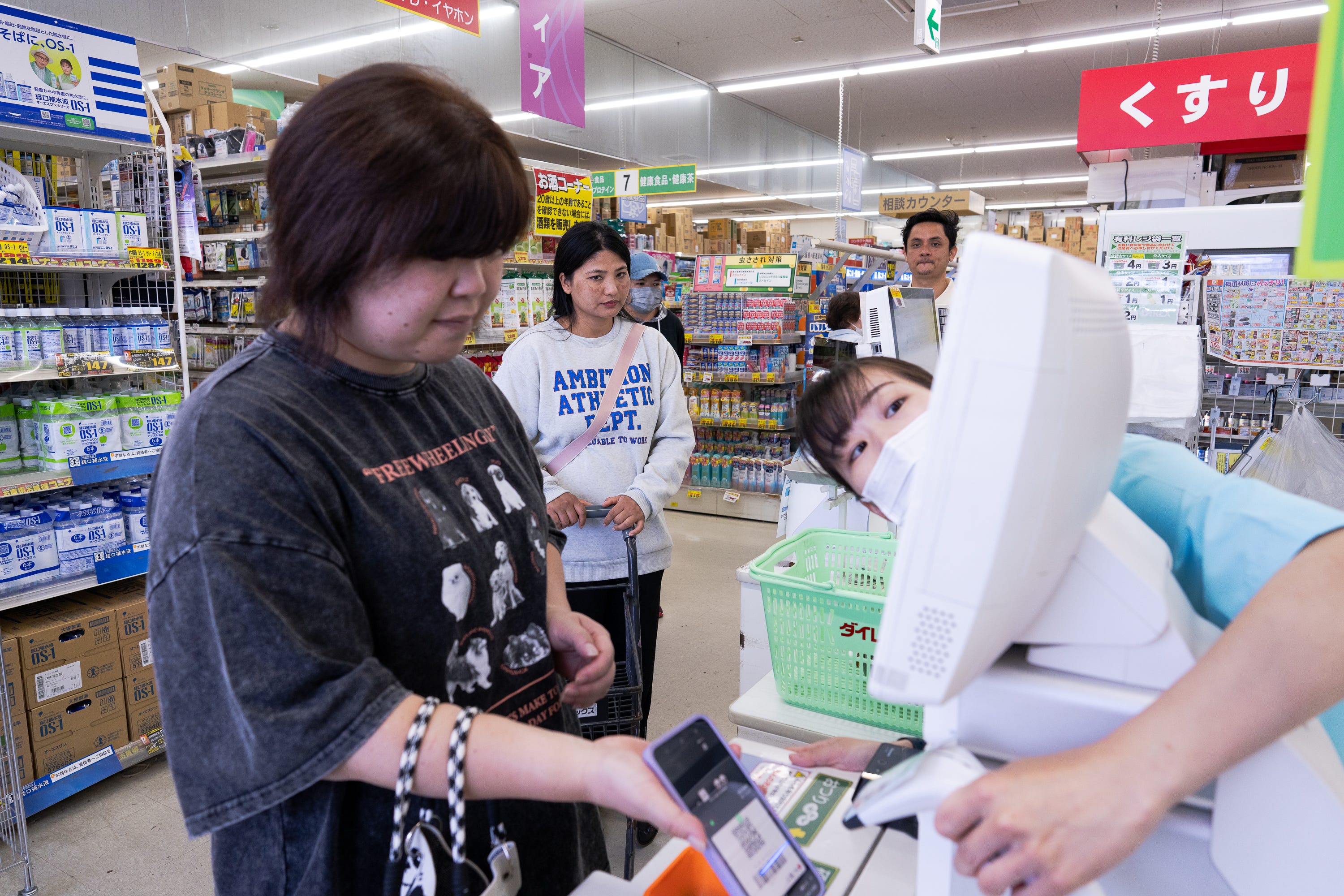
And so Anjana and Milan, Ha and their six other foreign colleagues at Tadakari-so are not “immigrants” or “migrants.” They are gaikoku jinzai, “foreign human resources.” They are inputs, a resource to be sourced and allocated and, when the time comes, sent home.
In the summer of 2025 a fringe party ran on a slogan of “Japanese First” and a promise to halt the “excessive acceptance” of foreigners. The party, Sanseito, won 14 seats in the upper house, sending the ruling LDP scrambling as it chased the mood rightward. By autumn the woman who had spoken most sharply against foreign residents, Takaichi Sanae, had taken leadership of the LDP and then the country, the first woman to run Japan, riding the same current, launching her campaign with a story about tourists kicking the sacred deer in Nara. In February she won a snap election by a landslide, the firmest grip on power a Japanese leader has held in a generation. And she has used it, creating a new cabinet post for “a society of well-ordered and harmonious coexistence with foreign nationals,” floating a plan to mine social media for foreigners working outside their visas, and in October raising the permanent residency fees by almost 2,000 percent, her politics chasing a public mood that is also chasing her politics, a dog after its own tail. Unsurprisingly, the numbers have followed. Two years ago a third of Japanese opposed taking in more foreigners. This year it was more than half.
And so this semantic dance is not benign. Because Japan isn’t the only option, or even the best one. South Korea now pays more in its factories than Japan does in its care centers. And Germany pays double, allows family from the beginning and citizenship at the end, a prize Japan barely even intimates is possible. So as Japan goes on conceding in its ministries that it can’t survive without these people while stoking out loud the very mood that will keep them away, it is jeopardizing its own policies, and potentially the country’s survival.
Neither Anjana nor Milan imagined they would end up here, tucked back between the hills and the water, this tiny village of Tomie. Neither imagined a life beside the sea, this beautiful, empty expanse of blue, or that their days would narrow to this rhythm of work and home, the pressures and friction and never-ending, over-the-top love and care and noise of family removed from their life, left only with a handful of friends, free to feel solitude for the first time, to become islands within islands. Neither imagined they would one day be ordering Nepali spices online, hankering for the taste of dal bhat or the smell of rope incense so pervasive in the shops and houses and streets of home.
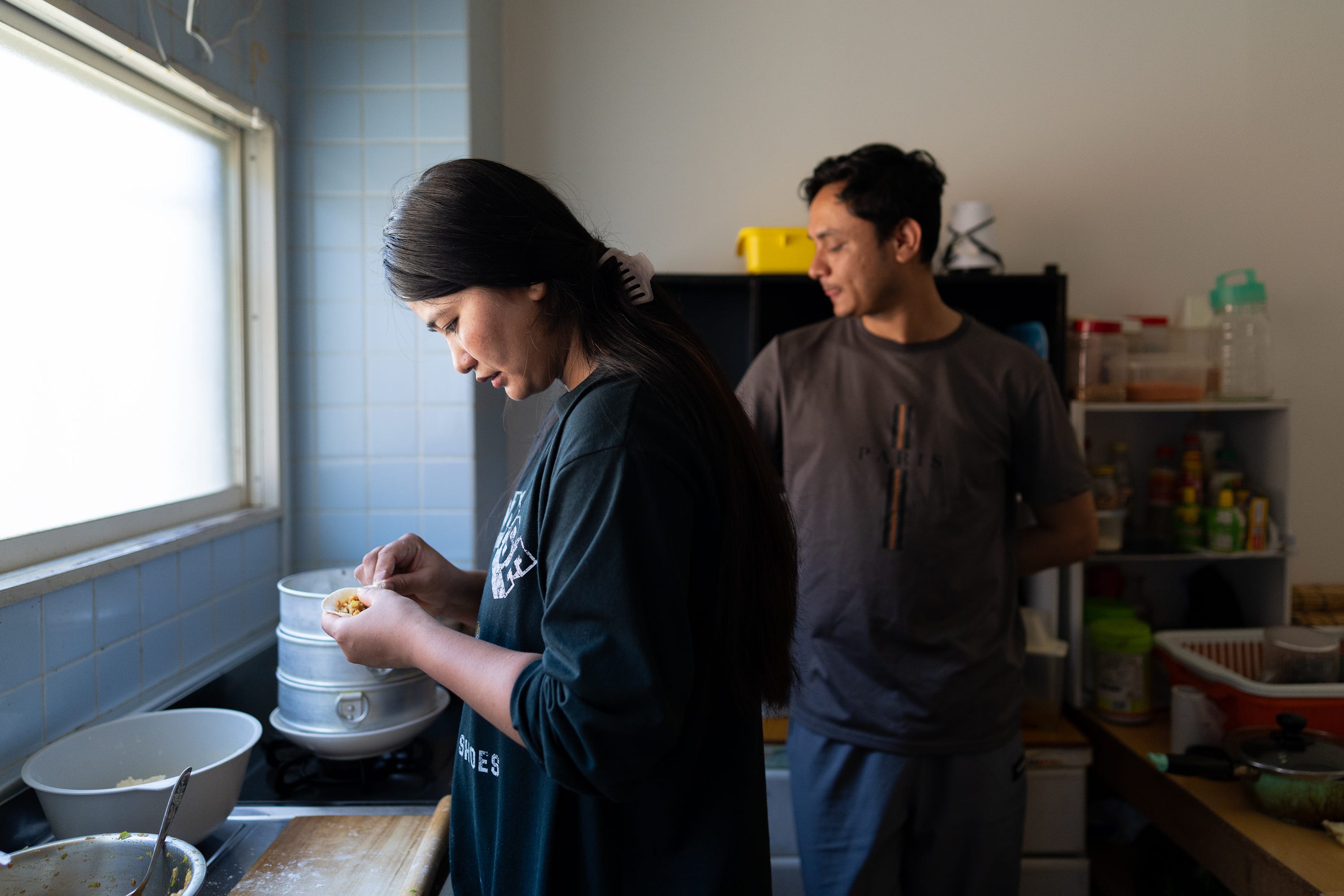
Standing with them one afternoon back in their kitchen I ask how things have been, this massive transition they have navigated together and on their own, and they fall silent, stealing glances back and forth at each other, and I’m not sure what I have waded into. Because moving to a foreign land is hard, and Anjana and Milan have done far more than that, and they laugh nervously as they remember the early days, Anjana eight years ago, Milan just three, but there is an unease beneath the laughter, for Milan in particular a shellshock he has not fully shaken, a tenderness that flickers behind his eyes as he holds his words.
Milan met Anjana at her brother’s wedding in Nepal, the two catching eyes across the dance floor. They talked and there was something there, a magnetism, a laughter. And so they kept seeing each other, that feeling catching their breath as they walked the village roads together in the days and nights that followed. Then Anjana flew back to Japan and Milan left for Poland to begin a job at an Indian restaurant in Warsaw, two lives flung in opposite directions, and still they called and messaged across the time zones, late at night here, mid-shift there, any way to hear the other’s voice, to sink back into that feeling, their minds whirring into the future of what could be and what that would mean. And after a few short months they knew. Knew what they wanted it to be, what they decided it to be, and so they spoke to their families, their mothers and fathers playing dumb to the starry-eyed looks they had seen in their children since the wedding, and their families spoke to each other, hashing out the formalities, the invitations, the food, the dance hall, and then a date was set, marriage, their lives now on this collision course, each boomeranging back to Nepal to formalize this hope and bet for the future.
And with it came their first negotiation, where to live. Milan had only just started his life in Warsaw, Anjana hers in Goto, but Anjana could bring a husband now, having finally cleared the hurdles to do it, and she had invested years by that point, her family a lifetime of savings, and so they decided Goto would be where they began. And within days of the wedding, after the steaming plates of spicy khasi ko masu and sweet sel roti, the dancing and the hangovers, Anjana flew back to ready the home and the life Milan would step into a few months later.
Standing in their kitchen now, the two make momos, Milan pulling spices from the cupboard Anjana has yet to ask for, Anjana taking the plastic-wrapped package of pork Milan can’t seem to open and slitting it wide in one motion, the two of them laughing and appreciating and ribbing the other as they work the small space. They are cute together, there’s no other way to put it, nearly strangers until the day Milan dropped his bags in this apartment they would make a home, their lives beginning to fold into one as they learned the other, Anjana joking about his inability to clean a dish, Milan laughing at the treadmill Anjana impulse-bought during a fitness phase, its frame now doubling as a rack to dry clothes, “She’ll use it when she wants! Or she won’t! I don’t care!” he says happily, speaking as much to her as to me.
Once the momos have steamed we sit cross-legged on the floor at the low table in their bedroom and dig in, dipping each dough-wrapped parcel of meat and vegetable into a spicy red sauce made with sesame and tomatoes, cumin, ginger, and chillies.
“It was crazy when we first married,” smiles Milan, “We were together for seven days and then she left. Then three months later I came here and I was freaking out.” He was 23 at the time and shakes his head about how much happened, “Everything changed. It was a lot to deal with. It was easy in some ways because we were together, because I had her, but the first six months were really tough. Really tough.”
“Even just the food,” he says, “I didn’t eat Japanese food for three months. I couldn’t handle it. I lost eight kilos. At the company party a colleague told me to try some wasabi and I thought it was chocolate so I ate the whole thing. I couldn’t see or speak - I just cried for 10 minutes.” And he laughs the way you do when something has to come out and that’s the only acceptable way to let it, but then quiets. “The homesickness has been the hardest,” he says, “I miss my family.”
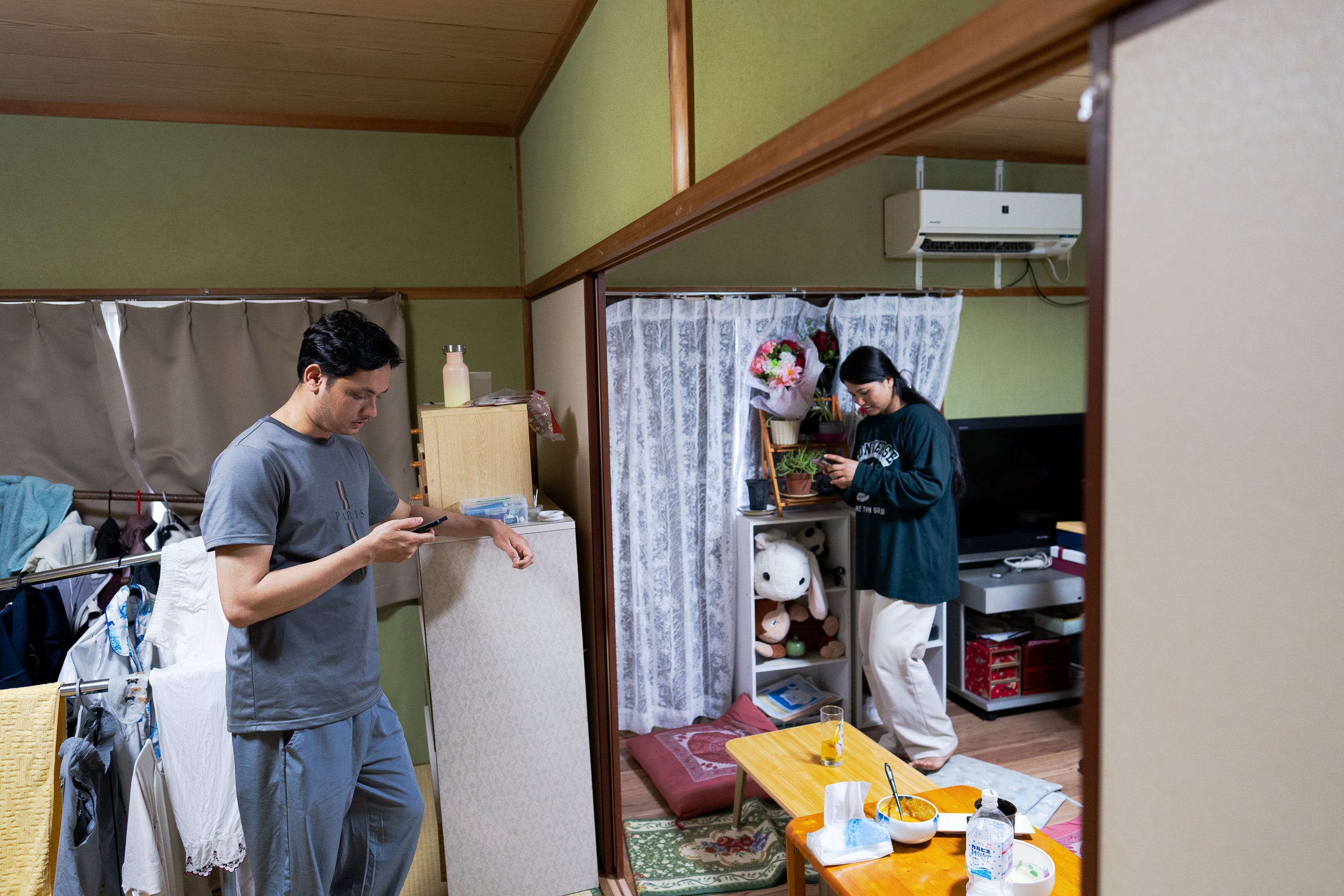
When I ask about Goto they diverge. “I love how peaceful it is,” Anjana says, which is precisely why Milan wants to go. “It’s too peaceful,” he laughs, “I need more life. I want friends, I want to be around other people my own age.”
And while they both appreciate different aspects they both know they will leave, that their time here is coming to an end. They finish their contract at the end of October, and after a trip home to see family they will come back to Goto for a few months before moving to Osaka or Tokyo or some city where they can build out a fuller community. And there, after the dust has settled, they hope to start a family, the big brushstrokes of a dream, but with some sharp definition for they are clear their children will be Nepali, not Japanese, and are already planning to send them back to stay with their parents once they’re a few years old.
“Nepal is home,” says Anjana, “It’s where we’ll return and we want to ensure our children are Nepali. Not Japanese.” And so it cuts both ways, clear what all of this is. Clear for Japan what role Anjana and Milan fill, and clear what Japan does for them.
Japan is a gateway. They hope to be here for 10 or 15 years more, to save enough to return to Nepal and start a business. To leapfrog into an economic position they could not have dreamed of had they never left.
They are not the only ones leaving.
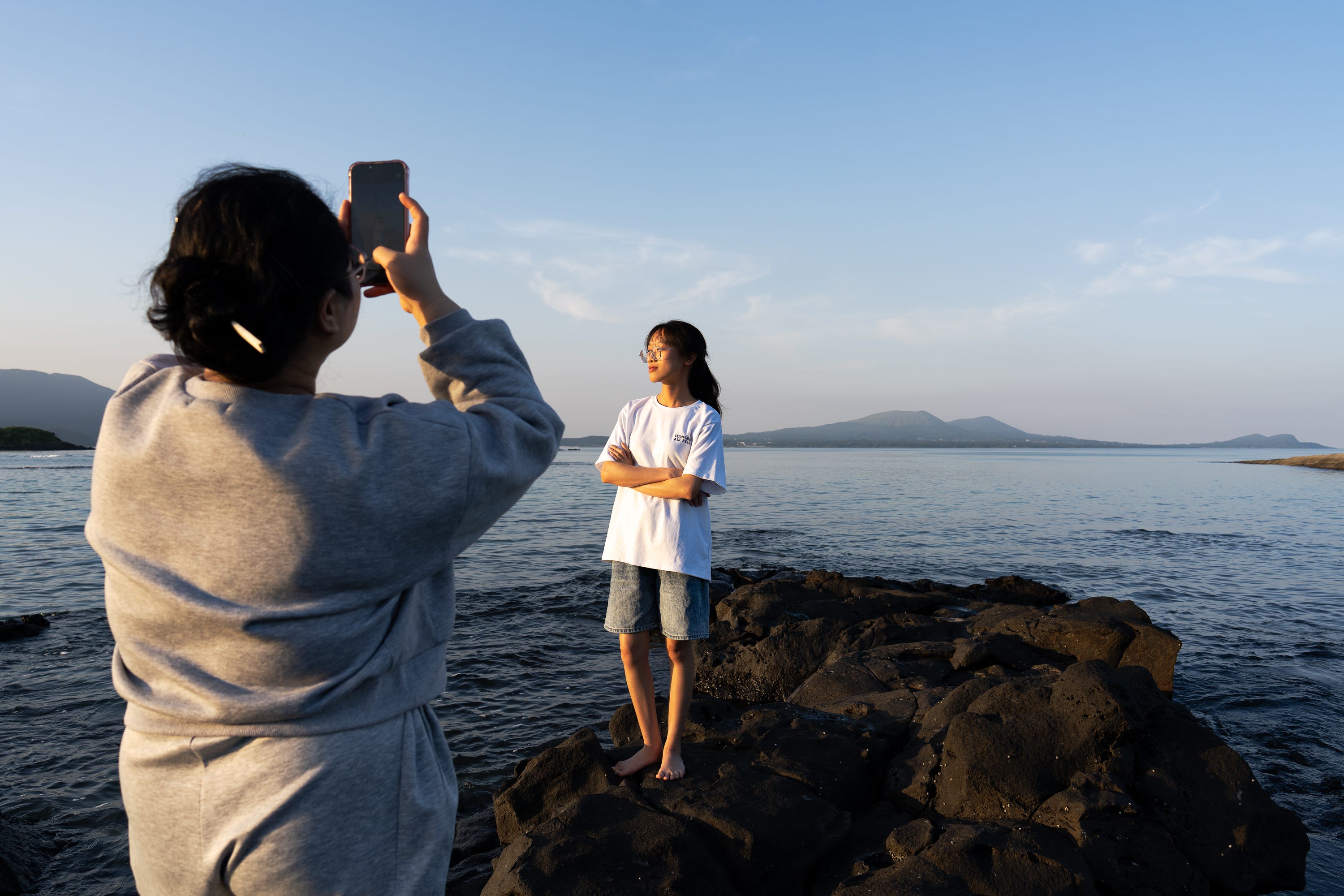
On their day off we drive down to the water and pack a grill full of charcoal and soon there are nearly a dozen colleagues and their partners, Vietnamese and Nepali and Indian and Japanese, all of us standing around a smoking BBQ as the sun drops over the water. The air is warm and still and we grill pork chops and chicken wings, oyster mushrooms and hot dogs, pile onigiri on the table and wash it all down with coke and cold barley tea. Two Vietnamese women who have recently arrived on Goto wander off down to the water at one point to take photos for their instagrams, posing at the edge of the sea, the blue of it stretching behind them as they throw up peace signs. Up by the grill I talk with a young woman named Supune, from Nagaland in northeast India, who has been at the facility for three years and is leaving the following month. “I miss home,” she says matter of factly when I ask why she’s going, “I just want to be home, with my family. It’s nice here, but I miss home too much.” And so the facility will soon lose her, then Ha a month later, and Anjana and Milan shortly after that, four of its nine foreign staff, some pulled back to the lives they love and miss, others toward the same city lights that have been attracting the island’s own youth for years.
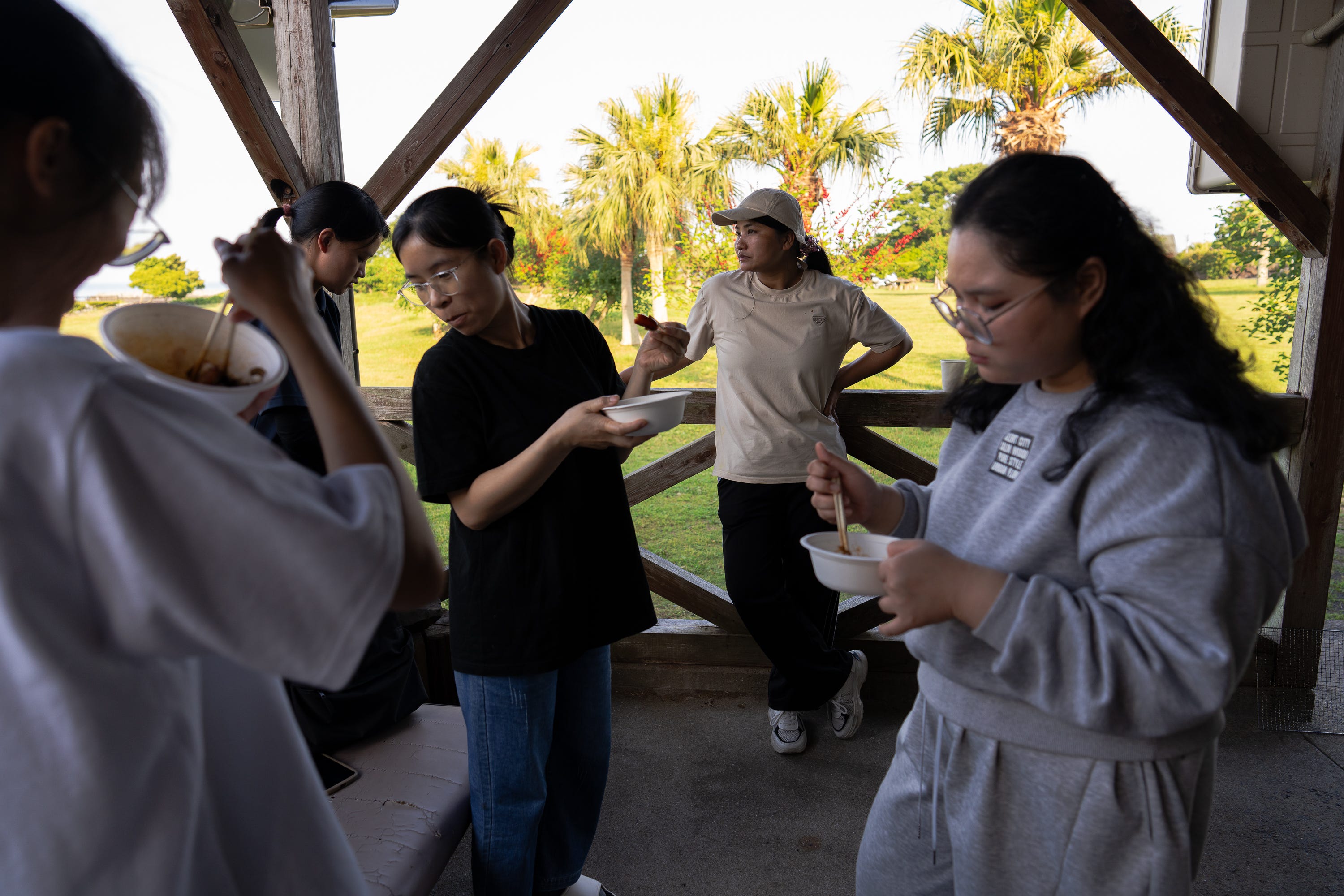
Ha’s departure is different. She came six years ago, the center’s first foreigner, leaving her husband and three-year-old son in Vietnam. He is nine now. And over those years she has gathered one certification after another, saving toward her dream of eventually opening an elderly care home back in Vietnam. Her husband had wanted to come a couple of years ago, when her visa finally allowed it, and they made a plan, but his mother became sick, and the window closed. Now Ha is pregnant, and whatever the paperwork says, the birth isn’t something she wants to do alone on a small island 3,000 kilometers away from her family. She says she wants to come back, that there is still more she wants to learn, more she wants to earn, and her visa is good until 2028. Whether life pans out that way is something different entirely. “I’ll miss Hatsuo the most,” she says quietly, a little away from the smoke of the grill and the noise of the group. “He cares for me and I care for him. He reminds me of my grandfather.”
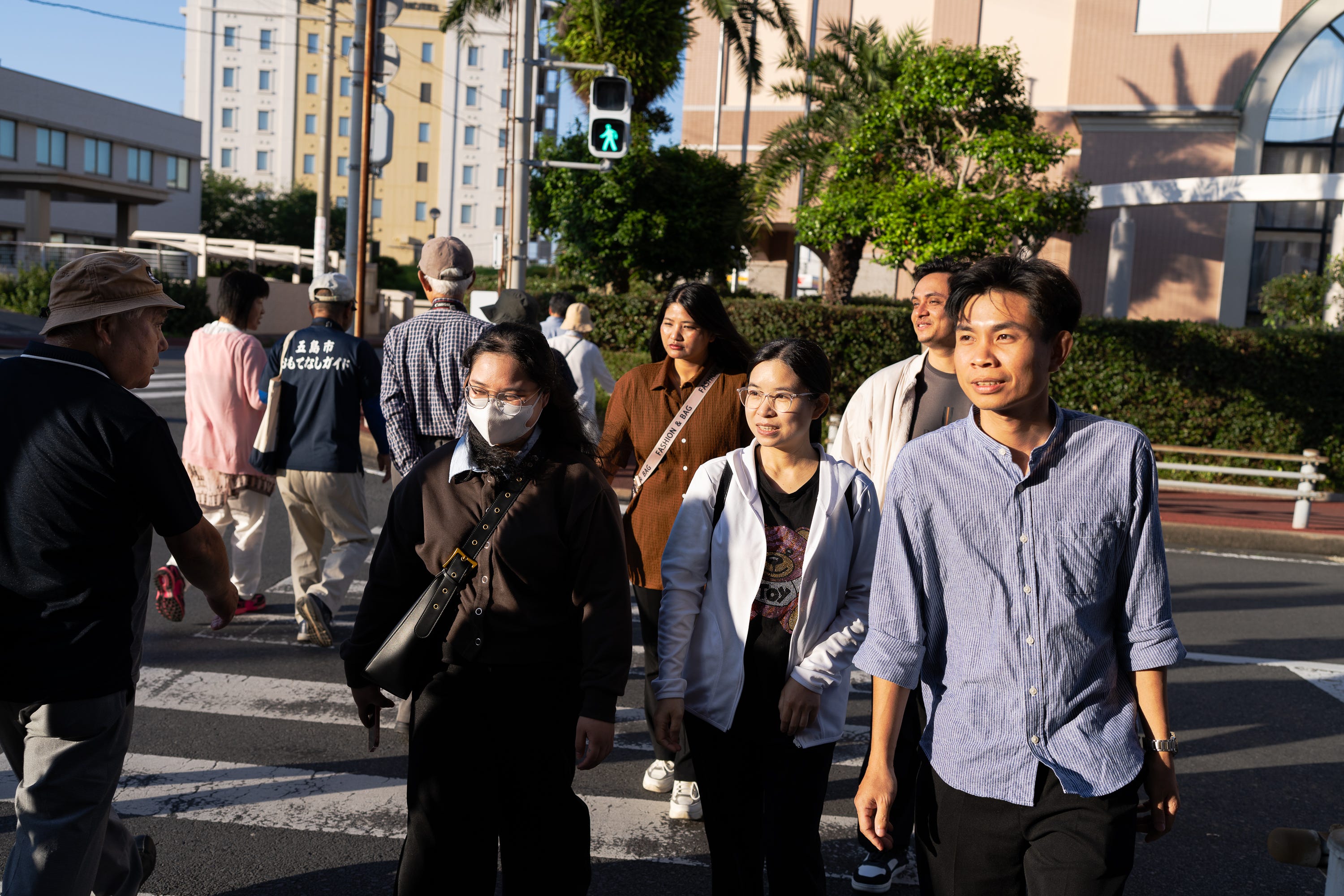
How much of a migrant’s life do you allow in, how far do you let the worker become a person? These are questions every aging country must eventually face, and there’s no ready-made answer. And so countries run the spectrum, with some like Canada selecting workers as future citizens, family and citizenship on the table from the get, while others in the Gulf or Singapore treat them as something closer to consumables, items to be used up and discarded when they run dry. Japan has settled somewhere in the middle. The worker is the point, the life they come with a complexity to be managed, but that management must work for both of them. It must be tenable.
But a system built on a continual flow needs to keep running, year after year, decade after decade, no generation that settles and pays out dividends over time. It’s a risk.
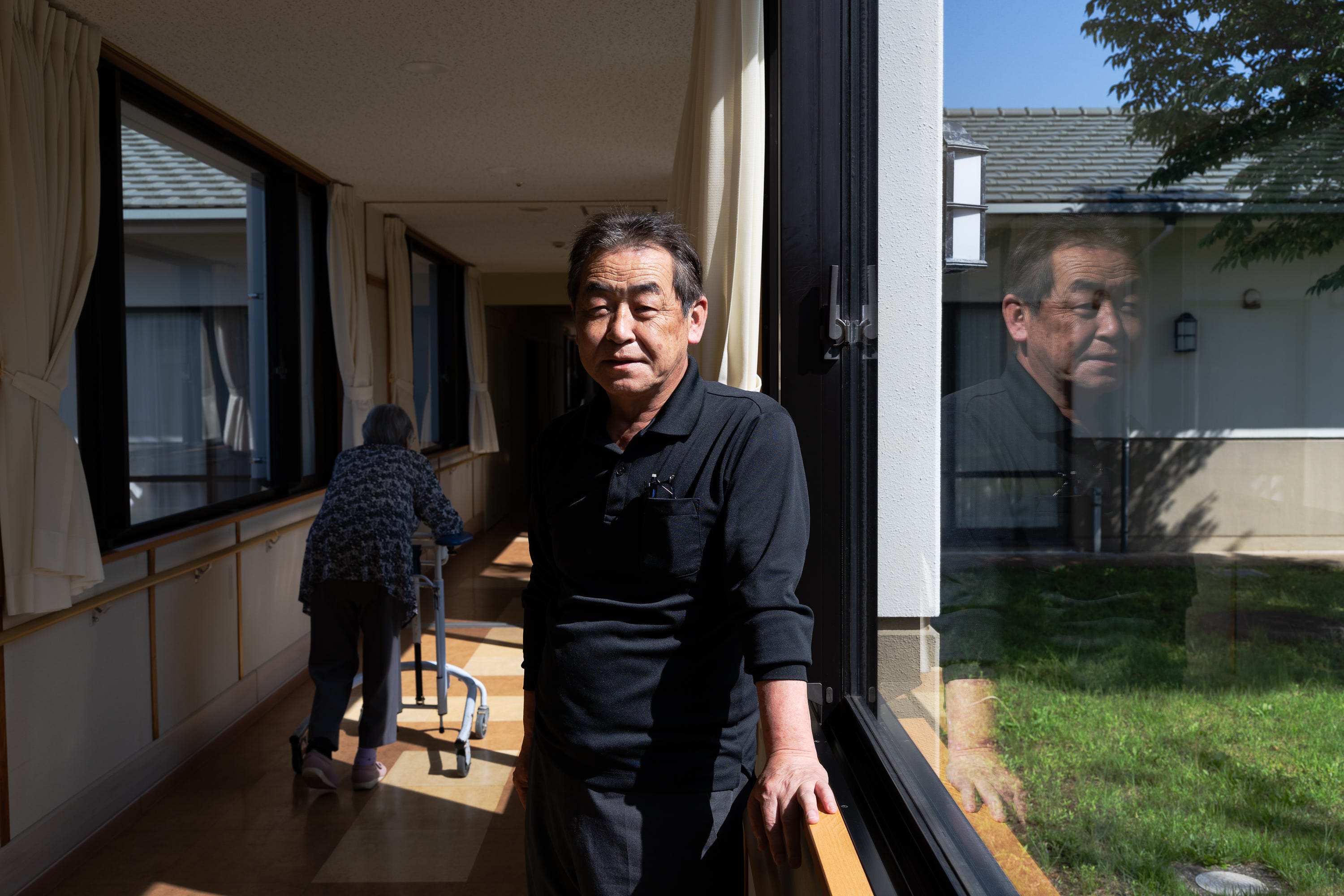
For Yamada Mineo, the director of Tadakari-so, it’s a practical and financial risk above everything. Bringing a foreigner here costs roughly $7,000 a year beyond the wages and the company absorbs that on the understanding that the person will stay. It’s a bet, and so when they leave that investment goes with them. “It’s hard to have people leave,” he says one day as we speak in a facility conference room, “The way we work here, we try to build connections between staff and residents, Japanese workers and foreigners. We become very close, and to lose someone is difficult for everyone. We try to keep people here as long as we can.”
But the financial cost is only the surface of it, for the wards run on relationships, are greased by the warmth of knowing and understanding, of learning how to listen, how to speak. Many residents develop their own language with a particular caregiver, a private vocabulary of head gestures and long blinks, grunts and coos that mean hunger and pain, fear and happiness, and when that person leaves that language leaves with them, these losses their own earthquakes, small and seismic both, shaking the routinized world of a ward where even the tiniest disruption in rhythm can throw a resident off for weeks. And so what makes Ha and Anjana good at their jobs is also what makes their absence so bewildering when they eventually leave.
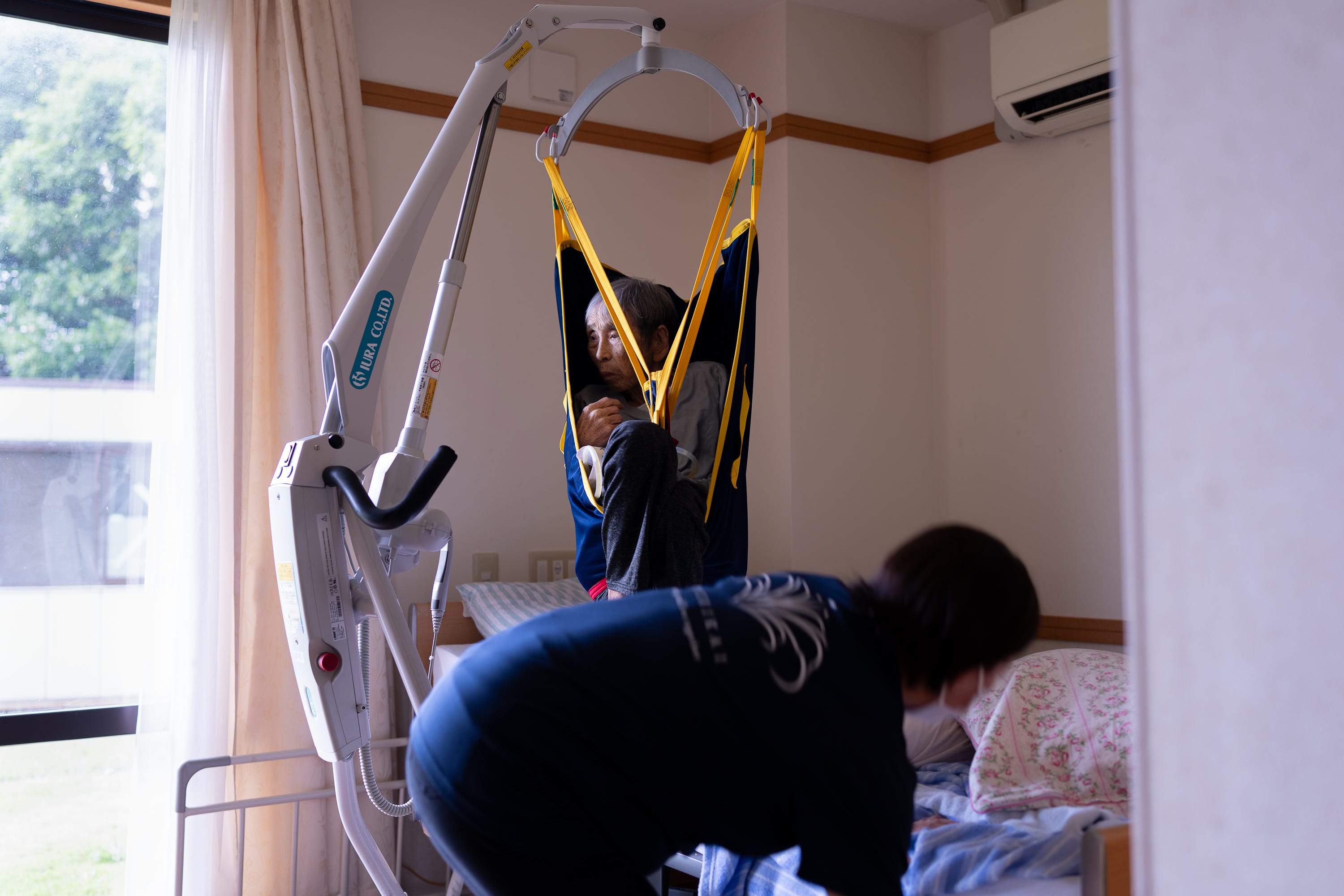


Back in the care center Anjana has spent three years learning that language. “For people who can’t speak, you can tell by their appearance,” she says as she sits beside Hatsuo finishing his lunch, “Sometimes when they’re not feeling well, their face looks a bit different. Even if they don’t speak, if you touch them a little they move like they want to speak, or they squeeze your hand. It’s person to person - the country doesn’t matter at all.”


Hatsuo rakes the chopsticks across the bottom of his bowl, eyes closed as he fishes for the last of the rice and Anjana leans forward from her stool and cups his hand in hers, lifting the bowl slowly to his lips as his right hand holds firmly to the chopsticks, their wooden tips clacking back and forth between the sides of the bowl as it tips further toward his face, a steady incline as Anjana guides it upward, his hand still ricocheting, until the last grains are dislodged and tumble to his lips and his hands stop, and he sits there chewing, eyes closed, hand grasping chopsticks stuck in a bowl that is pressed to his lips, until Anjana slowly begins to lower it, his hand trailing as it goes until she sets it on the table, and he places the chopsticks by the side. And his hands rest flat against the table now, palms pressing into the smooth surface, fingers stretching out, like the inhale of two small animals, and they begin to move up and down along the gloss, and Anjana wets a small napkin and dabs his cheek, a rogue grain of rice still stuck to the corner of his mouth.
“You all finished, Hatsuo-san? Do you want anything else?” she asks, and his hands stop, the gliding paused mid-stroke, and Anjana looks at him and he faces forward and then she gently lays her left hand over his right, holding it above his hand as much as resting it on top, the way you place a dish towel over rising dough, and asks again, “Would you like something else?” and the two sit there for a moment as the words settle and neither moves, and then she stands and steps to the center island of the kitchen to fill a cup with iced green tea, setting the opaque plastic cup down before Hatsuo as she returns to her stool. And Hatsuo faces straight ahead, eyes still closed, as his right hand reaches for the cup and lifts it to his lips, his left hand resting on the table, palm pressed flat, fingers stretched like a starfish, and Anjana sits by his side as his body takes large gulps, the adam’s apple in his neck jumping as his head tilts back to drain the last of the pale gold liquid. And then he sets the cup down, and his hands begin to move across the table’s surface once more, searching and touching and feeling and absorbing, his nimble fingers, tactile, communicative, alive.
And Anjana sits beside him and begins to talk softly, the way you talk to someone at the very edge of sleep, and she talks about the bright sun outside, about the coming summer heat, about how his son will visit tomorrow. And his chest rises and falls, exhaling some long murmuring, creaking coo like the pods of humpbacks swimming off the coast, the echoes of their intent slipping along the depths, this communication from another world, and his hands continue to glide, up and down, back and forth along the table’s glassy resin, this body pressed in time, able and searching, as Anjana goes on about the birds picking through the grass outside, the menu for dinner, the two of them seated there beside each other, Hatsuo’s 89 years cascading out behind him as he faces forward, back erect, eyes closed, Anjana’s stretching out in front of her as she looks across the corner of the small table toward him, and she sits silently now, the words gone out, just the two together for no other purpose than to be there, these lives brought close by chance and happenstance and dumb luck just as anything ever is, two people who slowed enough to learn to listen, to catch sight of the other, like drivers glancing at each other from across the highway, this fleeting instant of eyes caught mid-flight, and he is seen and she is seen, and that is no small thing, a moment of meaning to briefly halt the indifferent march of time. And what is there if not that. What matters if not that. For that is the work. That is everything.
My sincere thanks to journalist and fixer, Hiromi Tanoue for her work, keen eye and expert translation, as well as to Yamada Mineo and all the staff and residents at Tadakari-so. This work would not have been possible without their support and trust.