

||Audio version of this story||
Journalism is, in many ways, the repeated act of dropping into other people’s lives. Sometimes the amount of time is only minutes, swooping in to grab some tidbit of information, and in that way it can occasionally feel predatory, like some bird of prey picking off a field mouse. Other times the duration is longer, settling into someone’s life, forming connections that, at times, can even approximate friendship. Always though, I am looking at someone’s life from a distance, and assessing what it means, what it tells me and how it fits into some broader context.
There are times when the friction between being a human and a journalist feels stronger than others. When my role as an extractor and conveyor of information feels paramount. When I feel conflicted. When I leave a room unsure whether I have witnessed a life or somehow consumed it.
So when Mohammed tells me he wants to die, this friction becomes blisteringly clear.
I feel a sweep of questions. I wonder how that fits into the story, how many people are like him. I question how to respond, how to help. I question my role. Is it purely to report it to you, the reader, convey the gravity of these decisions, reveal to you how fraught the act of migrating can be? I question how much weight to give to that.
Because you’ll see in the main story that Mohammed is merely a sideshow, an example, no more. His entire life, the hope that has driven it, the grief that has met it, the full weight of whether he will end it, the hurt and anger and world-ending absence he would leave behind, all compressed into a few short sentences.
And those sentences come from just 50 minutes together. 50 minutes speaking in a humdrum white office, this fleeting moment in our lives as we barrel past each other. 50 minutes in which he tells me of his pain and shows me where it lives, pulling his shirt up to reveal the soft rolls of his belly, grabbing a chunk of his flesh to point to the place where the stress and hate and shame and fear has burrowed into his guts, twisting the smooth rope of his intestines into a hateful knot. 50 minutes in which I pull on the thread of his story, his life: “Tell me about this. What about that? How do you feel about this? What happened here?” 50 minutes in which he cries multiple times, his mind visibly spinning out in front of me. 50 minutes of him telling me that the stress and the shame are too much, that he has fucked it all up, that he just wishes it would end. And throughout it all I sit there, listening, caring, but also, on some very real level, grading his experience. Evaluating it against the story I’m trying to tell you, against the broader context of what I’ve heard, weighing how much time it’s worth.
And Mohammed carries on, speaking of his regret, his worry, he can’t stop himself, this dark matter that has accrued in his belly just billowing out like moths from a closet or blood from a broken tooth. This last gasp he has thinking “maybe you will help. Maybe by stripping myself bare and striking this match here in front of this man, he can do something. Maybe it will mean something.”
And yet I sit there, dumbly, asking questions. And after 50 minutes of doing this and looking into his flat eyes as he tells me about the night terrors he has, I ask to take his picture. I ask to take his picture. I ask this man who is so visibly, palpably undone whether it is okay to take his fucking picture.
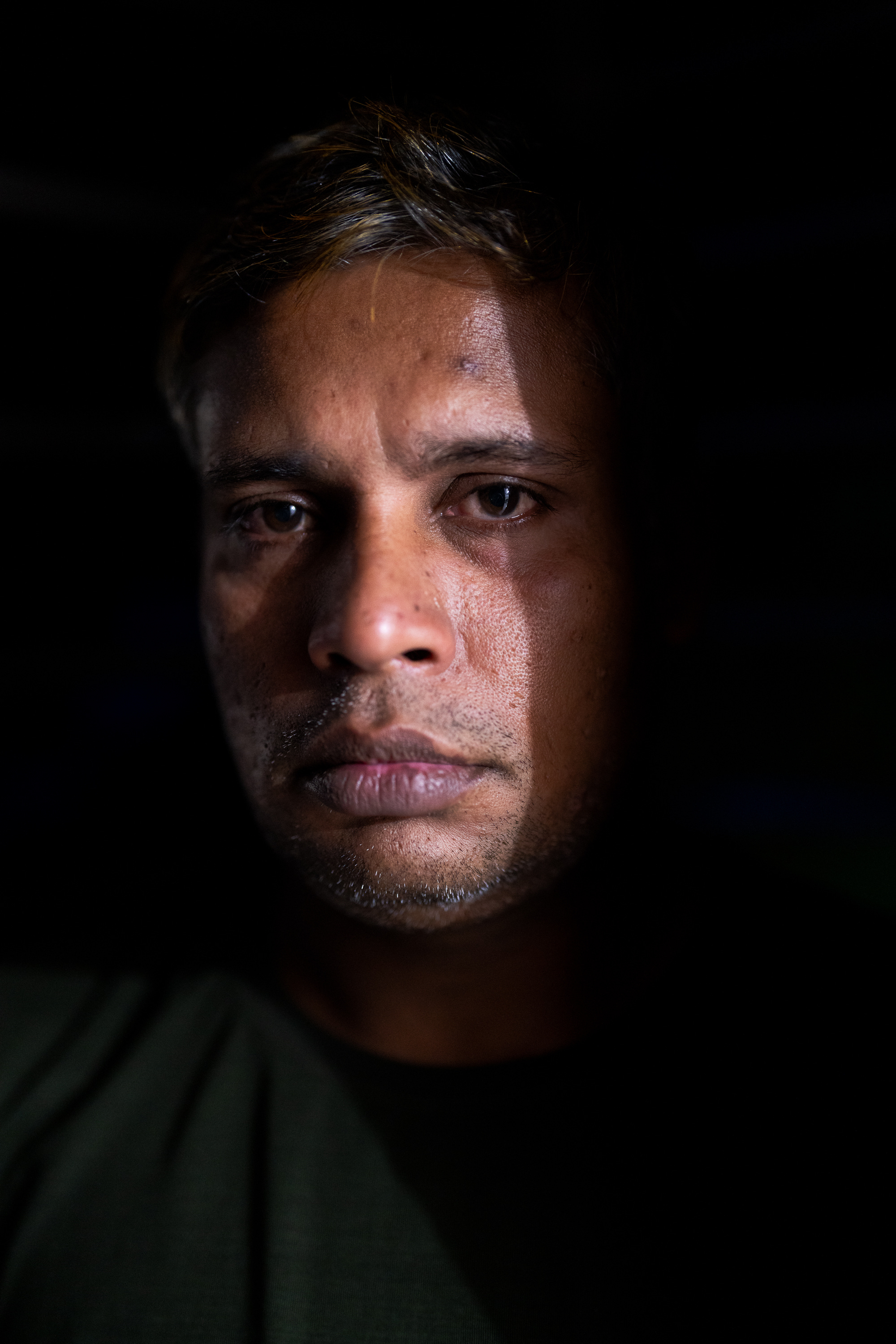
And he says yes, because maybe this will help. Because why not when the world is fucked. Because this is what he came here to do and he is still in it, still pushing forward, still committed to the idea that being seen might be worth something. And so I take his picture. And then I move him to where the lighting is better. And yes, take his picture again…and to what end? So that I can feel proud of a pretty picture? So that I can convey the emotional weight of that moment? Who does that serve?
Yes, I want to make sense of it all. And I want to convey the gravity of these decisions. I want to show you that the choice to leave home is fraught and precarious just as it is rewarding and stabilizing. I want to show you that there is risk and that some people come out on the wrong side of it. That not all bets pay off. That lives and families and dreams and futures are the stakes. Not for pity, for there is no cheaper an emotion, but for recognition that men like Mohammed, who do everything right, are still chewed up and that the machinery of it all is real and relentless and brutal and savagely indifferent.
I do this to show you that this man is real, his story worth attention, but in that very doing I risk making him less so.
Because I do this all with someone’s life. And that person is standing in front of me, digging mindlessly at the skin on the tip of his thumb while I look through the photos on my camera and think to myself “oh this one is okay, this one is better, oh this one is shit, maybe I should move him a little to the left. I wonder if the light can dim here somehow…and hmm should I take this one again?”
And while I want this to matter, I also sit with the possibility that this will just be a story people read in The Endless Scroll. That his pain will become content.
And when we are done, we are done. And we talk a little more and then he exits the room, looks around as he walks out into the hallway, and goes back into his life, me into mine, never to collide with each other again. And I stand there in the room exhaling, taking a moment to collect myself and make sense of this crashing encounter, and also to wonder whether I captured what I needed.
And don’t get me wrong, when we sit I feel the weight he is under and I am so terribly sorry. I comfort him. We take breaks. I offer him tissues and something to drink when he is tilted and needs to level out. I check in on whether he wants to continue. And he does. Every time, he does. And so I follow his lead, pushing when he signals me forward, pulling back when he needs it. But let’s also be clear - this does nothing for his life.
And so I think about what I can do. I speak to the NGO that has organized these interviews about his case, and I ask what additional support can be given. I emphasize that he needs serious counseling. That he is careening towards the edge and will not take his foot off the gas unless someone intervenes and something changes. I say these things because I’m worried for him. Because he is dying. Because I feel a very real sadness and pain seeing him as I do.
But I also say these things because I have nothing to give. Because I feel useless and gross. Because this man’s entire world, all of his pain and hurt and self-loathing will be an anecdote, a few punchy words in my story, no more. Because I cannot give him any respite and because I want respite of my own. I ask because I care. But also because I don’t care enough to stop everything and do what I can to help him then and there.
Because the reality is that I have a wad of cash in my bag that would be life-changing. I could sweep away his debt and then some. I could find a therapist in Dhaka, and pay for the help he needs. Maybe I could keep him alive, buy the treatment his sick mother needs to be comfortable in her final days. I could put his daughter back in school, the daughter he pulled out because he could no longer pay, the daughter whose ruined future adds to the shame that consumes him.
But instead I defer that responsibility, shift it to the NGO. It’s not my place after all, that’s not my role. That’s what I tell myself.
I know some of this sounds like self-flagellation. Maybe it is. But I’m writing this because the tension is real, not unique to me, but real. Reporting elements like this can feel like a tightrope, an act of pulling something out of someone while trying not to destabilize. Trying to do right by them and do right by the story. To tell what needs to be told while remembering that the people telling it are real.
When to stop asking questions, when to end the interview, whether to take the photograph…those lines are clearer than they might seem here. We are in that room together, a place he has chosen to be, and I want it to mean something. That means getting as much of the story as I can without doing harm. And that can feel uncomfortable. I accept that even when I don’t particularly like it.
But whether to step in beyond my role as a journalist, whether to provide some kind of material support, when to simply be a human, that’s where it can get murkier. Because there are times when I have, and others when I haven’t. And that has had much less to do with the person’s circumstances than my own. My own headspace, my own capacity, what I had left to give that day, what I had left to do. And that’s the part that unsettles me, frustrates me. Because where I draw the line between helping and not ends up feeling totally personal, subjective. And that feels fucked and ugly, but also inescapable.
And so I take a sip of water. I eat a banana. And I call the next interviewee in.
Thank you for telling us this, too. It’s so trite but I am sure, knowing you and seeing this work, that Mohammed and everyone whose pain you’ve witnessed and recorded, felt seen. Believed. Respected. And that is clearly not enough, not the material solution, but it is meaningful.
So powerful and yes, you got the photo right.