


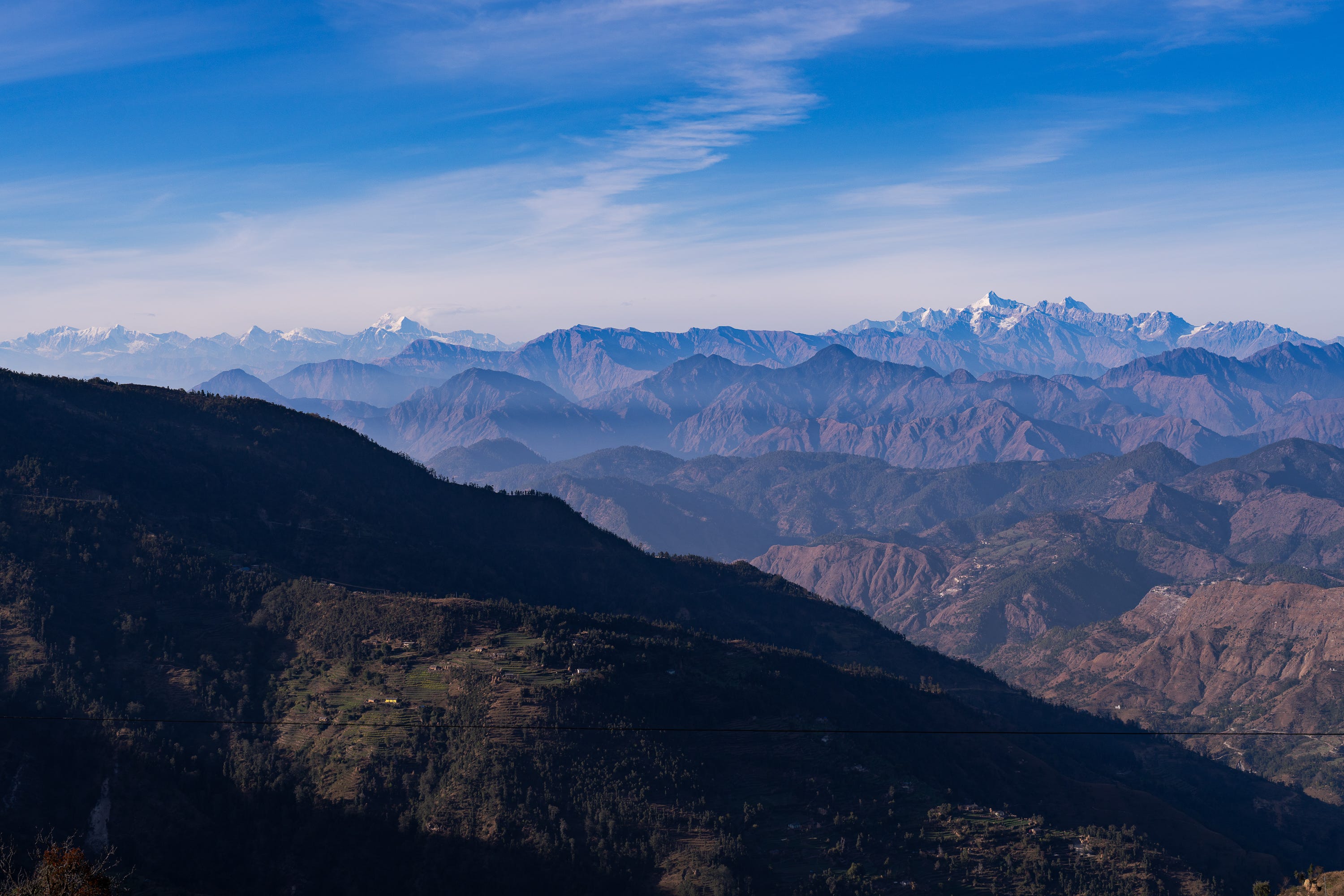
I can hear the crying from outside the house. Standing in the front yard, the mountainous valley cascading down below, Dipak Katri’s home has come alive, a moan rising and falling like the guttural ache from some wounded animal. The chatter of his relatives, wizened and stooped women and men who have come to say goodbye, quiets in the yard as the cries from inside ring out.
I take off my shoes, placing them beside the small yellow marigolds the family has set at the entrance for good luck, and walk through, the wails getting louder with each step. The wooden staircase is steep, ladder-like, and I steady myself against the sandpapery skin of the mud and earth wall as I step from rung to rung, the planks smoothed and bowed from the three generations of family that have worked the surfaces with their passing.
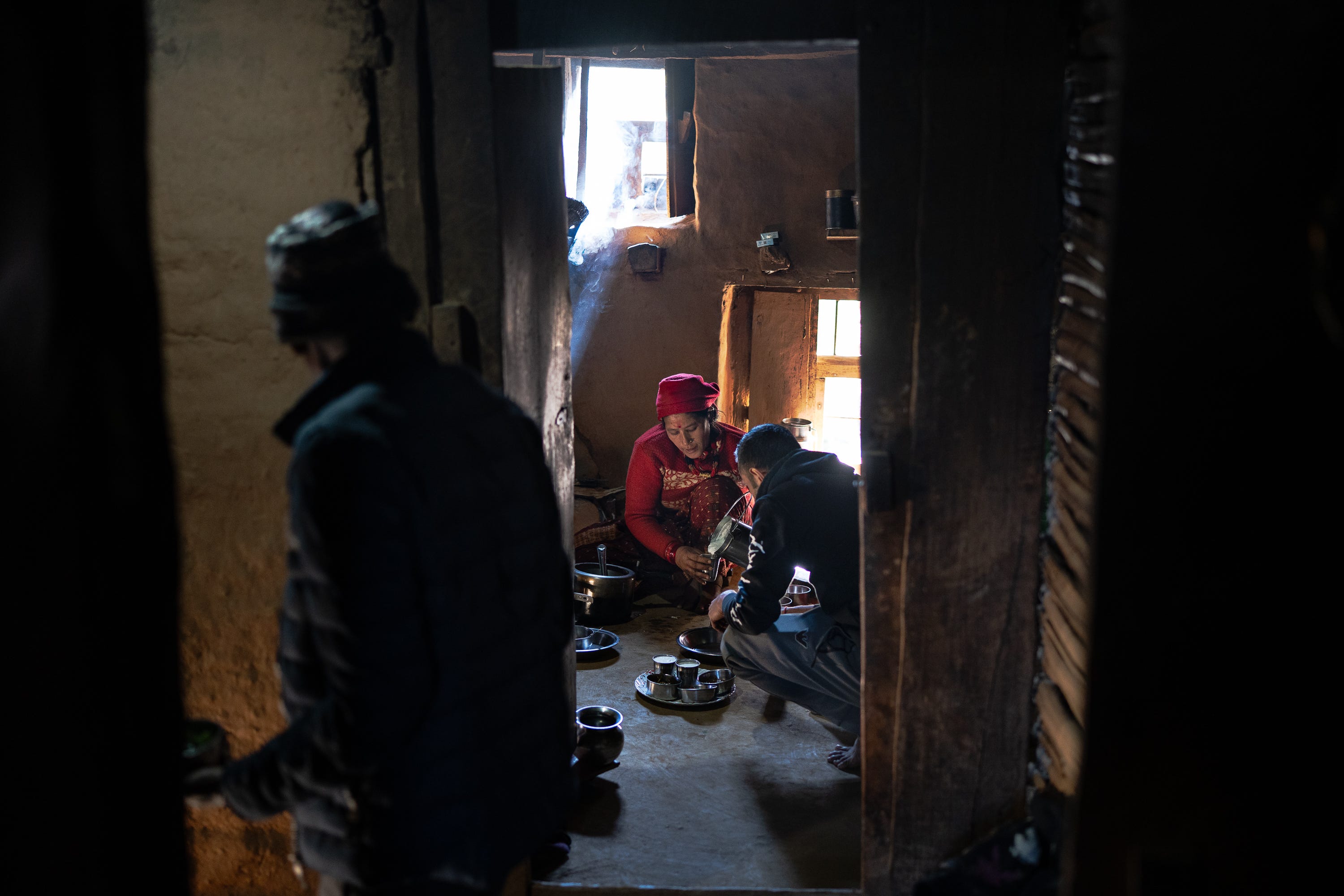
The air thickens as I climb, the smell of woodsmoke creased with sandalwood, hay and freshly cooked roti, and with each step the sound swells higher, the air trembling with heartache as the family begins to say goodbye.
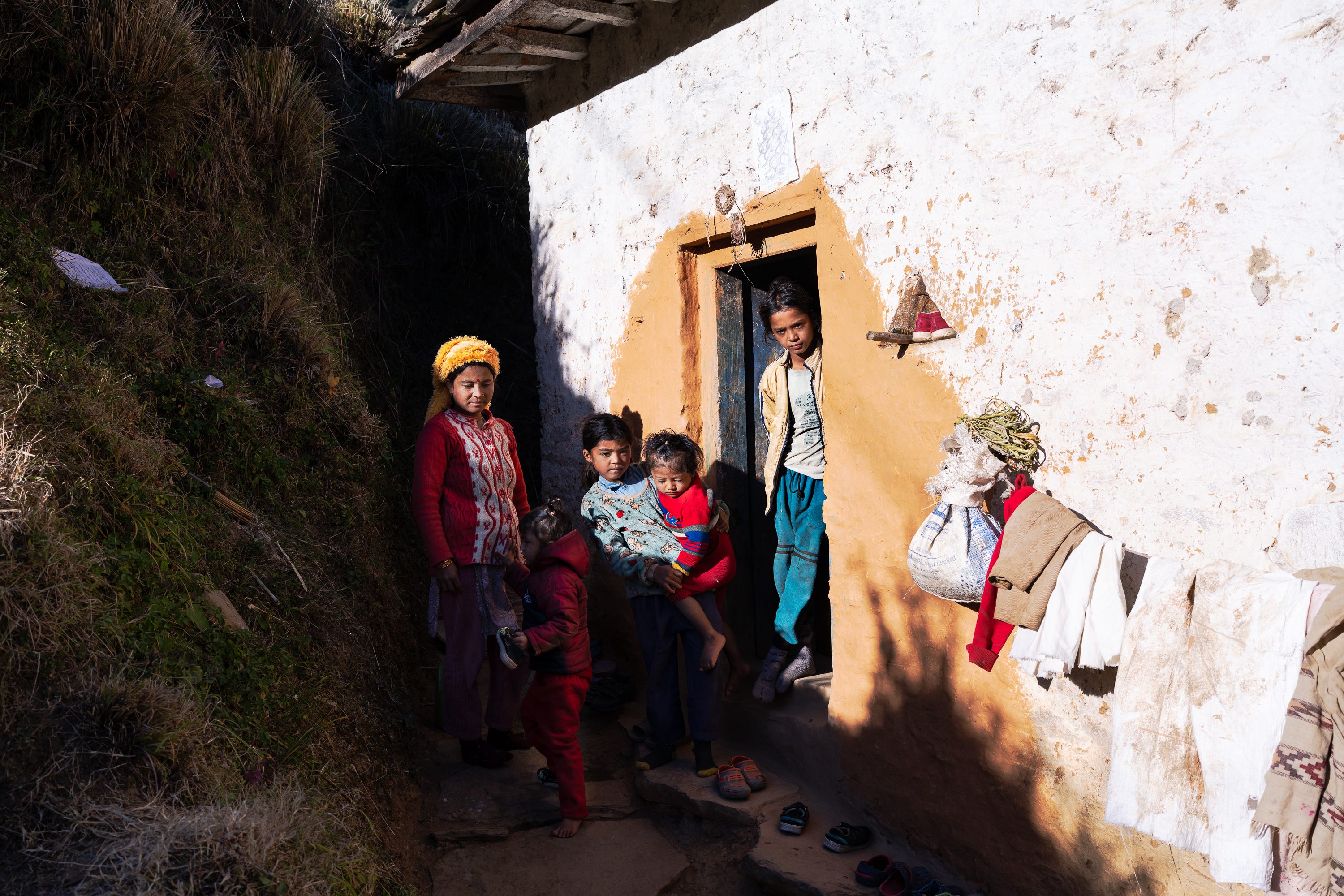
The door to Dipak and his wife Shanti’s dimly lit room is open wide and I can see the family standing there, just beyond the threshold and I question my place, whether I’m trespassing on something sacred, something too raw, too unadulterated to muddle with my presence.
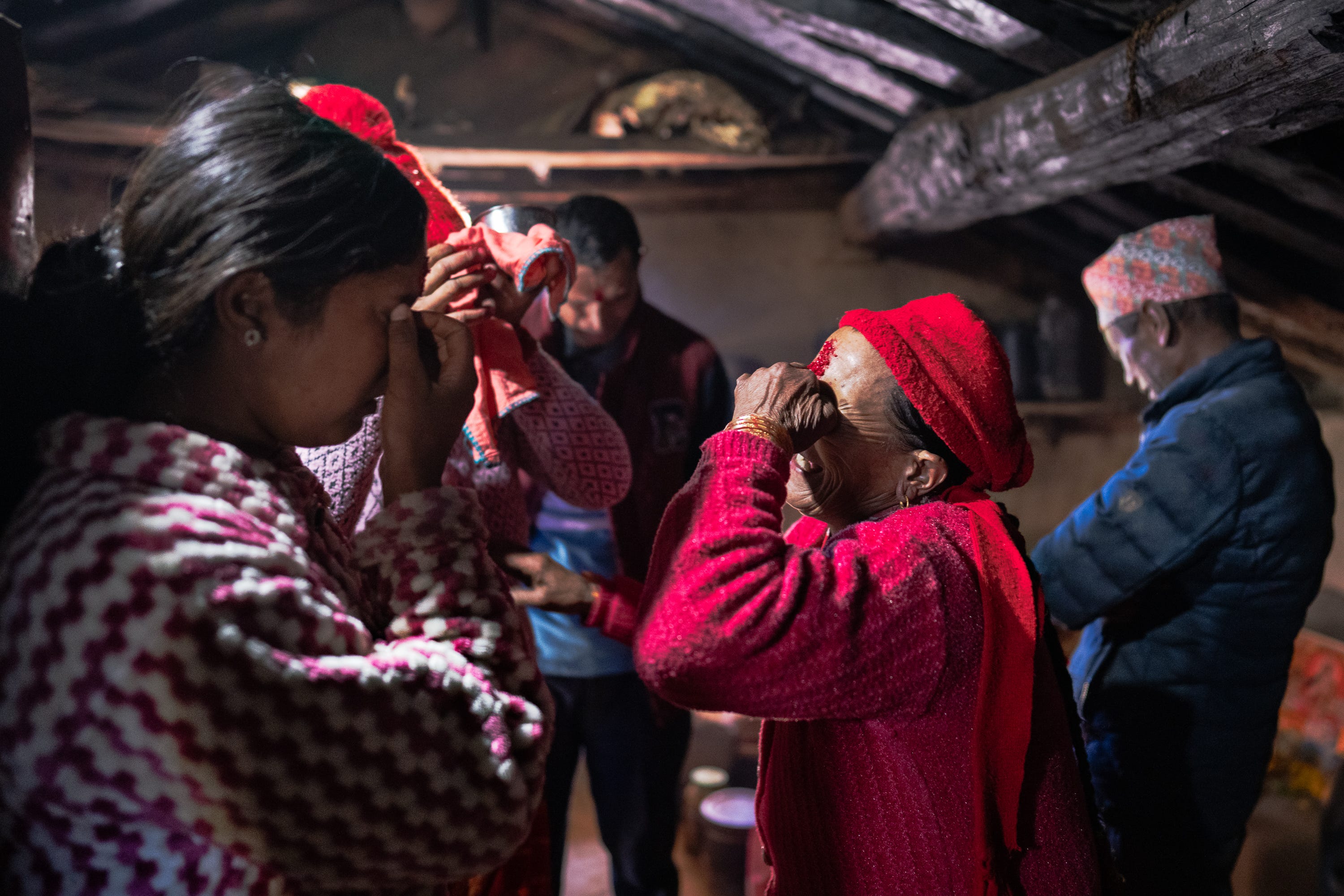
Dipak’s mother, Chakhuri, stands closest to me, her back arched, face to sky and mouth agape as she wails, tears streaming down her furrowed cheeks. His 16-year-old daughter, Asmita, stands to the left staring up into the ceiling, eyes wide, unblinking, hands over her mouth as her chest shudders and shakes, as if some hand has grabbed her from behind, yanking repeatedly from the darkness. His father, Amaraz, stands quietly in the corner, shoulders squared off, hands whiteknuckling his hips as he stares down the tears that have burned his eyes red. Dipak stands in the middle, bent forward, neck collapsed, hands on his knees as he steadies himself.
The family begins to move, their cries echoing around the room, and slowly, one by one, they rotate through the space, as if their grief is creating some new center of gravity they begin to orbit, each taking turns dipping a finger in a silver bowl of vibrant red pigment mixed with yoghurt and cracked grains of rice, pressing it against each other’s forehead, a tika, this blessing of luck and health and hope, always hope, stamping skin like a seal, a charge, something to change the other, to mark them with their love and carry them into what comes next. And they embrace as they pass and then one crouches low, onto hands and knees, their body bent forward as they touch the other’s feet, this gesture of love and humility and respect and surrender as hands touch toes touch forehead touch toes. And then they are up and everyone is moving downstairs, noses running, faces streaked with tears and snot, coughing and sniffling and spluttering with swallowed grief, chests heaving as they lug this weight and grip of breath and nerve and heavy heart to emerge, stumbling forth into the light mountain air like boxers at the bell.
And the sun is bright, blindingly so, as they step into the yard, relatives crowding around Dipak as he moves from one to the next, a new ring of orbits circling as he embraces each, kneeling to touch feet, the painted tika, and Dipak’s tears have retreated now, erupting only in short bursts from his relatives like sparrows darting from trees.
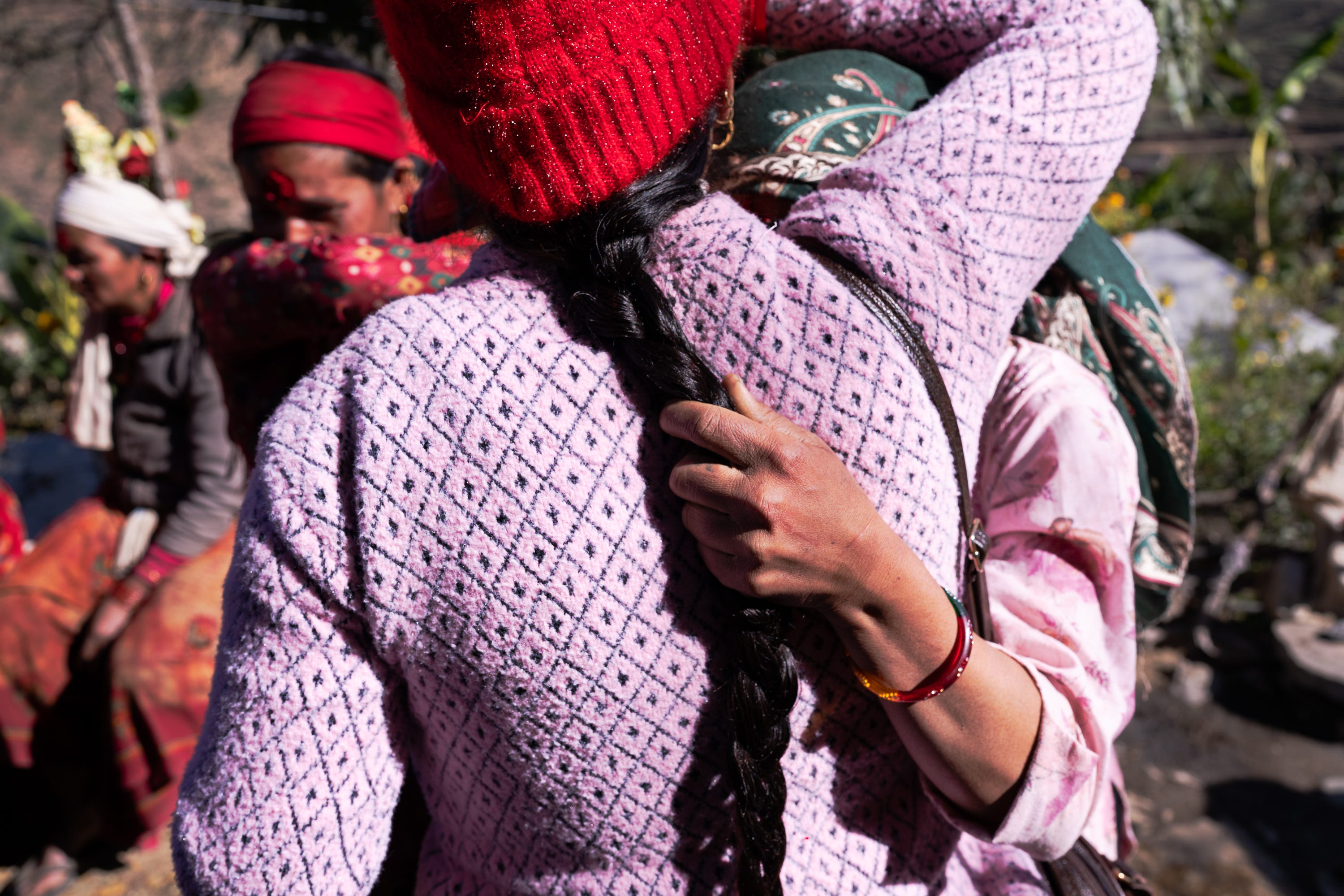
And soon the crowd is moving him up the hill, less a walk than a procession, bodies pressed close, bellies to backs, hands held, shoulders against shoulders, to the 4x4 waiting for him on the dirt road above his house.
Dipak opens the car door and turns to face Asmita who has trailed one step behind him, and the quiet that had begun to settle into him takes flight once again as the two hold each other’s gaze, their eyes quickly underwater, and he takes her face with both hands, her cheeks cupped by his palms, the dark soil from working the fields the day before still packed tightly under his nails, and they stand there rocking with breath, chests rising and falling as if to inhale this final moment, to welcome it, to savor it because after this there is no more and because this is true and this is what we’ve chosen and I wish we hadn’t but I’m so glad we have and here we are and there you are now let us say it, and relatives crowd close and the world spins around and the 4x4 idles loudly and then he kisses her cheek, the other, and pulls her close.
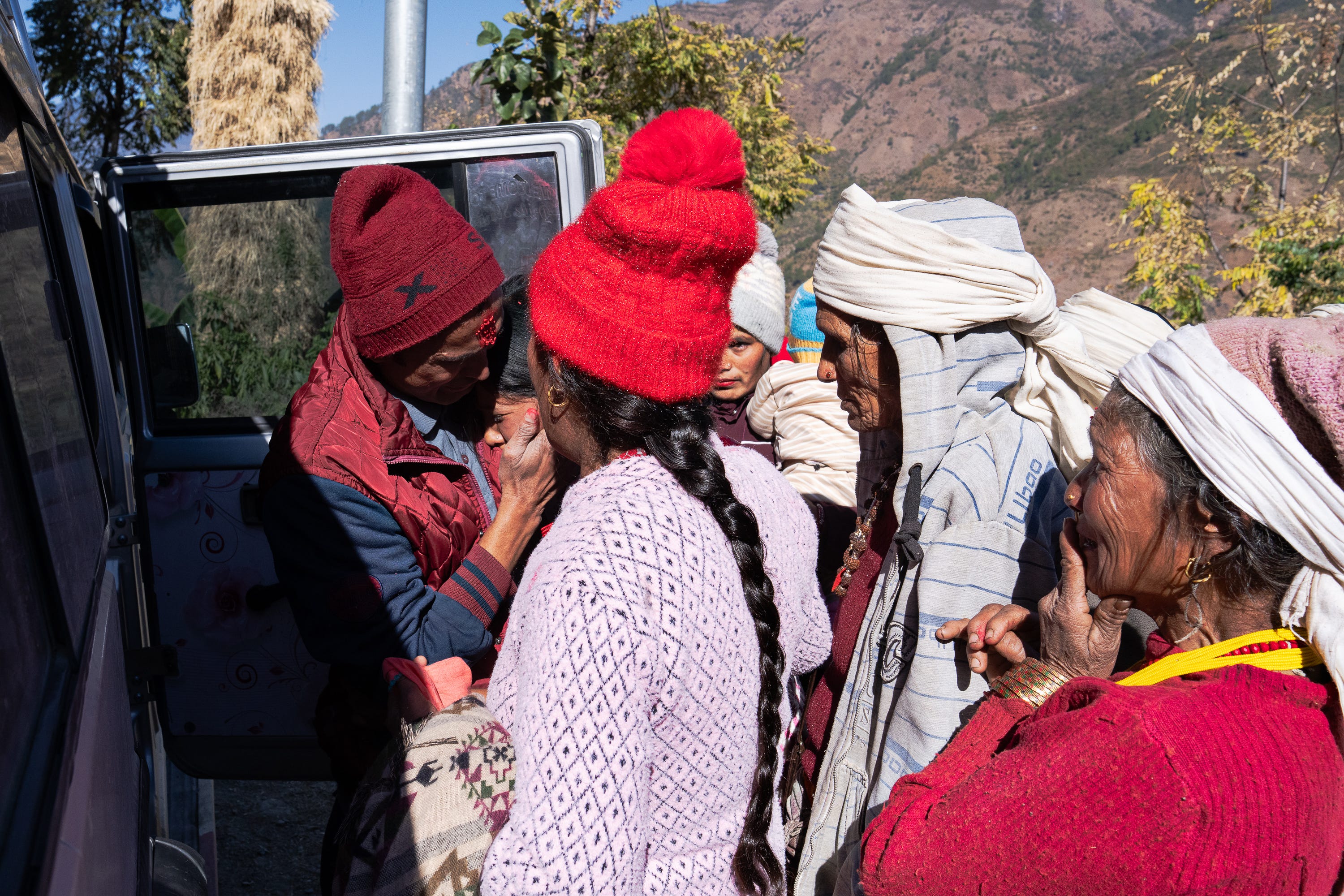
And then Dipak turns and is in the car, Shanti by his side, and the door closes.
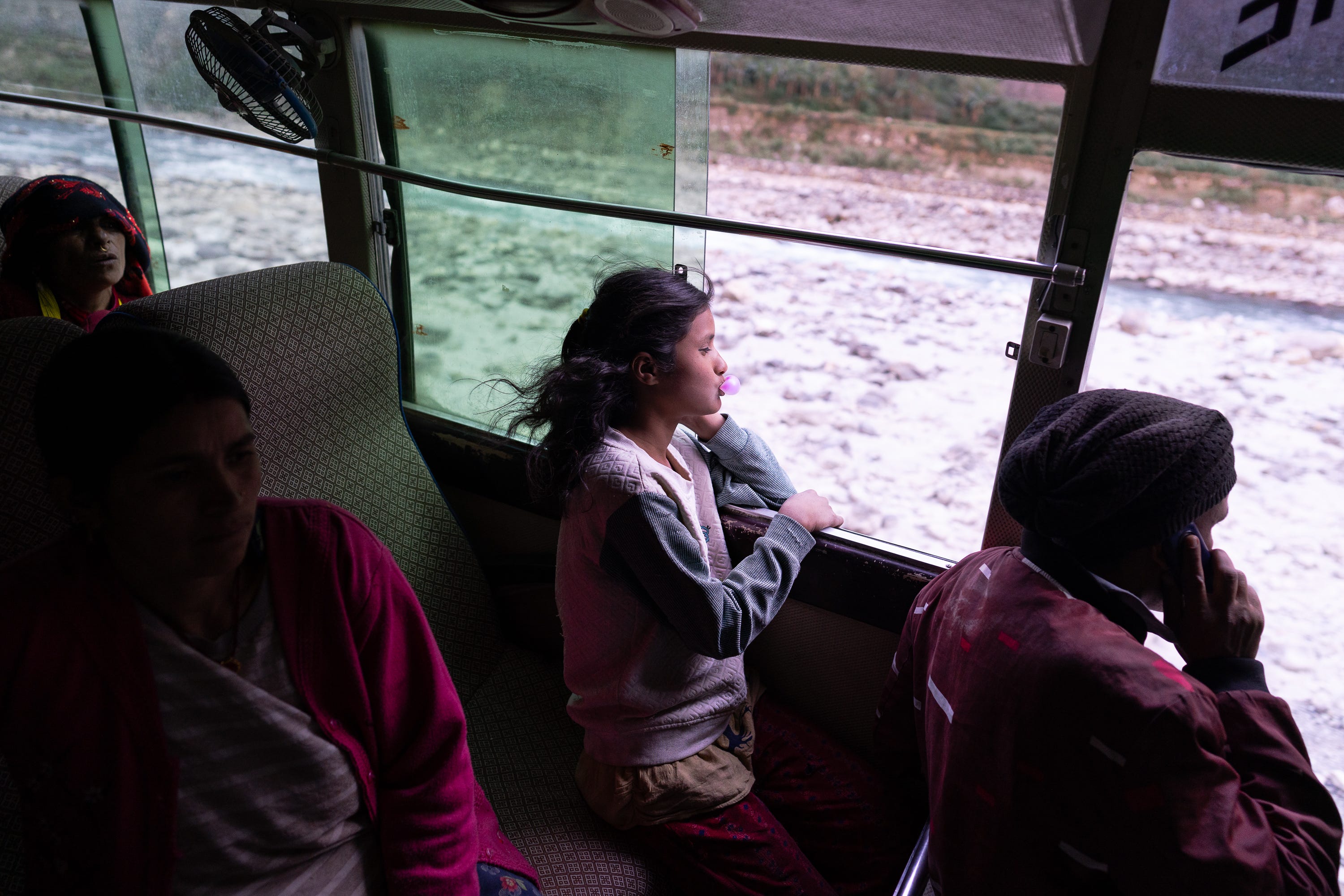
The vehicle is moving almost immediately and the wails left behind quickly fade as the road curves and the crowd disappears and suddenly there is only the sound of the engine. The crunch of tires on dirt. The wind through the open window.
Shanti keeps the window down as they drive, the cold, cracked mountain air drying their cheeks, pulling tears from eyes like a magic trick.
And they sit there motionless in the backseat, mute, hollowed out by what has just been pulled from them, by what they have just given. Their faces slack, eyes wide as they replay the goodbyes, what they mean, the choices that have led them here, this emotion they have lived again and again and yet still shakes them with the same harsh hand.
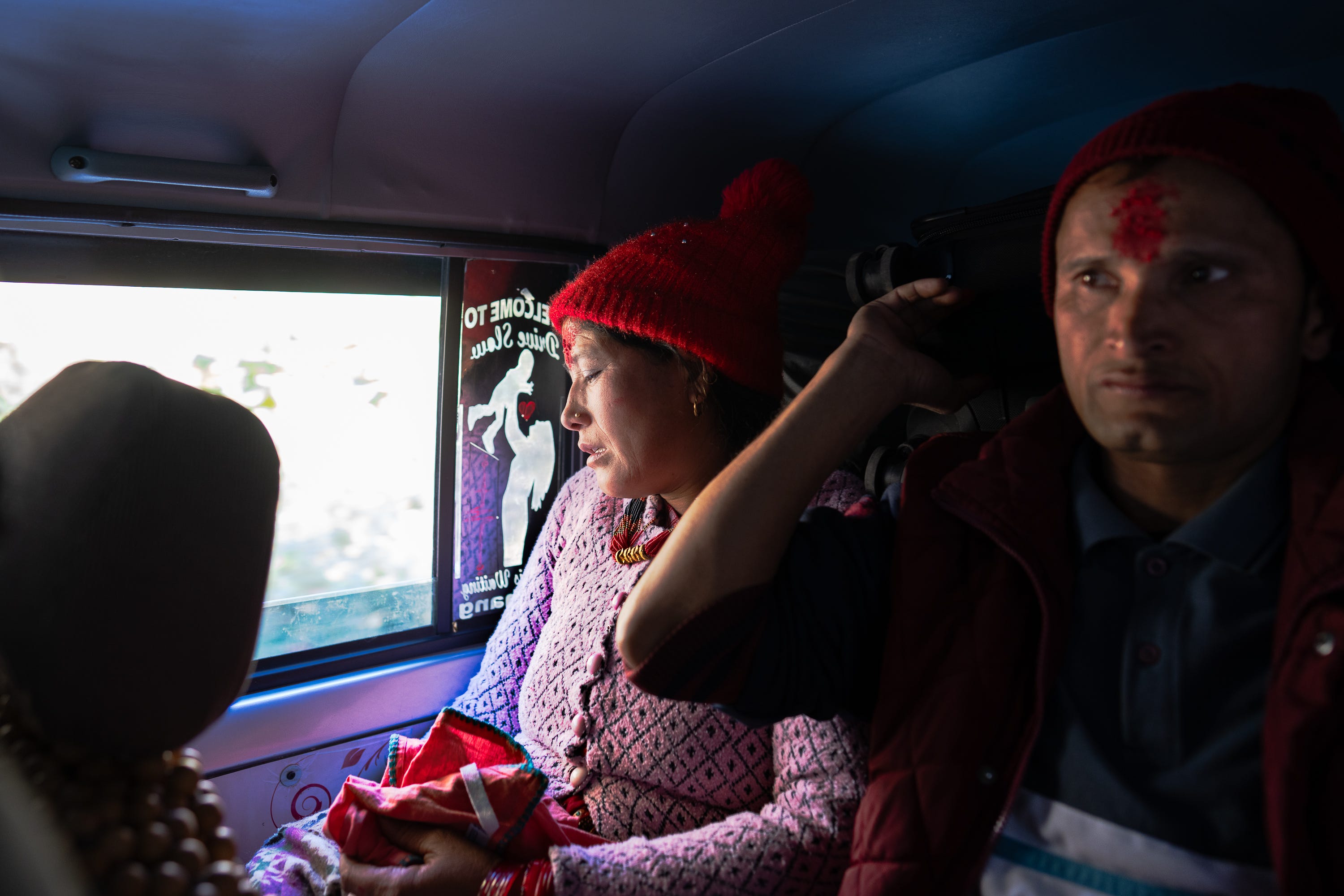
Like millions of other Nepalis, Dipak is headed to neighboring India. Shanti travels to a city on Nepal’s plains where she’ll stay with their sons in boarding school while Dipak continues to Delhi alone, a trip he has done once or twice a year for more than ten years, yet the goodbyes have only gotten harder as his children have grown, his parents have aged, the weight of the life he must forgo has grown.
It is a goodbye the family knows well. Dipak’s father said it every year for twenty years before him as he made his own journey south. It is part of life here in Katri Wada. Of the roughly 52 homes in this tiny village alone, every single one has at least one, often more, working in India. And like them, Dipak will not be gone forever, not even for years, but rather part of a coming and going that has existed long before Nepal and India even existed on maps.
“India was a character in my life growing up,” Dipak tells me one afternoon as we sit together in the yard of his home, the winter sun edging low over the ridge of mountains behind us, “My father worked there, my friend’s parents worked there, my uncles and cousins. Everyone worked there.” He looks out over the valley, the terraced fields that have rotated in their winter crops of wheat and potatoes catching the last of the sun’s warmth before the cold night, “It was just part of life.”
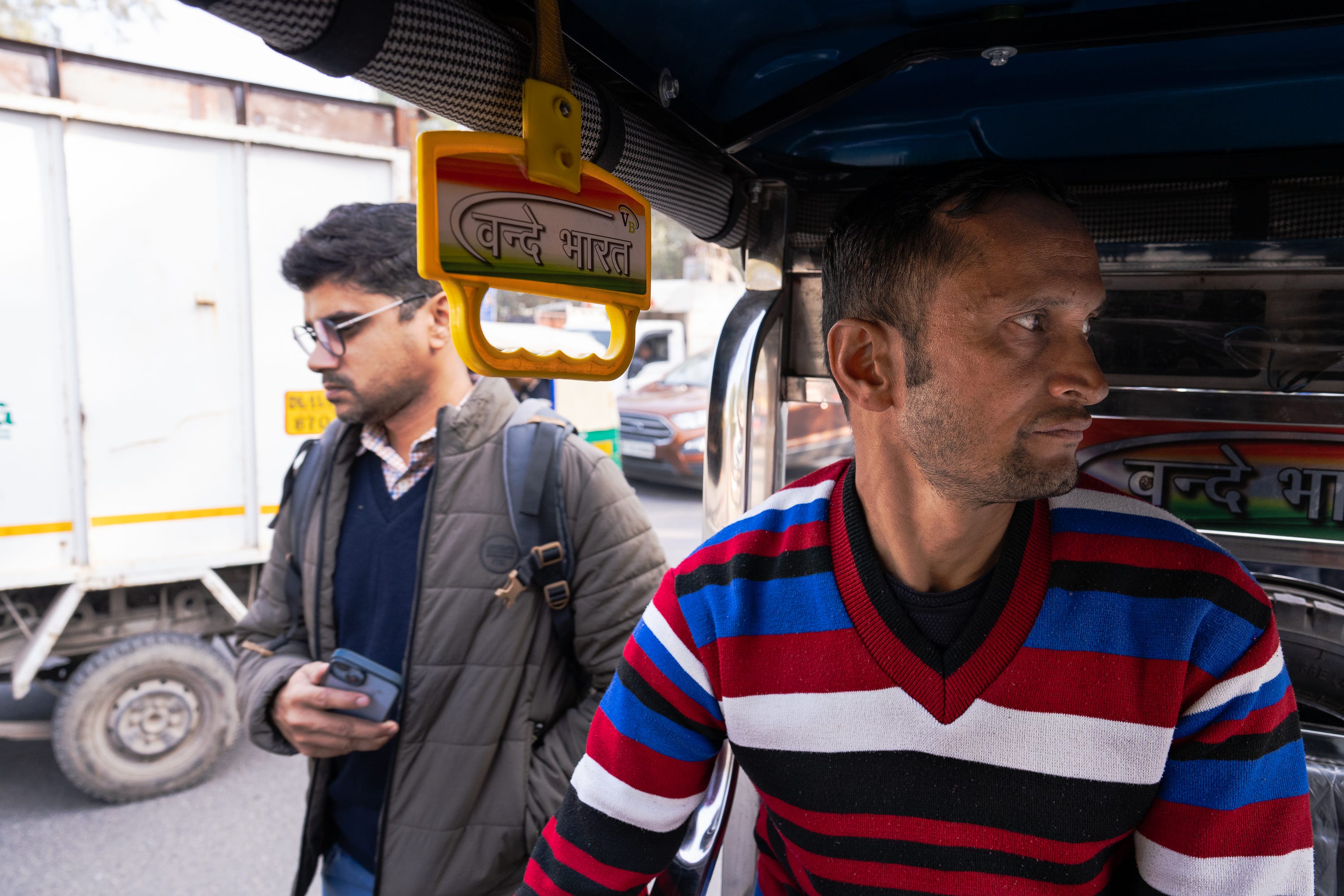
Delhi is closer than Kathmandu here. Closer in access and history and possibility if not kilometers. Basic roads didn’t reach Nepal’s far-west, where Dipak lives, until the 1990s. Paved sections came only in the early 2000s. Before that, reaching the capital could take two weeks of walking, a sheep or two to carry supplies, first south to India, and then east on a bus to the border towns near Kathmandu.
“Even fifteen years ago it would take you three or four days to reach western Nepal from Kathmandu,” Kunda Dixit tells me, the veteran journalist and publisher of Nepali Times leaning back in his seat at the cafe where we’ve met. “And that’s only to the plains. To go up from there into the hills was another two or three days. There were no roads.” He pauses, letting the weight of it settle. “But India was right there.”
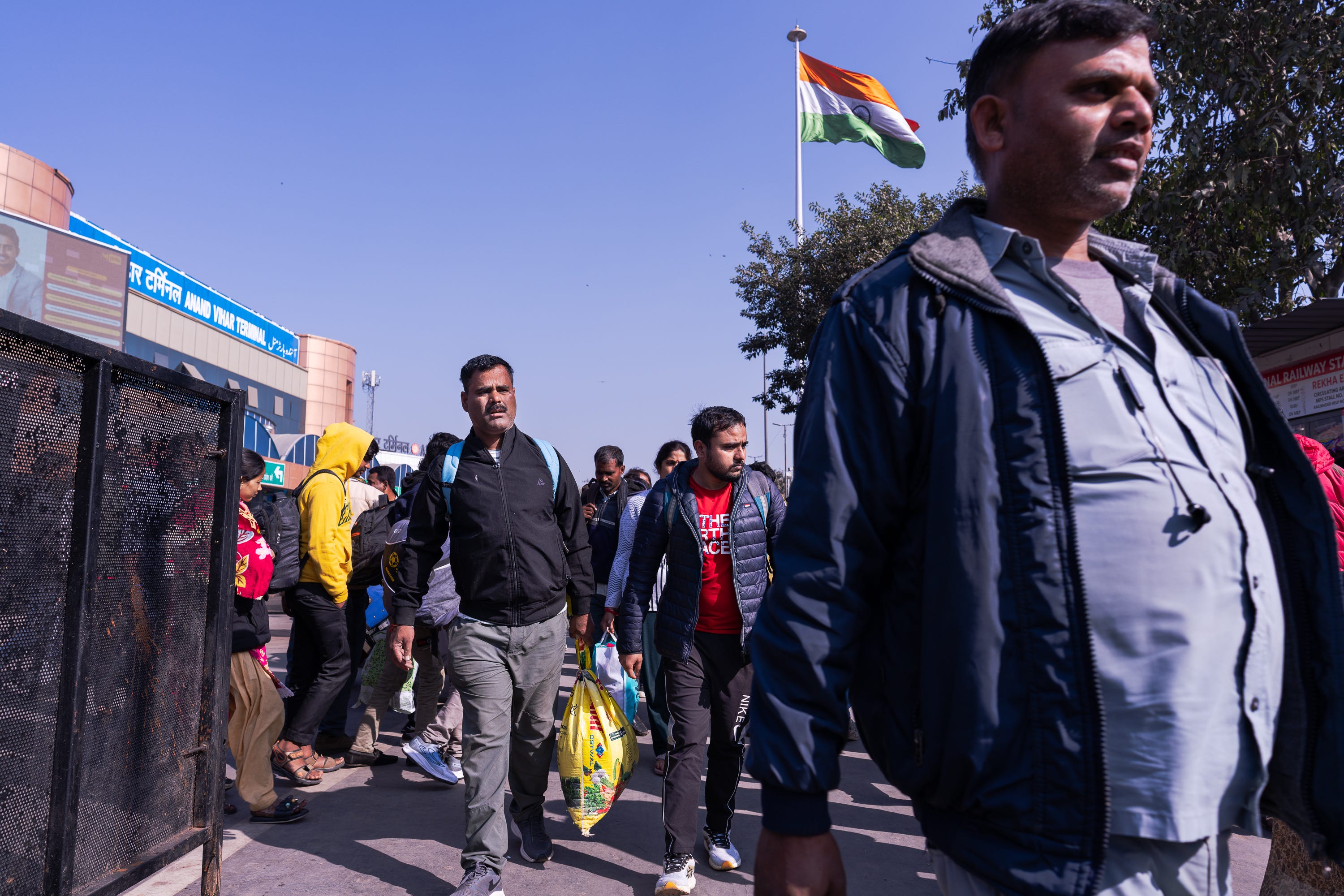
The result is a kind of inverted geography. Jeevan Sharma, an academic who has done fieldwork in western Nepal and followed migrants to Delhi and Mumbai, puts it bluntly, “Nepali migrants are often treated far better in Delhi than in Kathmandu,” he says when we meet in Kathmandu, “The social networks, the kinship ties, the history of who helped whom find work and where to sleep, all of it runs south to Indian cities rather than east to the capital of their own country.”
State services were on a similar timeline with health posts, banks, schools, and electricity all coming late to this far-western region, or not coming at all. Dipak’s home was only connected to the national grid three years ago and internet arrived just last year. Yet work was already waiting across the plains, with India’s fields and factories in need of muscle and sinew, homes looking for security guards and cleaners, restaurants hungry for dishwashers, and so people moved south.
Long before there was any line drawn between Nepal and India, the Himalayan foothills and the Gangetic plains of this region formed a single world, and people traveled back and forth to work the land, graze their animals, trade, marry, fight, worship, with the movement following seasons and opportunities, the mountains funneling people into the plains when they needed wages, and pulling them back up when the work was done or the harvests called.
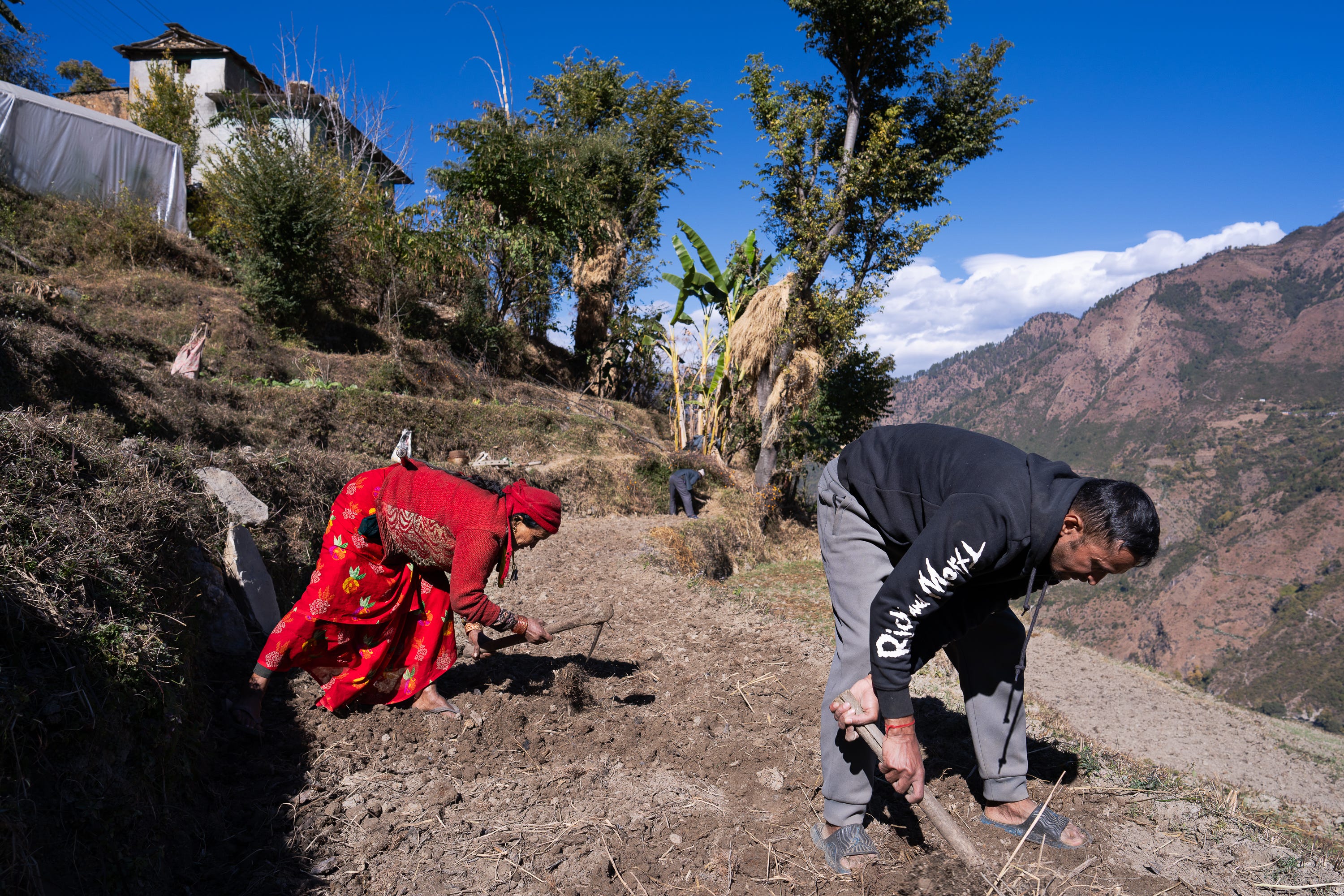
When Nepal’s border with British India was formalized in the nineteenth century, this movement was given a name. The Treaty of Sugauli, signed in 1816 following the Anglo-Nepalese War, gave the world-eating British East India Company carte blanche to recruit Nepalis into the British military and young men who had crossed to the plains for seasonal work now crossed to serve in the Gurkha regiments, their bodies fed into the machinery of empire, their reputation for loyalty and grit becoming a commodity, another thing to be traded.
And then in 1950, three years after India won its own independence, the two signed the Treaty of Peace and Friendship, a document that solidified what had always been, and what makes the Nepali-Indian border so unusual in a world that has spent the last half century hardening its lines, fortifying its borders. There are no visas or permits or papers here. There is no smuggling, no coyotes, no bodies in the sea. Just a border that has stayed porous with citizens of either country able to cross on a whim, to live and work and own property, to move as their ancestors had, following seasons and work and adjusting to the demands of lives that stayed firmly rooted back home.
Dipak’s family comes from the far-western province of Sudurpashchim, a province that has always been the heartland of the India route. Official estimates for the number of Nepalis working in India hover around one and a half million, but those who study this flow dismiss that as a massive undercount, instead placing estimates upwards of three million.
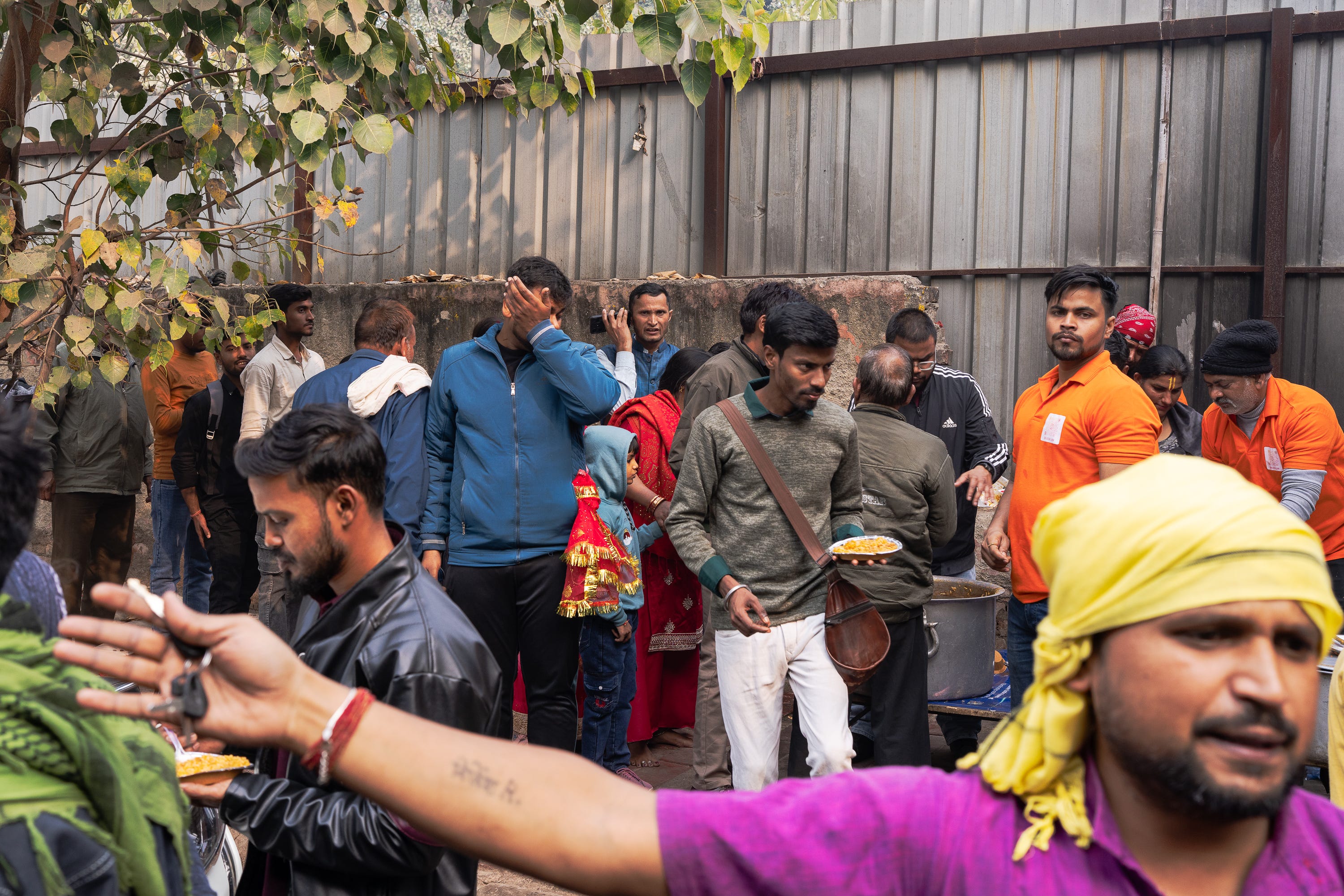
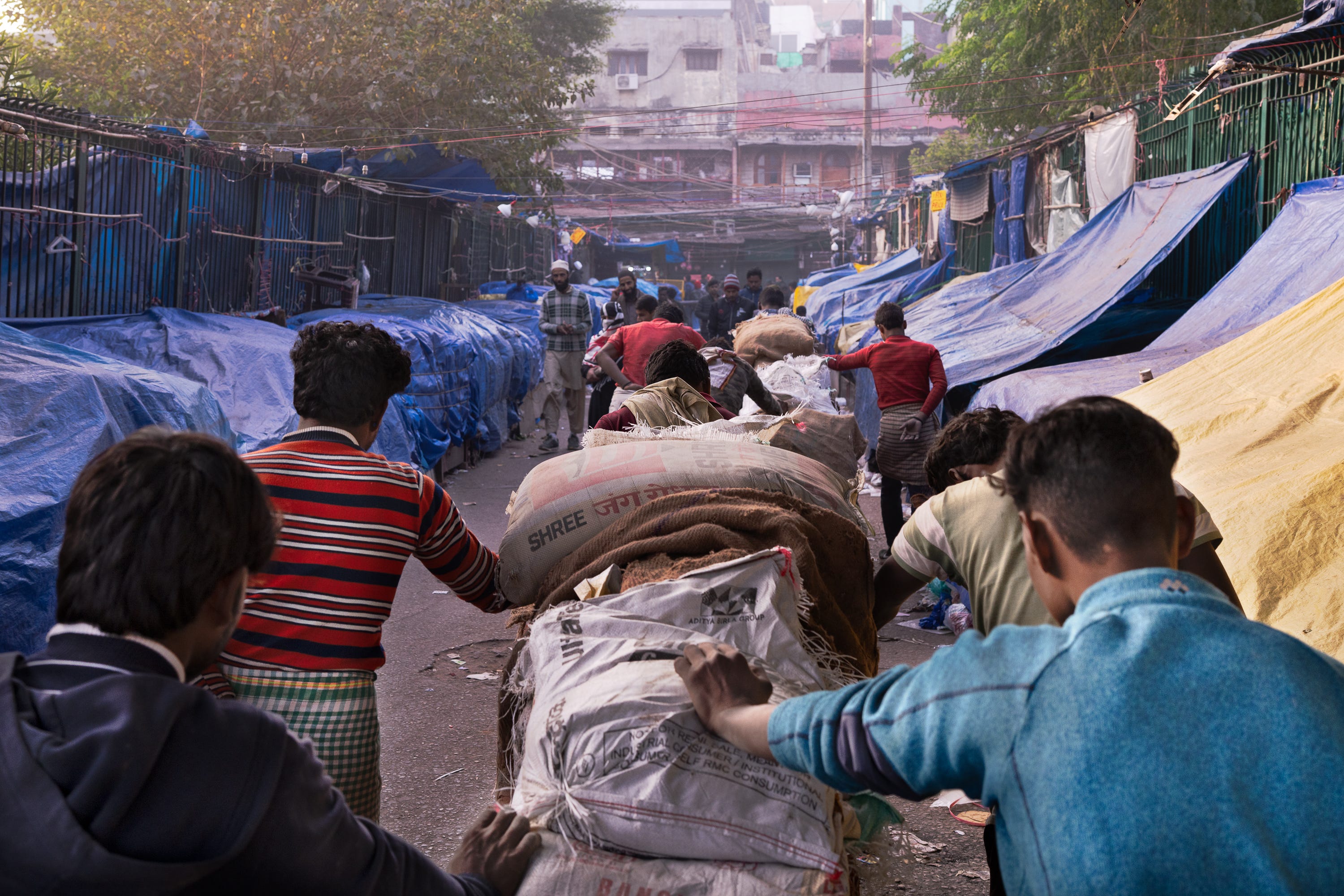
It’s a flow that’s served both sides. India’s cities have swollen, its middle class has thickened and climbed, and as young Indians have moved into the call centers and IT parks, into the work their parents could only imagine, they’ve left behind the work that made the climbing possible and yet someone still has to cook and clean and mop the floors, to guard the gate and wash the car, and Nepalis often fill that role.
“They’re hardworking and honest,” Josy, Dipak’s boss, tells me, “Moldable. According to their situation, they will mold.” He pauses, “They don’t mind doing hard work. They only need respect. An Indian guy won’t be as happy to wake up at five in the morning.”
He describes Dipak as family. “He was very raw when he first came,” he says, “But he learned how to be presentable, how to fit in. He’s a fast learner.”
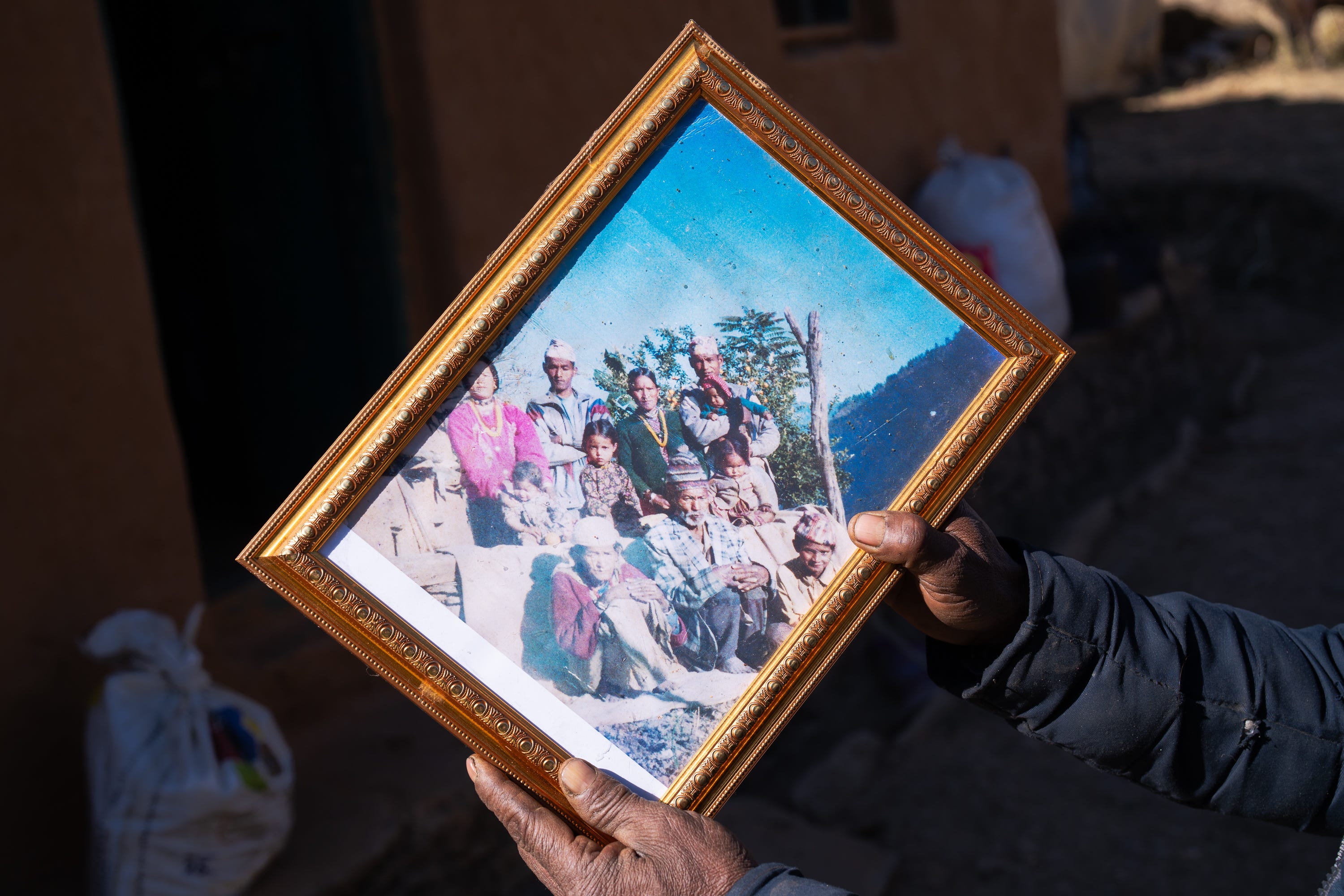
Dipak’s father, Amaraz, sits on the corner of his bed, back straight and jaw set square in the dim light of the room. His voice is careful when he speaks about his son.
“He was a good student,” he says, and pauses, chewing on the words he thinks to say next, “If I had been here, I’m sure he would have a different life. Different opportunities.” He crosses his legs, shifts forward and looks down at his hands, the same hands that packed his bags every year for twenty years, that carried the weight of twelve people under one roof. “But I couldn’t stay. I didn’t have a choice, and my lack of choice forced a lack of choice on him.”
For there is a particular kind of inheritance that passes between fathers and sons in places like this. Less tangible than land or name, harder to see than the slope of a nose, the delicate fingers of a hand.
Amaraz could have stayed. The family would have eaten on most days, but on others there would have been less. Twelve mouths and fields that weren’t large enough meant staying was subsisting, just holding the line, and he wanted more and had just enough to get after it. Land as capital, connections to work in Delhi, and enough float to pay for the journey and stay above water until the first wages came. And so he left, year after year headed south to India, and in that absence his family adjusted and reconfigured and learned to survive without him in the same way they came to depend on what his absence gave.
The family needed hands more than it needed students, and so Dipak became hands, a body in support of the greater good. He worked the fields, worked construction, worked whatever jobs needed doing while his father was away. School slipped and with it his future narrowed with each semester that passed.
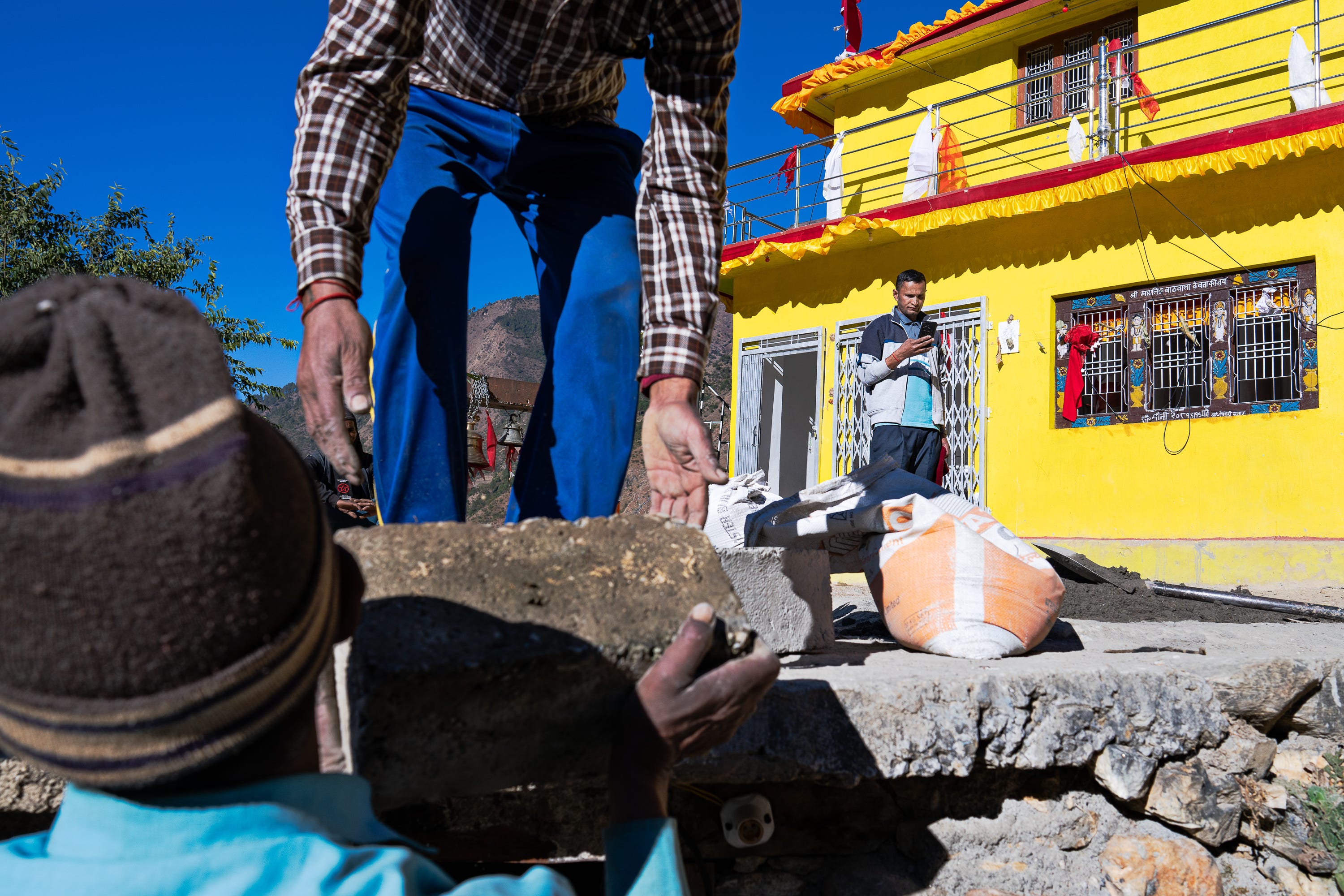
Years later, when Dipak finally went to India himself, it was the same calculations that demanded it. He had a wife, aging parents, three children and the life he wanted had outgrown his fields and the odd jobs laying brick and working wood, and so he stepped into his father’s job. Same company, same work. Making tea, cleaning, packing shipments for the business that had employed his father for years, an export house that checks the quality of textiles and trinkets before they ship. The job gave him a place to sleep, a small room on the second floor that doubled as storage, and a steady income.
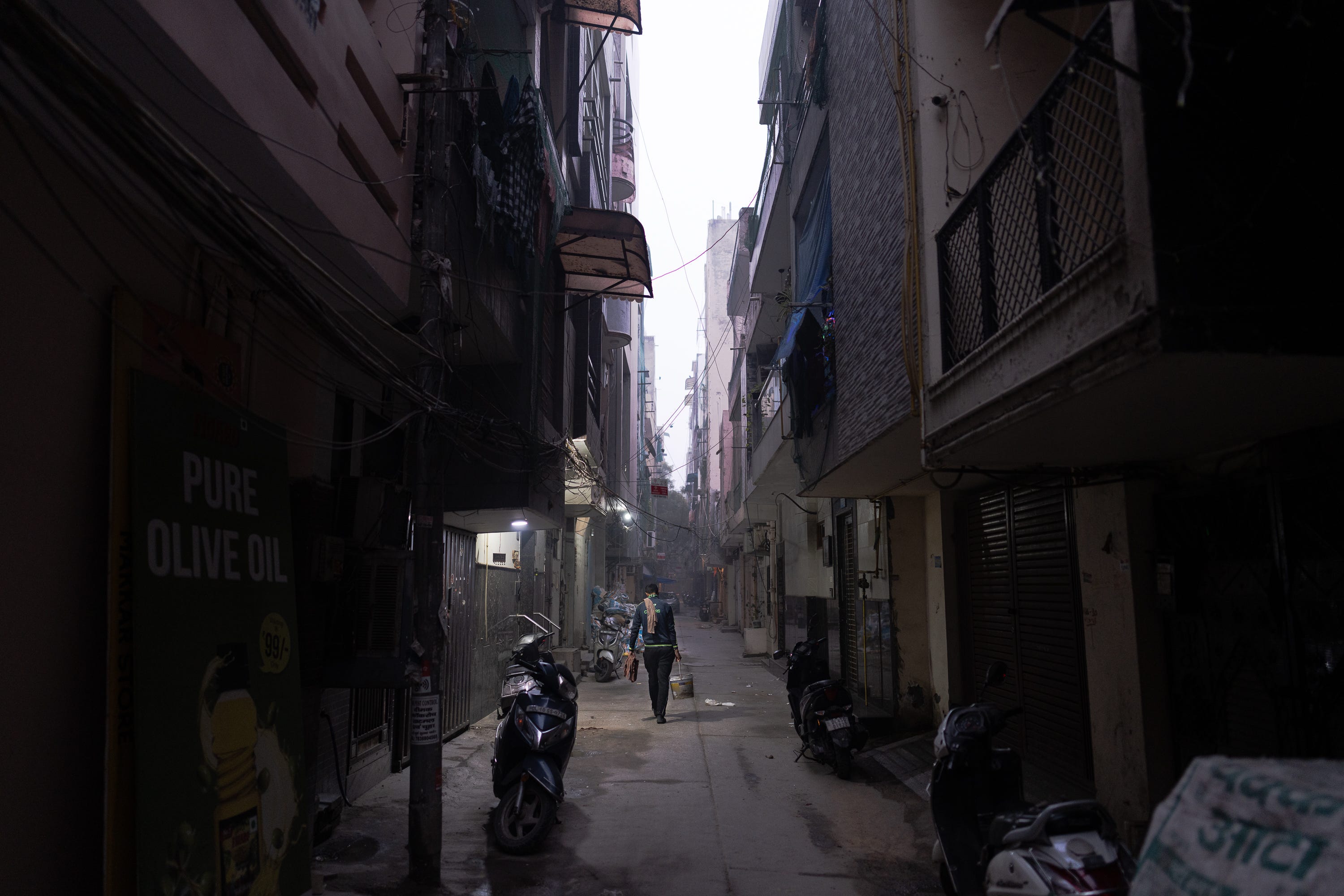
But Dipak wanted more, expected more. He was a father now, leaving as his father did and knew that unless he protected them, his children would feel the same pressures he had, inherit the same constraints. And so he cobbled together a side hustle, waking before dawn six days a week to wash cars in the neighborhood, crouching in the cold morning air with a bucket and rag, fingers stiffening around the cloth as the water prunes and puckers his skin.
He washes twenty-five cars a day, a task that brings in $110 a month on top of his $250 salary and that difference has changed the math of his life, the life of his children.
His father supported twelve. Dipak supports five. And so his children stay in school. His sons attend boarding school and his daughter will soon too. They study in better classrooms, learn English, learn math, learn the things that just might let them choose a life rather than inherit it.
“I’ve already spent more than ten years in India,” Dipak tells me one evening at his home, matter of fact about the rhythm of his days, “I can’t make a big change in my financial status. But I can change the future for my children.”
“I’m happy that at least I can reduce the work they have to do,” he tells me, the firelight throwing shadows across the room. “I can provide for them to be in good schools so they don’t have to go to India. If they do migrate, I want them to be able to go to America or the UK or Australia. They will have education so they can go somewhere better.”
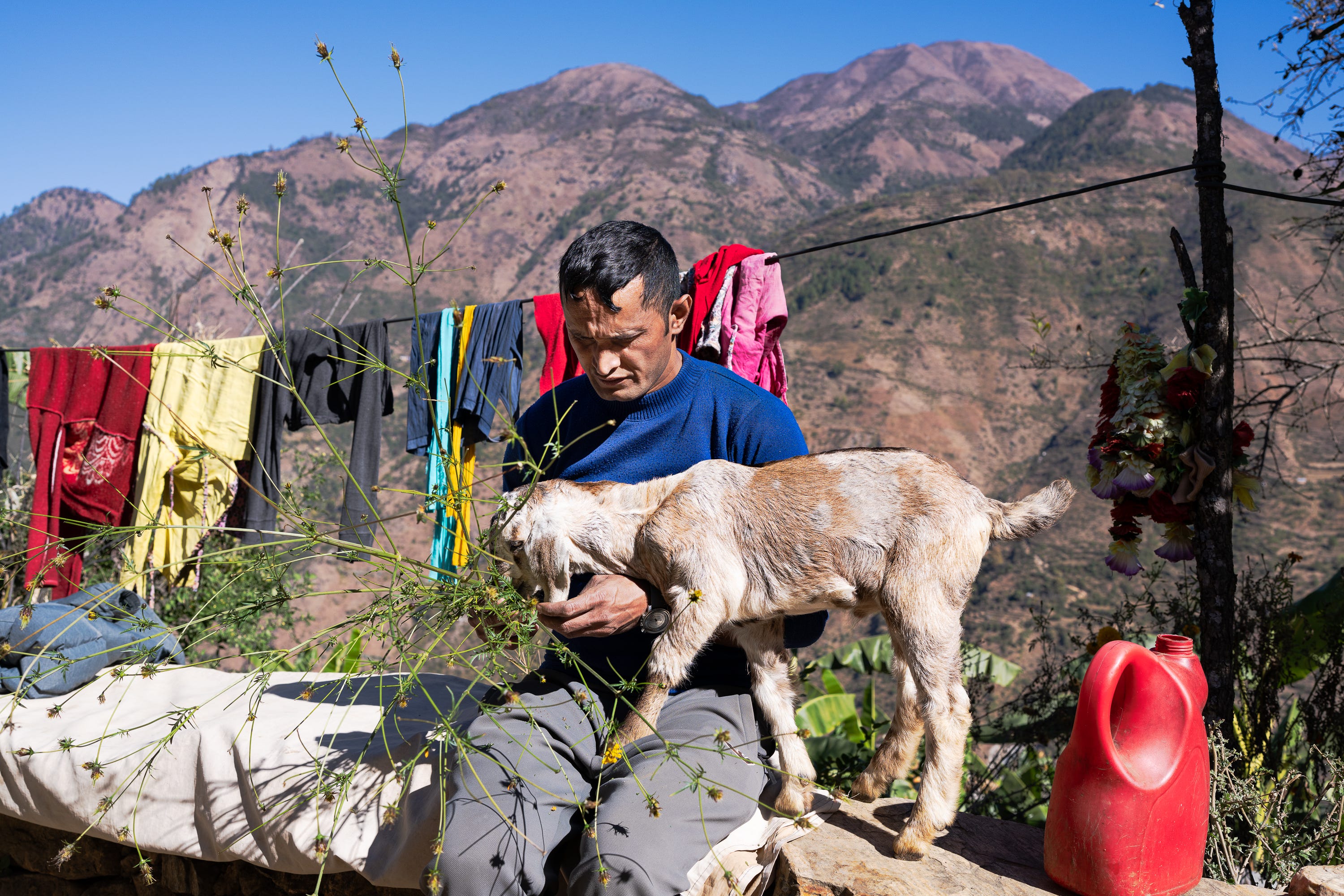
Amaraz grabbed the lowest rung, the one just within reach for a man with a small amount of cash squirreled away, a plot of land and some connections. Dipak has climbed one higher, high enough to keep his children in school, to imagine them somewhere else entirely. And his children, if things go as he hopes, might reach for rungs far beyond his grasp.
Ganesh Gurung, one of Nepal’s most prominent migration researchers, has spent decades studying these patterns. When we meet in Kathmandu, he describes what he calls the tiers of Nepali migration. “The poorest don’t migrate at all,” he tells me, “They can’t afford to. Then you have those who go to India, the most accessible, the cheapest. Then Malaysia, the Gulf. Then Korea, Japan. Then the West.” He says, ticking them off on his fingers one by one, “As families accumulate resources, as education improves, they move up and the destination changes. The migration doesn’t stop.”
It’s a pattern that cuts against what we often assume for there is a common belief, repeated in policy circles and editorial pages and the frantic, looping conversations of people who have never decided to stake out on their own, that the solution to migration is simply development. That if we just build roads, expand schools, grow economies, then people will stay where they are. This statement is one that sounds intuitive, maybe even self-evident, but it is also, in important ways, wrong.
Migration scholar Hein de Haas has looked at this dynamic throughout the world and argues that migration is a function of capabilities and aspirations, not poverty and desperation. Moving takes money and knowledge and networks. It takes enough to imagine something more and believe you can get it. The poorest aren’t afforded those and so they don’t move at all, trapped instead by the very circumstances that give them reason to go. It’s the people with more, sometimes just enough like Amaraz, who pack their bags and steal their hearts and say goodbye.
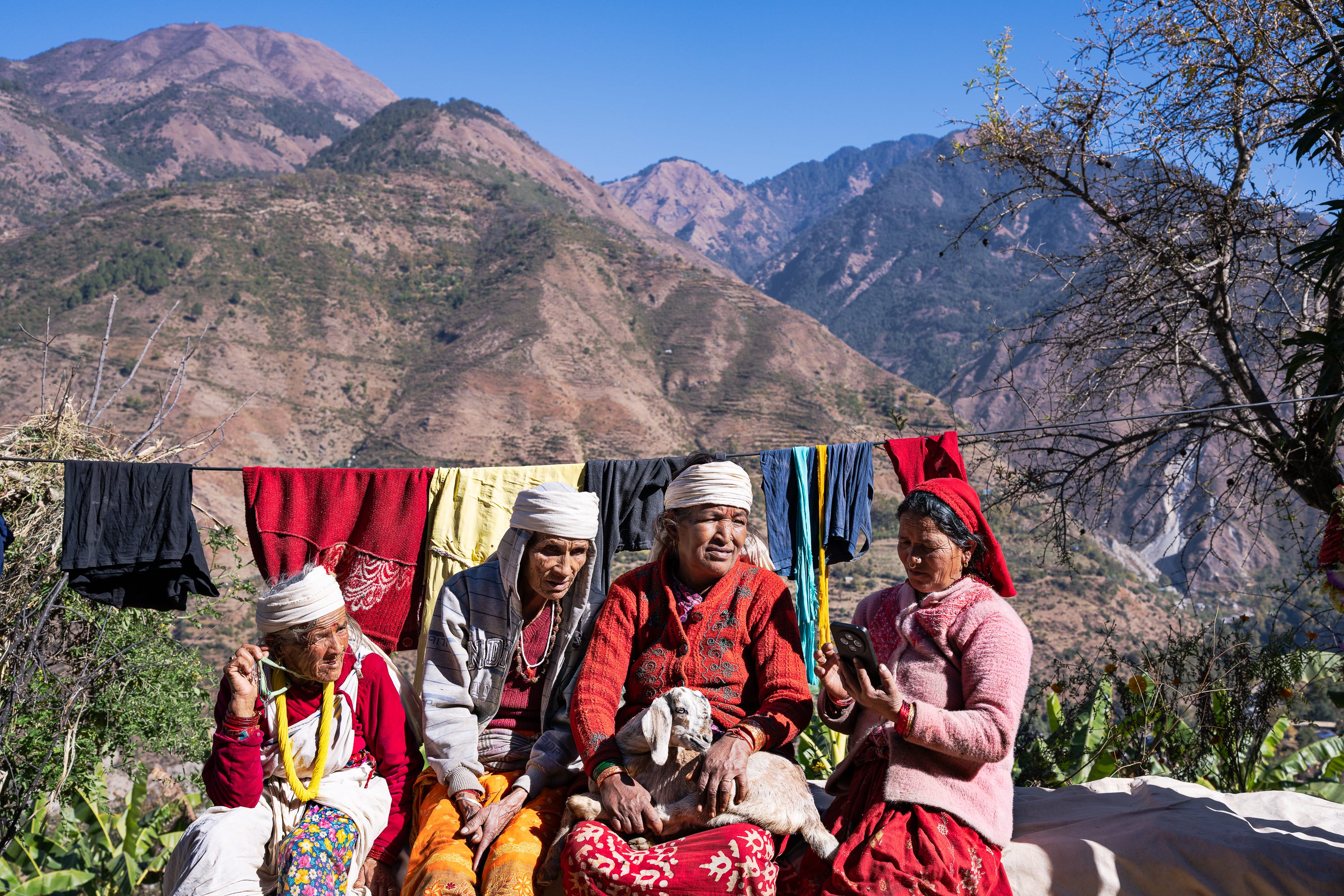
Because development works on people just as it does infrastructure, and because people don’t leave home simply because they have to. People leave because they want more, they want better, and as roads are built and health metrics improve, as literacy increases and internet arrives people begin to see possibilities they couldn’t before just as they gain the means to pursue them. Education and technology open windows onto the world and roads make that world reachable and money in the pocket makes those journeys possible. And as long as aspirations rise faster than local opportunities can match them, people will leave.
Dipak sits squarely in that middle. More than his father had. Less than his children might. And the migration that his family’s slow accumulation has produced, the migration that development makes possible, is happening, and is going to happen.
And when I ask Dipak how long he’ll be gone this time, he answers simply. “Until I’m needed at home.”
He says it like it’s obvious and in many ways it is. “I can come back when I need to,” he says. “It costs money so I need to take that into consideration, but I’m able to go home when I need to.”
Over the years he has returned for harvests, for festivals, to plant the year’s rice and potatoes and wheat. He came back when his mother was diagnosed with cervical cancer, traveling through the night to reach her, to sit with her, to help arrange the treatment that would eventually take them to a hospital in India. He has come home to celebrate weddings and graduations, to welcome new life and to bury old.
That flexibility is far from the norm. Nepalis who go to the Gulf for example leave on contracts that bind them for years. Their passports are often held by employers, their freedom to leave or change jobs or simply walk away nonexistent. Two years is often the minimum before they can return home, but many stay for five, six, seven years or more before even visiting.
“I’m thankful for the opportunity,” Dipak tells me of the freedom, “I can go easily and find work. I don’t have problems with visas. I can change jobs if I need to and I’m not a slave as my status isn’t tied to my work. I can go anywhere in India right now for work,” He pauses, “I have freedom so I’m grateful for that.”
I ask him what he thinks would happen if things were different. If there were visas, restrictions, papers to file, bureaucratic wheels he needed to grease.
He thinks it through, turning the hypothetical over in his mind. “If it was difficult to cross, then I would probably have to stay in India,” he says. “And my life would look very different. I suspect we would all move there.”
Before 1986, people, often men, routinely crossed the border between Mexico and the U.S. with the same freedom as Dipak. They would go for a season or a few years, earn what they could, and then return home to their families, their land, their lives. They might cross again when circumstances demanded it, when the money got tight, when the costs of their lives required another stint up north. But they returned home. The border was a line on a map, a new language to speak, a new type of food at dinner. And the migration it created was circular, seasonal, temporary by design and desire.
And then in 1986, the Immigration Reform and Control Act launched a new era of enforcement. More agents. More fencing. More money. As de Haas lays out in his book How Migration Really Works, the border became harder to cross, more expensive, more dangerous. But the result wasn’t that people stopped coming but that people stopped going back.
Men who once came north for a season, who had always known they could return when they wanted now stayed put. Crossing had become too risky, too costly, too uncertain to attempt more than absolutely necessary and so they dug in. They sent for wives and children, mothers and fathers, because if they couldn’t go home, home would have to come to them, and so temporary workers became permanent residents and a circular flow of men became a settled population of families and the very policy designed to reduce migration had, instead, transformed it, amplified it, made it permanent.
Between 1986 and 2008, the undocumented population in the United States grew from three million to twelve million. This happened during a fivefold increase in border patrol officers. It happened during a twentyfold increase in funding for its enforcement. It happened despite increased walls and fences and sensors and patrols. It happened as the border became harder to cross, and so while fewer may have crossed even fewer crossed back.
This pattern has repeated across the world with South Asians in Britain in the 1960s, Turkish guest workers in Germany in the 70s, Eastern Europeans after Brexit. De Haas and his colleagues have put numbers to it, finding that while visa requirements cut the inflow of people by about 67 percent they also reduced outflows by 88 percent, so that the barriers meant to keep people out worked better at keeping them in.
This isn’t an argument for open borders as some universal policy for that debate involves questions of labor markets and wages, security and sovereignty, cultural integration and the carrying capacity of public services, questions far beyond the scope of this story or any one story. But it is an argument against the knee jerk assumption that ratcheting down borders will straightforwardly reduce the number of people who come and stay. The Nepali-Indian border, rare as it is, offers a window into what migration can look like when it’s left alone.
It’s precisely because Dipak can return home that he does. It’s precisely because crossing is easy that staying forever becomes ridiculous. People leave home when they need to leave home, when the calculus of their lives demands it and the gap between what they want and what home can offer grows too wide. Borders will not stop that and the proof is clear in the bloated bodies floating face down at sea and the bleached out skeletons littering the Sonora. What the open border does is give them the chance to return. To exit gracefully, meaningfully. To provide for their families without having to sacrifice them.
And in that movement, that flow, something builds. Money, and even more so, capability.
Dipak’s family is among the more than half of Nepali households that receive money from abroad. Part of a stream so large it now accounts for more than a quarter of Nepal’s entire economy. Throughout the world, 2024 saw migrants like Dipak send home almost $700 billion to developing countries. It’s a staggering amount, more than three times what the world’s governments spend on foreign aid.
Yet unlike aid, which moves through glacial bureaucracies and private sector middlemen, which needs to pay salaries and float bottom lines and satisfy the shifting priorities of fair-weather, politically skittish donors, remittances arrive directly into the hands of those who need them most. No forms to fill out. No consultants to pay. No conferences in Geneva to attend. Just cold hard cash in the hands of the people who know exactly what to do with it.
The research bears this out. Nepali families spend remittances on food and healthcare and schooling, not booze or cigarettes or ceremonies. They spend it on futures. On the incremental, unsexy work of climbing up, one generation at a time.
Dipak knows that. He doesn’t need some study to tell him what his money does, why it’s useful. Each month he sends cash home by electronic transfer and sees the pay off in the books stacked on his daughter’s desk, the growing total of his local savings group, and the bright-eyed look of his sons as they talk about the tech used by the self-driving cars they’ve seen on TikTok.
“My father didn’t have a choice,” Dipak says, “He gave me more choice than he had. And I want to give my children more choice than I had.” And so he wakes each morning in Delhi to pay for it.
Just after 5 he opens his eyes to a room stacked high with a small army of items destined for European and American homes. Pastel vases bought to perk up the corner of some Airbnb in Amsterdam, a blue tasseled pillow snagged on a whim after too many glasses of wine because the price was a steal and could give that little je ne sais quoi to the living room.
Dipak dresses quickly, bundling up with a winter hat, a warm jumper and thick socks, knocks back a small glass of water, grabs his bucket and rag and heads downstairs.
He begins with cars and motorcycles right on his street, working top to bottom, throwing water over roofs and handlebars, lifting windshield wipers, and moves steadily down until he’s at the tires, crouching in the cold as he threads his rag through spokes and along rims.
His fingers go numb in these winter months and so he beats them against his jacket occasionally as the sun begins to rise, a pale smudge behind the polluted haze like a stale jalebi wrapped in wax paper.
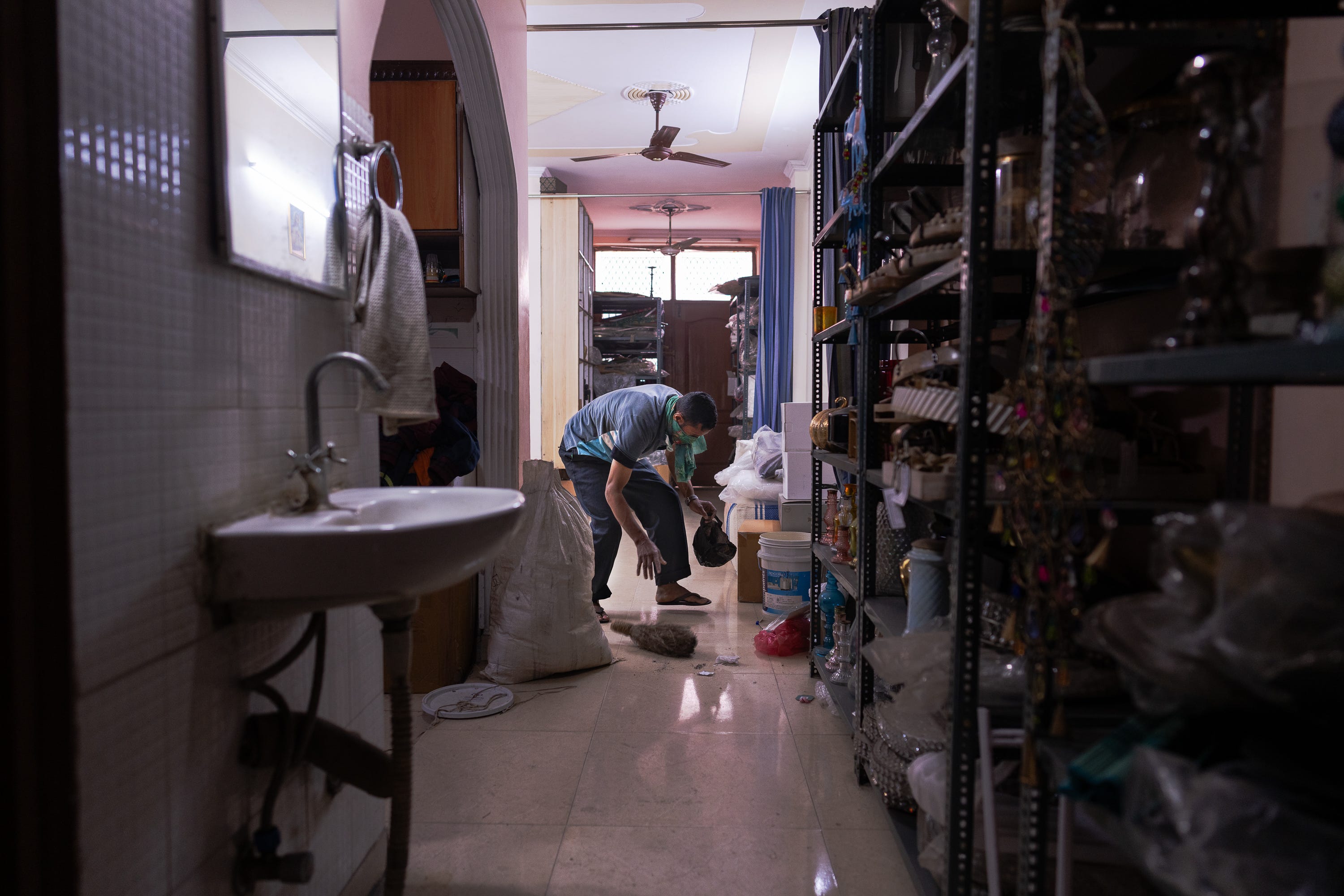
By 9 he is back at the office, cleaning up and getting ready for the day and by ten he is downstairs, wiping down computers and whacking dust off chairs that have somehow accumulated a new layer after just one night.
From ten to six he cleans and makes tea, helps pack shipments and greet clients, whatever is needed.
On most days, after finishing his morning circuit washing cars, he doesn’t leave the building, and his life cinches up like drawstrings around a sack of rice, tightening down to a daily set of tasks and rhythms and rooms. On Sundays, his one free day, he walks to the nearby park and sits in the sun, if there is any, and remembers the sky above him. In the afternoon he occasionally meets with other Nepalis as part of a local organization for diaspora. He’s the secretary of the branch and proud. Afterwards he goes with friends for beers and dal bhat at a nearby Nepali restaurant, sitting on the rooftop to take in the air, pretending that it’s clear, that they can see the stars, that the city’s smog isn’t actually poisoning their lungs.
“I don’t feel any hardship because it’s my job,” Dipak says, one evening back in his room, leaning back against the wall, “and it’s my job to feed my family and give my kids a good education, but the transition is difficult.”
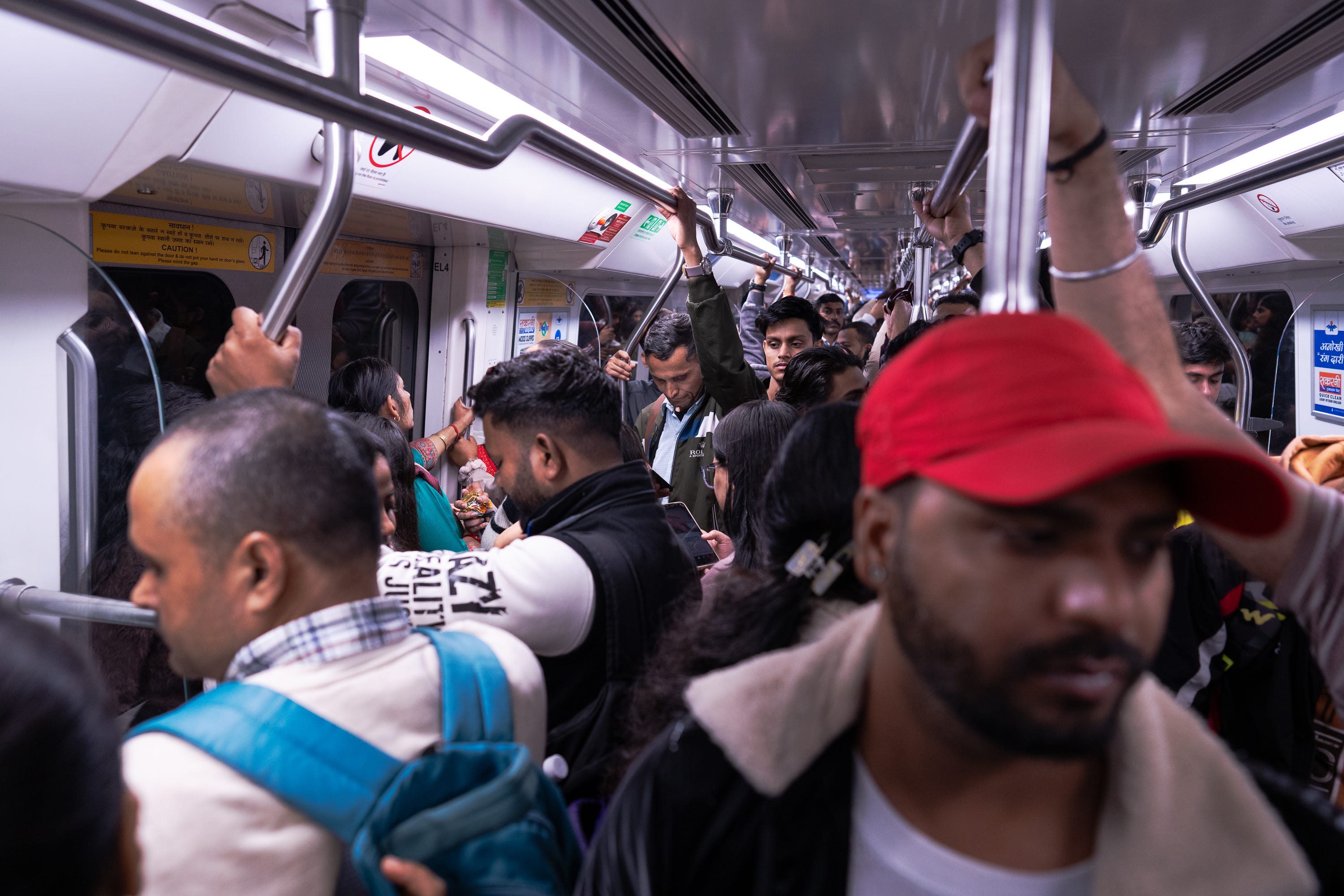
“Life in Delhi is very big,” he continues, the inventory stacked around him, “The noise and city and everything is just very big. But my life here is narrow and sometimes I find it suffocating. I miss my children. I want to cook for them, to hold them in my lap. But in order to care for them I need to be here.”
This dilemma is not unique to migrants, but migration strips away the illusion that one can have it all. Dipak can’t pretend. The distance makes the cost visible. He must sacrifice time at home in order to keep it and so his life is shaped by outcomes that make sense accumulated over years and decades. By the fact that his mother is still alive, her cancer in retreat. By the fact that his children stay in school, that they have time to play and be kids without worrying whether the work they do that day will put food in their growing bellies. By the fact that they will have more choice than he had. That things will be better. And in these results, paid through cups of tea prepared and windshields washed, life is made meaningful even though it’s never fully inhabited. And in this there is a process of letting go, a thing all of us learn at some stage or another, for we cannot do it all or hold onto anything or anyone and that is life and so Dipak lets go of the sickly Aunt he’s unlikely to see after this trip, lets go of the soft melody Shanti hums as she cooks roti on the fire, lets go of watching his daughter captain the volleyball team or listening to her radio play softly at night as she does homework in her room. He lets go of being able to see the look on his son’s face when he first meets the girl that bowls him over, thunderstruck by that glorious, thumping ache he feels in his guts.
He lets go of it because he has to, because he can’t choose it all, because it’s all so precious, life inhaled in delicious, greedy gulps on trips back home.


On the Saturday after we arrive in Delhi, Dipak and I go out to lunch at a nearby place called The BBQ Industry. The restaurant is packed and loud, full of Indian families and parties and groups of middle-aged women out for lunch. A row of tables a few rows behind us is celebrating a man’s 40th birthday and emerald green balloons in the shape of a “4” and “0” bob above the gathering as kids chase each other between tables laced with golden bunting.
Our waiter comes to take our order and Dipak’s face shifts as the two begin to talk. The waiter is Nepali, from a village less than an hour away from Dipak’s, and the two instantly soften as they speak the names of the families and valleys that made them.
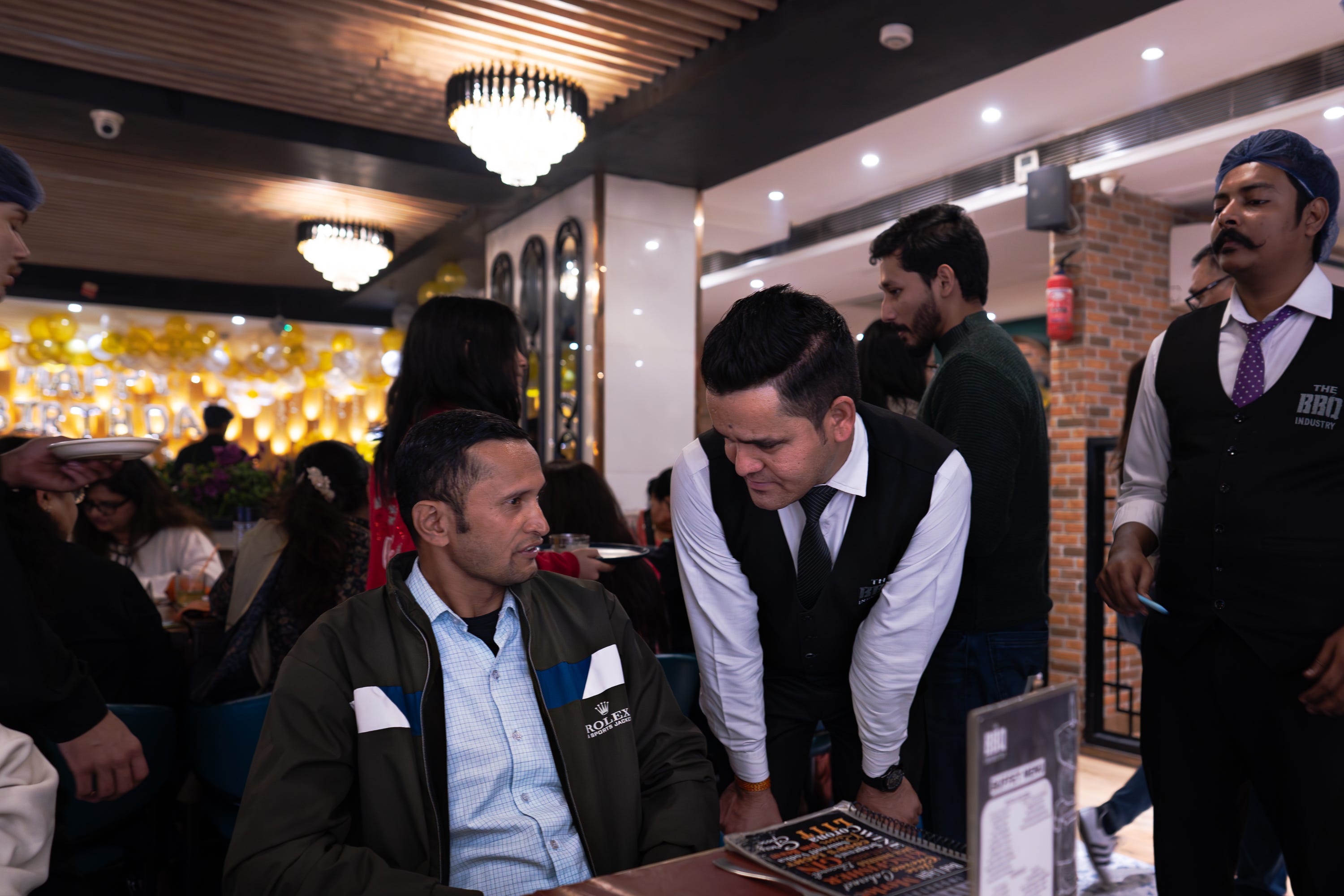
Dipak makes the order and soon young men descend onto our table carrying plates of glossy red chicken wings and grilled gems of pineapple, others loaded high with something called “Mexican Salsa Potatoes”, mint chutneys and a sickly sweet barbeque sauce.
We eat and talk, nearly yelling in order to hear each other over the din, as two young boys race their toy cars around the restaurant, revving and grumbling like little engines.
Dipak’s phone lights up and “Shanti Katri ❤️❤️” appears on the screen.
He picks it up, leaning back in his chair as if to distance himself from the food or the noise, and then stands, his eyes searching for any quiet space amid the roar. The call is a video call but he quickly raises the microphone to his ear as he walks towards the back of the restaurant. Within a few minutes he sits back at the table, phone in hand, and turns the screen toward me. Shanti fills the screen, grainy and dim, wearing a deep red sweater. She is lying on a bed and moves the screen so I can see one of their sons, the two of them in his small dorm room back in Dhangadhi. I wave and they wave back, small and pixelated, and soon Dipak turns the phone back around, speaking for a minute more before finally saying goodbye.
He sets the phone back on the table, his hand still resting on the dark screen when the birthday group nearby erupts in cheers and so we turn to the noise as a line of waiters emerge from the kitchen, the man in front carrying a cake, candles and sparklers dancing excitedly on top as they begin to sing, and soon other tables have joined in until the whole restaurant is singing and clapping as the cake reaches the man at the center of it all, his family circled up around him, phones out filming, and he leans forward in his chair, his face level now to the little flames and smiles and takes a big breath in and blows them out, the room erupting in applause.
And Dipak watches as a waiter cuts the cake, the family pressed together now for a few photos as the restaurant settles back into its high-geared hum, and then he turns back to his plate, the Mexican Salsa Potatoes growing cold, and we sit there amid the noise and the families and the bobbing green balloons, the gold bunting and screeching kids, as a waiter pulls up to our table and sets another plate of chicken wings down in front of him.
This story would not have been possible without the tireless work and support from journalists Basant Pratap Singh and Deepak Adhikari. My sincere thanks to both of them.
Mackenzie, thanks for sharing this story. It warmed my heart to see your photos and hear your voice telling this story. How special that you were trusted enough to be a part of this family. Thanks for doing the amazing work that you do as a kind and compassionate photo journalist. Much love to you, Laurie