



I’d seen goodbyes before, traveled with people as they left home, and there’s always a gap between them and me, my life and theirs. And while the distance may vary, there’s safety in that gap, that space where “Objectivity” lives. Remain unaffected, a neutral party, and you don’t change the space. You don’t give it anything and you don’t take anything in kind.
Standing at the threshold of Dipak and Shanti’s room, watching the family hold each other as they said goodbye, witnessing them fall apart before they built themselves back up, I was taken aback by the rawness, the vulnerability, the power of it all and how quickly that distance between me and them began to close.
I don’t believe in spirit or energy or the supernatural, and yet I can’t get past my own understanding that there’s something intangible that we pass between each other. You can feel it on a bad date or a good one, that difference between a connecting conversation and a tiring one, the difference between your people and others that you like but just can’t click with. There’s that thing, that little something that we read and pass back and forth through the thousand little facial muscles that tick and twitch and paint a roadmap to our interior lives. But there’s something even more than that, something in the way the air becomes light at a kids birthday party, the helium of laughter lifting everyone, the way someone’s voice, calm and steady can ground you, remind you to breathe when your body and mind are spinning out, the way your stomach tumbles when you hear a friend get hit by sadness on the phone, that extra swallow they have to take as the grief crawls up their throat. There’s no hiding that stuff, and when we see that pain we feel for them, we want to comfort them, and in that pain we also see our own, we see our lives, and it can strike a chord, deep inside and with a resonance that can shake us from the inside out.
And standing there on the threshold of Dipak’s room, I could touch the sadness in the air, I could breathe it in, and very quickly without even thinking I was crying too. And maybe it was fatigue. The many miles I’d already gone to get there stacked up into a teetering tower and so I was more swayed toward melancholy, my defenses down.
Into Kathmandu for interviews and then west on a small prop plane, banking out of the smoggy bowl of the city, the hulking backs of the Himalayas looming to the north, all weight and quiet violence. Then down to Dhangadhi, city on the plains, flat with dust, the winter cold folding a ceiling over the wheat colored sky, then into a 4x4 and eleven hours north into the mountains, the roads narrowing as we climbed, the pavement snaking up switchbacks, tarmac hollowing out to craters within craters, and onwards up the bowl of the final valley to Dipak’s village, asphalt giving way to dirt, dirt to washboard tracks and rockslides and stretches where road seemed like just a suggestion.
Or maybe it was my own sadness from missing my own family. Just a few days earlier I’d been camping with them, with our friends and their kids, celebrating my son’s third birthday, chasing him and his friends around in the grass, shrieking with laughter, as I pretended to be a lion chasing little antelopes, this ridiculous band of chaotic little dervishes, all cackles and pizza crust, sitting around a campfire, waking with the sun, parents already delirious from lack of sleep, wondering why the hell we decided to sleep in tents with our kids, until we see the looks on their faces as they soaked in this uninterrupted time with their friends, their family.
And we got back from that weekend and the next day I was off, into boarding gates and more off kilter sleep, constant movement without much movement, time alone in a seat.
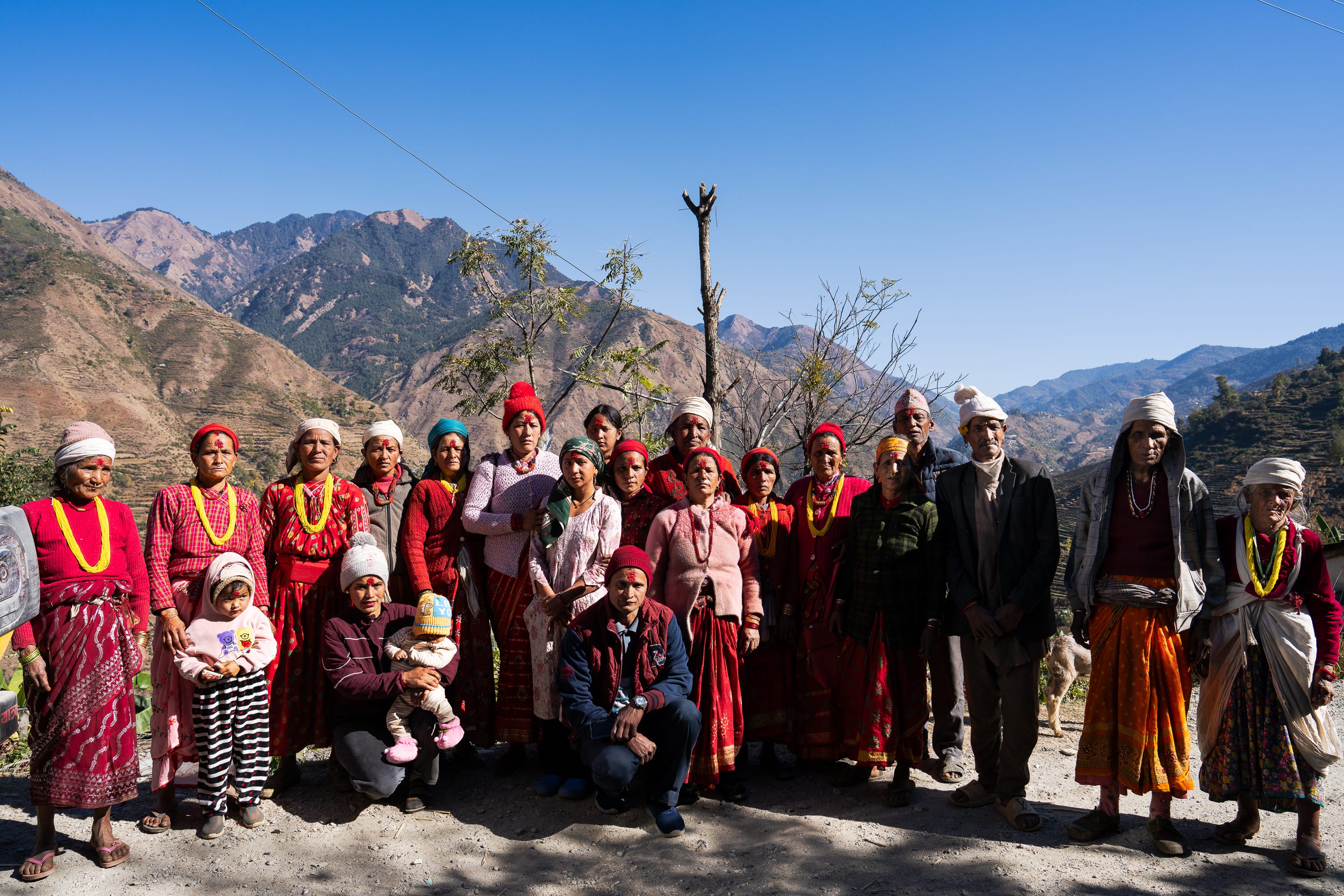
Arriving into Dipak’s village I found myself switching gears again, the movement and tempo of the previous days slowing down into another life at another home. Into a rhythm dictated by the hours of the sun and the warmth of the fireplace, the movements of family and working the land.
And as I watched Dipak I could see a man soaking in this rhythm, drinking from it like a thirsty man at a fountain. I could see it in the way he smelled the lemons as he tenderly plucked them from their tree, in the way he carried the family’s kid goat into his lap to feed it like a baby, the way he bought his daughter and wife stir-fried noodles from the shop at the bottom of the valley, carrying this favorite treat of theirs back up the steep switchbacks in a black plastic bag, steam rising through the opening as the noodles slipped and tangled inside. I could see it in the way he sat in the morning sun, its warmth peeling back the night’s cold as he shed layer after layer of clothes, the way he walked through the village, stopping to catch up with relatives and enjoy the quiet moments when nothing was said, just three people standing together in a field looking at the mountains. He was a man preparing to say goodbye.
And in watching him I thought of my own life, projected out in front of me. The ways it has grown and changed and complicated and simplified. And I saw my own small goodbyes. The goodbyes I have said to the family that raised me, to my father and sister and the life we would have lived together had I stayed close by. And I see what I have gained and given up in that doing, the ways my children have let me feel and understand the weight of each more fully, and in this new life, the life of my new young family, the goodbyes are very much their own, and grip me in their own way. The goodbye I said to my son before leaving on this trip, his eyes heavy and easy as I put him down for his nap, aware that I would be headed to the airport before he woke, the ways he understands what “baba’s traveling” means even though he doesn’t understand what it is, the goodbyes I’ve said to these two weeks of life at home, a two weeks I’ll never get.
I don’t know why I was surprised by how potent it was for Dipak to say goodbye. Why I foolishly thought that it would weaken simply because his journey had become routine, the words uttered so often. Because the reality is that each time we say goodbye we bid farewell to something new, a time and dynamic we’ve never lived, and to the prospect of ever living it. Dipak would miss cheering his daughter on as she studied for graduation, he would miss taking his mother to the doctors for a check up on her cancer, he would miss helping his asthmatic father take the new calf to pasture each morning. And I would miss getting our first family Christmas tree, my son overjoyed by the fact there was a tree in the house. I would miss my daughter beginning to chase after her brother, the teetering drunken-sailor rhythm of her strong little legs getting steadier by the day. I would miss collapsing next to my wife at the end of the day and talking about her first days back fulltime at work following maternity leave.
When to drive life forward and when to just be in it? When to stay late at the office and when to go out with friends? When to search for better opportunities abroad and when to stick it out at home? When to take that call and when to build Legos with your daughter? Time. Where do we put it, this finite currency that children see so clearly as the only one that matters, and the one we can so easily lose sight of as we exchange and spend it on all the many things that demand it.
It is a question I saw Dipak ask, a question I’ve seen every person who has left their home and family wrestle with, and in this they are not unique, it is only that the opportunity costs are higher, the stakes of what they give up or gain bigger than for you and me.
I came to document Dipak’s life, and in many ways I can still fool myself into initially thinking of that documentation as being an objective endeavor where I remain an unaffected party who watches from above, recording what is happening, without creating any ripples with my presence. But I’ve come to realize I’m not built for that and it’s not what I want out of this. I want to feel. Not just the facts but what those facts mean, to me, to Dipak, to this whole thing we’re all doing. Maybe this is a navel gazing definition of empathy, but I don’t think we can feel someone else’s life without first feeling our own, without seeing our life in theirs so that we can see them in us.
We spend so much of our lives performing separateness, each of us sealed and self-contained, bounded and competent and intact, these single units moving among other units, and it’s a fiction for we are forever ricocheting off each other. In real time, at the dinner tables and the birthday parties and the goodbyes, and long after those moments as we lie awake replaying some conversation, our brain tripping endlessly over a single word, wondering whether it came out wrong or stupid or cruel and is now living inside someone else’s head, shaping who we are to them. We carry each other around inside us. We are forever porous. We leak. I felt it in Dipak’s home. I felt it the week before, chasing my son through the grass.


